The videos are now up – although my tech equipment seems to be showing its age!
I’ve split the videos into two parts:
- Opening speeches and first half – filmed by Chris Rand (who was also hosting)
- Second half and closing speeches – filmed by Antony Carpen (me).
“Who are the candidates again?”
See the Cambridge Independent here.
- Immy Blackburn-Horgan – Liberal Democrats
- David Carmona – Conservative Party
- Oliver Edward Fisher – Green Party
- Thomas Ron – Labour Party
For whatever reason, the file for the first half recorded on my camcorder came back with a big error, and thus my laptop only agreed to process the second half. And then only after I had bought a new licence enabling me to process and convert the file. There comes a time when I wonder whether it’s easier just to film these things on a smartphone, but then when you start editing the visuals it kind of comes into its own. Also, optical zoom.
“So, who won?”
That’s for the electorate to decide. I’m not going to judge the candidates because the only people who really know what it’s like to face the public in such an intense setting are the people who have sat on a panel waiting for their responses and more to be judged by the watching audience. Which is one of the reasons I tend to cut them some slack because I imagine not many of us are cut out for standing up in public to face questions about opinions and moral values.
Rail Future’s annual Cambridge meeting
A fair number of people in South Cambridge commute to London to get to work, so the meeting that Rail Future East Anglia holds in December every year in Cambridge may be of interest. They campaign for improved rail services and new rail lines for new services across East Anglia.
- The Signal Box Community Centre, Cambridge, CB2 8DB (it’s near the railway station on the NW side of Hills Road Bridge).
- 2pm on Sat 2nd December 2023
For those of you on FB it’s listed as an event on Cambridge Connect here.
Which reminds me – Cambridge Connect has a new iteration of their light rail proposals
See the confirmation on Twitter here
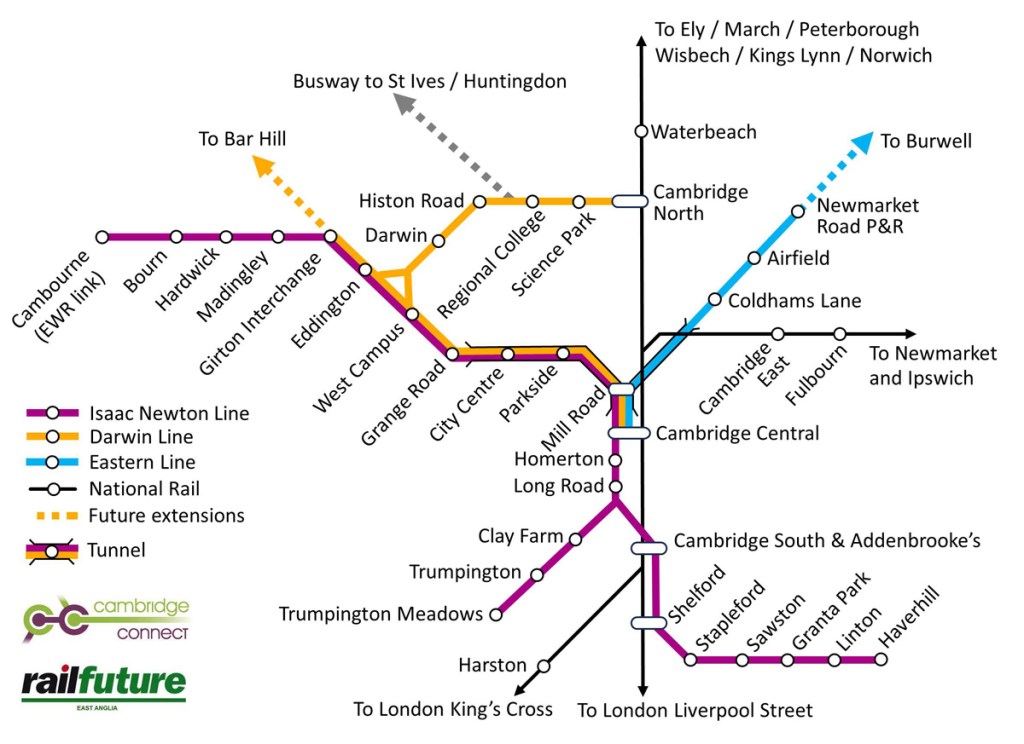
Above – note the additional stations on the principal line (the Isaac Newton line), and the proposed Eastern Line which incorporates the confirmation of the redevelopment of Cambridge Airport.
If you have any questions, please email Dr Colin Harris via Cambridge Connect here.
One more session to go for The Great Cambridge Crash Course series in 2023
I am planning a new round starting in Mid-January 2024 depending on if a general election is called or not. These will involve several more introduction sessions, plus trialing some new topics. Furthermore, I hope to have a further range of venues and times – although this will be contingent on support from other people on things like room booking and transport. Especially if it involves going to another part of town that’s not within walking distance.
Over 40 people have participated in the half-dozen or so sessions I’ve held over the past six weeks.
Most of the people who came along were people I was not acquainted with, and came from a wide variety of social backgrounds. Always a positive because it means people get to talk to others that they might not normally speak to on a day-to-day basis, even though we all have to live with the same issues, however differently they affect us. Same storm, different boats and so on.
The questions and conversations have been largely group-led rather than me giving a long lecture – although some of people have asked for an online session that’s more suitable for the latter. Accordingly, different groups have focussed on different aspects of the maps and materials that I have used – some more interested in the changing boundaries of Cambridge’s local government borders over the past 200 years, while others have focused on the decisions ministers have made in more recent times – in particular with establishing the Greater Cambridge Partnership.
The techniques I’m using, and the call for a comprehensive programme of civic and citizenship education are not new.
The recent books that I have acquired and digitised reflect what interwar and wartime generations felt was an urgent need to overhaul various institutions and put in place a programme of citizenship education as a foundation for a modern democratic state.

Above – the most recent four texts can be found digitised here and all pre-date the end of the Second World War
Furthermore, the pamphlet Training for Citizenship (digitised here) by Sir Ernest Simon and Eva Hubback make both the policy case and the methods to be used on training children and adult learners.

Above – Training for Citizenship (1935)
“We have endeavoured to show that in order that democracy may work in a modern complex community it must demand from its citizens a fund of self-sacrifice, a passionate love of freedom and truth, a power of clear thinking, and an equipment of knowledge of the modern world.”
Simon and Hubback (1935) final page
As true today as it was nearly 90 years ago.
“The Housewife and the Town Hall – little bit patronising isn’t it?”
This was written by economist Lettice Fisher (she was married to Liberal Cabinet Minister H.A.L. Fisher, who was in Lloyd George’s Government, and was President of the Board of Education in the days before it became a formal government department). In her preface she wrote:
“The basis of this little book is a series of talks broadcast by me and arranged by Miss Matheson, then Director of the B.B.C. Talks Department, in consultation with the National Federation of Women’s Institutes. It was thought that not only country women, for whom the Federation could speak, but women in all walks of life, were anxious to learn more about the government of their country, and especially about local government, of what was done and why and how by local councils and other public bodies.”
Lettice Fisher (1934) p4
Cross-reference this with the contents page and we find the subjects are ones that apply to a much broader audience than the stereotypical housewife of the era.
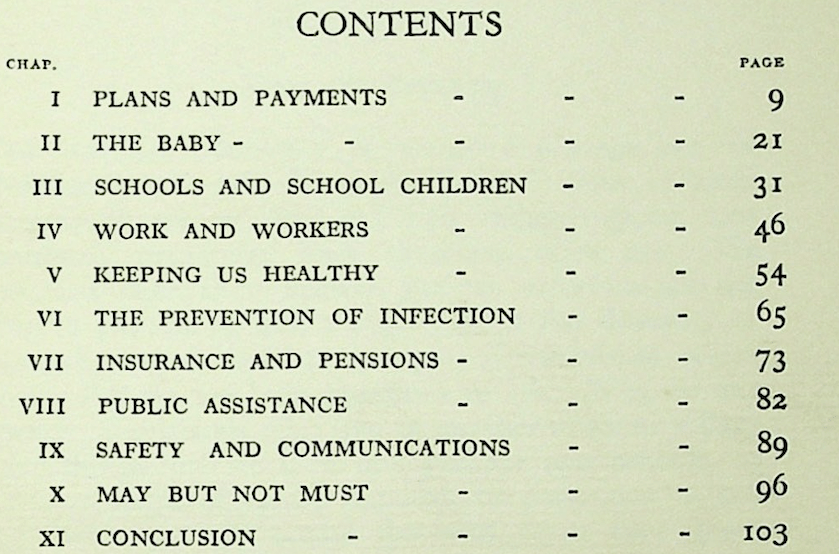
Above – note this was in the inter-war era where there were great domestic political battles over how big the state should be and how much it should contribute towards providing public services.
Hence why I think these books from past generations are just as important at explaining how we got to here, as the more contemporary books on GCSE Citizenship Studies that several authors have digitised here that examine the political system of more recent times – most of them up to the EU referendum of 2016.
Importantly, they all give the basic grounding that I believe is essential when it comes to cross-examining the candidates standing for election at the looming general election.
If you are interested in the longer term future of Cambridge, and on what happens at the local democracy meetings where decisions are made, feel free to:
- Follow me on Twitter
- Like my Facebook page
- Consider a small donation to help fund my continued research and reporting on local democracy in and around Cambridge.
 The Cambridge Town Owl