I don’t think anyone expected to see former Prime Minister David Cameron step out of the car at Downing Street this morning to become Foreign Secretary on the morning that the latter sacked his firebrand now former Home Secretary.
It had political correspondents consulting with political historians about who was the last Foreign Secretary to hold the post in the House of Lords (Lord Carrington in Thatcher’s Government) and that was in a very different social and political era where it was not uncommon for MPs to have battlefield experience – Carrington being awarded the Military Cross as a tank commander in WWII.
In the meantime, the sacking of the Home Secretary – which otherwise might have been the leading item in the news today, was relegated to the second tier – perhaps assisted by the holding statement by Braverman which said she’d put out more detailed comments at a later date. Expect an exclusive from a friendly print press publication and a TV show on a talking tellybox channel to appear in due course. Or at least the offer of one. In the meantime, one TV-show-MP has returned to ministerial office – the former DWP Secretary Esther McVey in a Cabinet Office post briefed as some sort of ‘Minister of State for the War on Le Woque.’ Or ‘Minister for the Today Programme’ – take your pick. I’m picturing the minister signing off fiery edicts on ministerial note-paper towards misbehaving councils with demands ‘to cease with this jiggery-woquery!’ Watch out South Cambridgeshire District Council!
MPs and Lords – scrutiny of ministers
This has been a talking point amongst policy wonks and a lot of heat has been generated by people inside the Westminster bubble who perhaps need to think things through. Have a read of Dr Alice Lilly’s post here.
Should Ministers be MPs as well?
The general viewpoint appears to be ‘yes’ because ‘ministers have been elected’. In the olden days, when an MP was appointed a minister, there had to be a by-election in the constituency – as happened in Cambridge twice in the 1830s when Thomas Spring Rice was appointed to ministerial office.
I’ve not read much into *why* the UK doesn’t have a separation of government from parliament (executive from legislature) – a core concept in international politics to ensure that power is not over-concentrated in one institution or office of state. It may simply be down to tradition/convention along with the huge amount of disruption that overhauling the system would involve. In the grand scheme of things, governments try to avoid large administrative and constitutional overhauls if they can avoid it – preferring to focus on social and political issues.
In the UK the power of the Prime Minister is far, far greater than those of other heads of government in representative democracies. For example in the USA, presidential power is strongly restricted by both the US Constitution and by Congress – the latter having the ability to reject legislation and budgets – in the case of the latter with very serious consequences.
“So, the only ‘democratic’ check on a minister being appointed is that of the constituency that they have contested?”
Exactly. And if you have been selected in a safe-as-castles seat for your party, and your party wins the general election, you are able to spend more time on ministerial work and less on constituency work (in principle) because there’s less of a risk of you losing your seat at the next general election. That doesn’t mean you can completely ignore your constituency. However, compared with tightly-contested seats or ones that have a very active and vocal electorate (especially university towns), demands on an MP’s time is often greater – especially attending events.
This is one of the reasons why I think there should be a separation of government from parliament. Keep the things like departmental question time, ministerial statements, urgent questions, and select committee hearings by all means. Then move to a system where instead of enabling a Prime Minister to select 90% of their MPs from their backbench MPs, enable the PM to nominate the best people for the job and recommend them to Parliament who can then cross-examine the candidates and vote either to confirm the appointment or reject it, thus requiring the PM to find someone better. That method also gives Parliament stronger powers of censure – and ultimately bringing in a convention of votes of no confidence in a minister in extreme circumstances. If necessary, put in legislation what criteria or conditions must apply in order for a motion to be tabled and selected.
“A good day to bury bad news?”
There’s that too.
…which is why it’s useful to check government announcements on such days – as well as any written ministerial statements made.
It will be interesting to see what comes of the Maude (the Cabinet Office Minister stung by Puffles a decade ago) review into the Civil Service – in particular on holding the all-powerful Treasury accountable.
This reminds me of a blogpost I wrote a year after I left the civil service asking if the Cabinet was too big. I managed to get the number of Cabinet posts down to ten – possibly 11 if there was pushback on having the defence functions subordinate to the Foreign Office. I also wrote it at a time when I hadn’t given much thought to devolution – whereas today having a smaller centre in Whitehall and Westminster makes more sense if a host of substantial taxation, spending, and policy decisions are devolved to regional and local government. The biggest barrier to all of this is that we do not have a politically literate population – which is something previous generations have campaigned about for over a century.
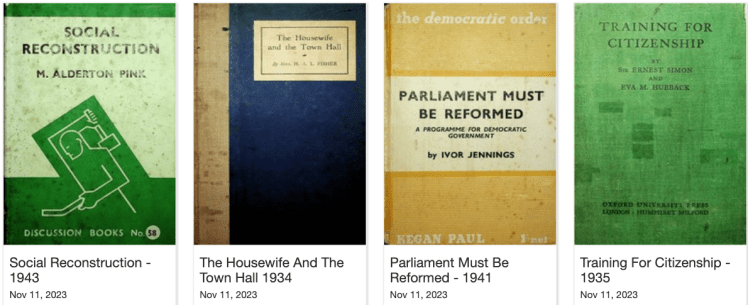

Above – Training for Citizenship (1935)
“We have endeavoured to show that in order that democracy may work in a modern complex community it must demand from its citizens a fund of self-sacrifice, a passionate love of freedom and truth, a power of clear thinking, and an equipment of knowledge of the modern world.”
Sir Ernest Simon and Eva Hubback (1935) final page
As true today as it was nearly 90 years ago.
“Will the November reshuffle make much of a difference?”
Depends on what the former Home Secretary does. If that wing of the Conservatives want to go out with a bang and make things impossible for their party to win the next election, that’s on them.
On David Cameron’s appointment, the liberal-leaning media and commentators were sceptical.
“Many will in any case see the latest reorganisation of cabinet chairs as the last gasp of an administration that is out of ideas.”
The FT, 13 Nov 2023
Above – I agreed with Emily Maitlis (formerly of the BBC) in that bringing the former PM back into ministerial office was a sign of desperation.
The appointment of David Cameron as Foreign Secretary, while a surprise, doesn’t indicate huge turbulence in foreign policy. Because he’s on first-name-terms with many of the heads of government already, he’ll be seen by some as a safer pair of hands than some of his predecessors, even though the new Home Secretary James Cleverley was seen to have done a reasonably competent job by the political media lobby. Furthermore, having served as both Home Secretary and Foreign Secretary means that he is a potential leadership rival to the former Home Secretary after the general election – assuming the Conservatives lose it.
There was also a noticeable exit of ministers lower down the ladder (see the list here of new appointments) – and the inexplicable decision to sack the Housing Minister the day before she was due to go into Commons Committee stage of Renters (Reform) Bill. As I mentioned to several people today, that requires a huge amount of preparation by the minister concerned as this involves line-by-line scrutiny of the legislation. And each clause requires its own set of speaking notes. When I worked on the Housing and Regeneration Bill (now Act 2008) our team had just over 2 pages of clauses and ended up writing over 100 pages of speaking notes for ministers.
Less than 12 months until the general election
With six weeks to go until the Christmas recess, there won’t be much opportunity for new ministers to bring in any major new policies because of the time it takes to familiarise themselves with the new policy areas. As the next general election has to be called within the next 12 months (and thus Parliament dissolved) there is also the convention that at the end of each term of office, ministers should not take big decisions that a future government may take a different view on. This is what happened in 2010 when the Coalition came in, announcing that all ministerial spending approvals dating back to the January of that year were to be considered void, requiring resubmission to the new ministerial teams. As it turned out, George Osborne’s austerity gamble did not pay off given the huge human and social costs inflicted, and the catastrophe of his own policies regarding the EU referendum when he kept such a low profile he trended on social media back in 2016.

Above – have you seen the former Chancellor?
How the mighty fall – remember in the run up to the EU Referendum he was portrayed in the media as an all-conquering Chancellor and a PM-in-waiting.
“What of the opposition parties?”
There hasn’t been that much media coverage of them – although the old adage goes that when your adversaries are making big mistakes and are in a big mess, best stand back and leave them to it. Especially as it is all in the public eye. Why distract their attention?
What this all means for the Government’s policy for Cambridge remains to be seen – we’re due to find out the conclusions from the Chair of Homes England in the next few weeks. Interestingly, the new Defra Secretary is Steve Barclay MP, who represents North East Cambridgeshire (Fenland) and will have to deal with the water crisis. Because Cambridge cannot achieve the ambitions Michael Gove (who has stayed in place) has without piping in new supplies. So on that side, a bit of a waiting game.
If you are interested in the longer term future of Cambridge, and on what happens at the local democracy meetings where decisions are made, feel free to:
- Follow me on Twitter
- Like my Facebook page
- Consider a small donation to help fund my continued research and reporting on local democracy in and around Cambridge.

 The Cambridge Town Owl