
The vote to leave the EU back in 2016 didn’t happen in a vacuum – rather it was the culmination of a wider set of multiple failures of politicians and political institutions over an extended period of time, as Dr Mike Galsworthy told an audience of Cambridge for Europe activists at Sidney Sussex this evening.
I signed up at the last minute for Dr Galsworthy’s talk in Cambridge because I’m still recharging from the series of Great Cambridge Crash Course events over the past couple of weeks, along with filming the Queen Edith’s by-election hustings. (The joys of CFS/ME).
For those of you not aware, there’s a growing movement in Cambridgeshire calling for the overhaul of local democracy in our county (see the recently-launched Cambs Unitaries Campaign here) because at the moment our local structures are a mess.
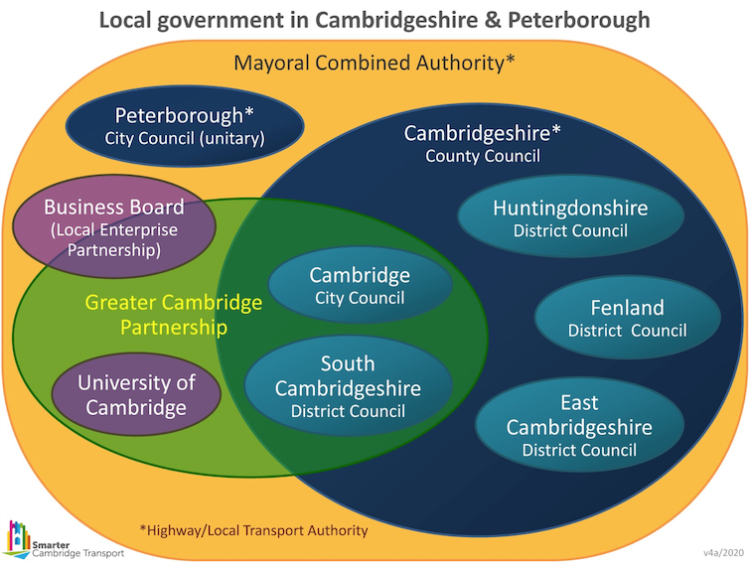
Above – George Osborne’s creation in 2016, visualised by Smarter Cambridge Transport
One of the biggest things I learnt standing as an independent candidate back in May in the Cambridge City Council elections was just how limited the public’s knowledge was of the essentials of our political systems – local and national. Hence why I started a series of events held in local community centres & libraries in South Cambridge for people to learn about them in a safe space. At the last count, over 40 people have participated in about half a dozen events.
Above – a review from Cllr Stephen Ferguson (Ind – St Neots East) – the former Chairman of Cambridgeshire County Council.
Above – from former councillor Hilary Cox Condron (Labour – Arbury 2021-23)
All of the introduction sessions involved embedding the basics of Westminster and Whitehall into the knowledge of the participants, including:
- The existence of political parties and their selection of candidates
- The convention that the individual MP ‘who commands the confidence of the House of Commons’ is sent for by the monarch and invited to form a government
- The responsibilities MPs have to scrutinise ministers and government policies, vs the realities of the whipping system
- How laws are introduced into Parliament, by whom, and how MPs and peers scrutinise them
“If local residents in a place such as Cambridge have such a limited knowledge of politics and democracy at a local and national level, what hope is there for their existing knowledge of European politics?”
This was the question I put to Dr Galsworthy following his talk. Prior to the start of the event, we were introduced to each other by the Chair of Cambridge for Europe, Paul Browne (scroll down). I asked if he was familiar with the GCSE Citizenship Studies, which has been around for over 20 years but still has a very low take-up due to government cuts. (Schools cannot afford the specialist citizenship teachers and don’t want to take the risk of lower grades in non-core subjects as defined by ministers). He said he wasn’t, so I gave him a copy of one of the textbooks published in 2009 that I had brought along, pointing out the pages that introduced the essentials of the EU.
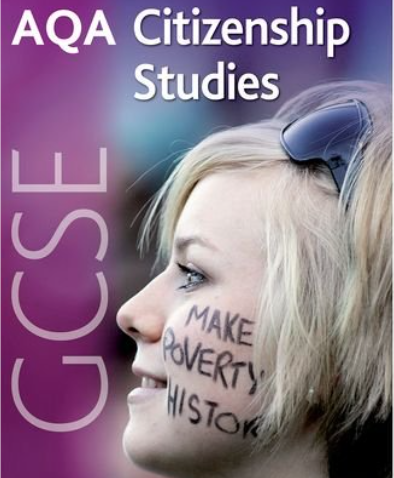

Above – same examination board, different year (2009, and 2016 respectively)
Many second-hand copies in very good condition are going on sale for under a fiver (have a browse on Abe Books here) and pointed out that anyone interested in running a discussion group or a short course via a series of progressive sessions that build upon the previous ones are more than do-able because the materials are already available, tried and tested. Furthermore, the Great Shelford-based publishers, Independence Educational (just over the southern edge of Cambridge) has a huge back catalogue of discussion guides written for teenage discussion groups – with the added benefit of not being written for exams. Which means they are suitable for, and accessible to adults as well. So if anyone wanted to run a topic-specific event in a European context (eg climate change) chances are there’s a topic guide for it.
Discussion groups on civics and democracy are not new – they’ve been around for over a century
And problems that sound familiar today were just as dangerous back in the early 1920s.
“An uneducated people is in constant danger of being deluded by false ideals. It will respond to the appeal of self-interest, and judge political questions from the standpoint of the present, rather than from their larger aspect. In a word, it will lack imagination, and will prefer the astuteness of the noisy demagogue to the far-sighted wisdom of the true statesman.”
Democracy and Adult Education – by J.H.B. Masterman – 1920, quoted in Lost Cambridge here
With the development of cheaper mass printing, discussion books on democracy and citizenship started to emerge in bookshops – also around the time when primary, and later secondary education became compulsory, side-by-side with the growing franchise and number of voters. I had a look at what previous generations were taught in this blogpost. Furthermore, alongside the topics, there were guides on how to run discussion groups – ones that still broadly stand the test of time (see here). In times gone by, there were institutions that published national schemes of work/curriculums that covered the whole academic year (see some examples here, and also from the old Adult School Union here).
So while the temptation might be to try and jump straight back in with ‘rejoin the EU’ given the shambles of a government we currently have, the longer term plan that Dr Galsworthy outlined is more likely to be successful *if* it involves enabling the public to discuss and learn about the system we currently have, the faults and weaknesses in it, and what possible solutions/improvements we can make. Furthermore, such gatherings cannot be set in elite/exclusive institutions such as universities alone. (Which arguably is one of the mistakes the movement in Cambridge made – it seldom got out to the residential estates and to the libraries and community centres (or what’s left of them) that local residents are more familiar with.
The big bonus is that many of the text books are already available for people to experiment with (see more here). Therefore the suggested discussion points are already there to guide you, and furthermore the text books cover local, national, and international politics and issues in a manner that is easier on the mind than a text-heavy academic tome.
Something for the European movement’s local branches across the country to experiment with in early 2024?
If you are interested in the longer term future of Cambridge, and on what happens at the local democracy meetings where decisions are made, feel free to:
- Follow me on Twitter
- Like my Facebook page
- Consider a small donation to help fund my continued research and reporting on local democracy in and around Cambridge.
 The Cambridge Town Owl