
This could be fun! (Even though I have no clue where it came from – but then I don’t feel the need to be involved in everything!)
It was voted through earlier by the Combined Authority.
“Creative Industries – £3m: Support for the development of the Cambridge Leisure/Junction site south of Cambridge centre to help create a regional hub for creative industries., including space for start-ups, artists and other creatives in one location that is not currently present in the South of the region.”
CPCA Item 14 Appendix D, 29 Nov 2023
Back in 2019, Levitt Bernstein Architects won a competition to redesign The Junction

Above – Levitt Bernstein’s vision from 2019
It came as a bit of a surprise at the time because I knew that local firm 5th Studio had been working on some options for a number of years, having been commissioned by Cambridge City Council to do so.
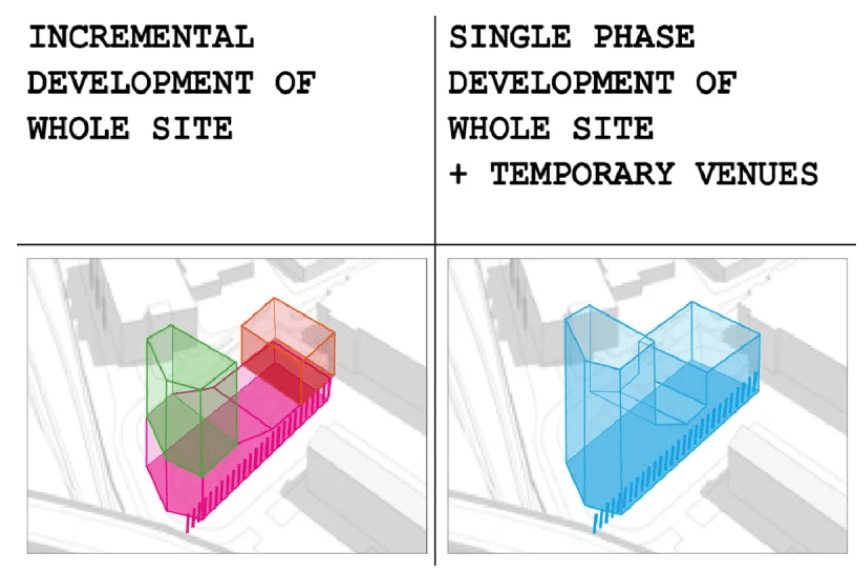
Above – concepts from 5th Studio from ***ages ago*** (but still relevant)
One of the things I’m also aware of is the Pandemic (it still hasn’t gone away!) combined with the Truss/Kwarteng disastrous budget alongside hard Brexit resulted in a catastrophe for the construction industry – and that was not counting for Grenfell Inquiry revelations, with costs of everything and costs for everything spiralling. Whether new Brexit red tape on imports, to new working restrictions on construction workers from abroad (without having had a plan to replace them with locally-trained workers) to interest rates spiking resulting in investments being pulled and projects cancelled, it’s no surprise that nearly five years later, nothing has happened.
“What is a creative hub anyway, and where are the existing ones?”
No idea on the first one. It’s a bit like ‘sustainable development’ – a concept so generalised as to be meaningless. Unless you add parameters to it. The British Council had a go in 2021 in identifying where the existing ones were.

Above – Mapping Creative Hubs in England – The British Council 2021
The nearest one to Cambridge that they have listed is the Wysing Arts Centre. Some of the gaps on the map are painful to look at. One thing to note with Wysing is that it’s in the middle of nowhere with next-to-no public transport. Hence why any future regional hub in/around Cambridge needs to have public transport explicitly designed in. Hence The Junction being a convenient location.
But then, isn’t The Junction is already a creative hub? It’s not like it isn’t on the Arts Council’s radar. Why weren’t included in this report? The clues are in their artist development pages.
“Cambridge Junction is a creative hub for people and ideas where audiences and artists explore, experience and are inspired by art, entertainment and learning. We are a centre for talent development of contemporary performance for the East of England, supported by Arts Council England.”
https://www.junction.co.uk/artist-development/
Can’t get much clearer than that.
“Wysing and The Junction – two very different creative hubs?”
I guess for a ‘non-creative’ like me, it’s one of those things where you’d know what a creative hub is it if you saw it [ie reflecting the sheer variety of the creative sectors. It’s not a monolith]. It’s not something that comes easily in finding a definition. And I lived in Brighton for three years!
“Wasn’t Brighton a creative hub in your uni days?”
It was in those days (very early 2000s) but at the same time it wasn’t something that you could consciously create. It was something that emerged from (and in response to) a dire set of circumstances stemming from decisions taken by Margaret Thatcher’s Government. I used to say to people that the scene exploded into life in the 1990s because it became a melting pot of all of the groups of people that Thatcher’s Government despised – something that one of her protege’s, Peter Lilley listed in a notorious party conference speech – delivered in of all places, Brighton (which was regularly returning Tory MPs for Pavilion and Kemptown seats into the 1990s). The point being that the creative scene I experienced in my uni days living in Brighton was a very different one that corporate institutions envisage – irrespective of sector that puts up the funding and/or runs it.
In the case of the Cambridge Leisure Park, it’s owned by Land Securities – the sort of firm inevitably more focused on the return on investment than on creating a vibrant scene of independent individuals and organisations doing their own thing and coming up with their own vision. Shareholders, trustees, auditors and electorates inevitably will cast a shadow over whatever the funding is put towards – hopefully there will be private sector match funding. How those responsible for creating this new regional creative hub will manage that challenge will be critical to its success. That’s not to say transparency and accountability are not important – they are. One of the ‘make or break’ issues for me is risk tolerance. Type into a search engine ‘percentage of innovations that fail’ and you’ll see what I mean. Think of the number of government departments or local councils who could tolerate those high rates of project failures. (i.e. 70%-90% failures). Exactly.
The Junction is long overdue a revamp – and I hope it succeeds one way or another
It’s part of my own potted life story from my teens to the present day. One of the few institutions still around from the 1990s in that part of town. (Which reminds me, people can sign up to support The Junction’s community work through their membership scheme).
If it is to succeed, then various other organisations will need to make some tough decisions about the future of the neighbourhood. That includes the future of the further education colleges and private institutions, the offer from the Leisure Park, the future of the Clifton Road Industrial Estate, and future public transport infrastructure improvements including but not limited to an eastern entrance to the railway station. The problem is Cambridge does not have the governance structure or institutions with the legal and financial powers to decide what should happen and deliver on it. Like with so many other areas, issues, and sectors, the governance – inevitably a Political issue, will be at the root of it. And we’ll continue to struggle until we take on that ‘too difficult to deal with’ problem of how we go about radically improving our democracy.
If you are interested in the longer term future of Cambridge, and on what happens at the local democracy meetings where decisions are made, feel free to:
- Follow me on Twitter
- Like my Facebook page
- Consider a small donation to help fund my continued research and reporting on local democracy in and around Cambridge.

 The Cambridge Town Owl