
As the final few sessions commence this month, what issues do you think we need to cover before both the local elections in May 2024, and the general election whose date is unknown?
I was interviewed by Alex Elbro on Cambridge 105 about what the first group of sessions had covered – you can listen to the podcast here. (Note to self: remember to breathe out when having photo taken!) The final sessions are listed up here – the next introduction session being on 09 Dec 2023 at Rock Road Library from 12:15pm (book your place here).
We’ll have more maps to have a look at – including ones from more recent history around the Year 2000. This means participants will be able to compare the hopes and ambitions from a previous generation of politicians and council officers about what they proposed vs what was built.
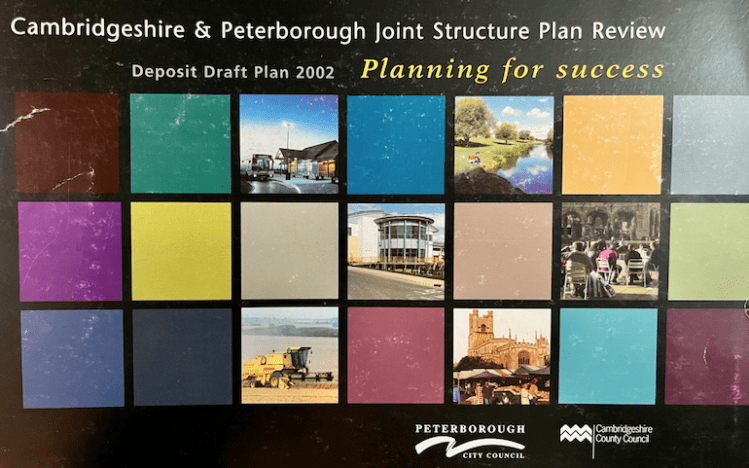
Above – 21 years have passed since this set of proposals (digitised here) was published. How does it compare with today?
Feel free to browse through some of the more recent purchases I’ve made of old books from the Cambridgeshire Collection’s surplus-to-requirements pile. There are three or four shelves-worth of local history books on sale for £1 each that may interest several of you. Pop up to the third floor of Cambridge’s Central Library in Lion Yard to see what they have. The collection also has on sale several locally-printed books and also a number of copies of publications from the Cambridgeshire Records Society (see the list here). One for those of you looking for locally-sourced Xmas pressies!
Cambridge Unitaries Campaign – their first meeting
The recently-launched campaign will be having their first online meeting at 7pm on Monday 11 December 2023 – you can register for free here. You can also watch Phil Rodgers tabling a question about the Cambs Unitaries Campaign to Cllr Mike Lode, Leader of Cambridge City Council here.
What would a workshop on local health services be like?
I ask this mindful that I don’t really have the full picture myself because a succession of ministers have made everything so complicated and fragmented that it’s difficult to know where power resides. (Or was that the objective?!?!) Furthermore, it’s very difficult to find easy-to-read books that explain the essentials.

Above – National health by Tracy Birham, published by the Great Shelford-based Independent Educational Publications. This is one of the few accessible books I’ve found.
You can see their back catalogue here on a host of other social issues. Sadly there isn’t one for Cambridgeshire’s structure of local government and public services! Which of the list might make suitable topics for discussion, and could you think of a suitable discussion facilitator who is not me who could run it?
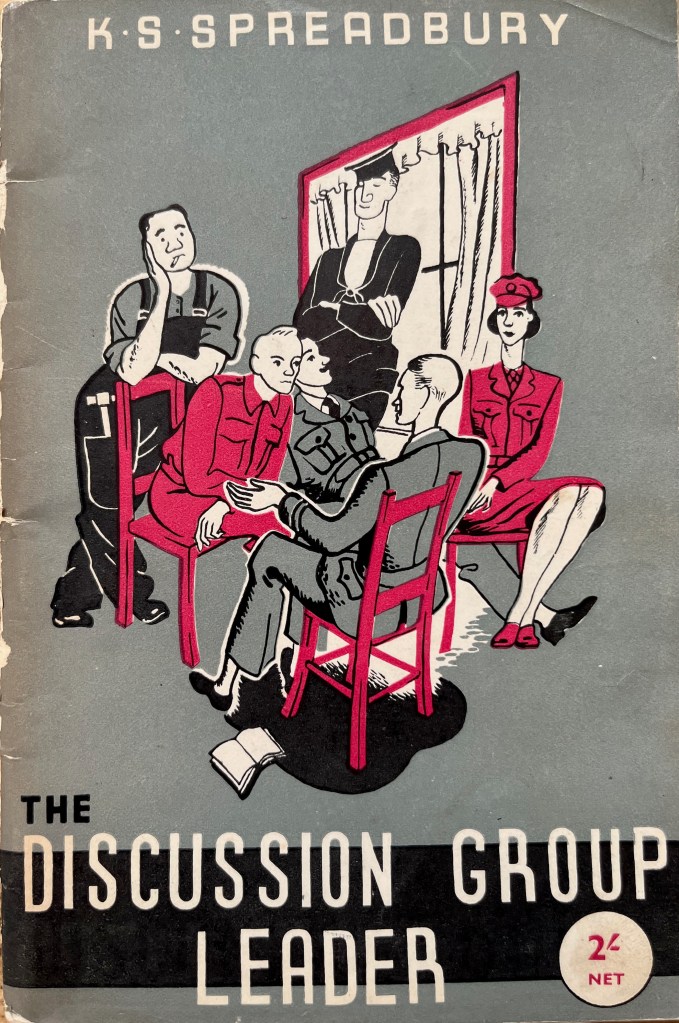
I’m thinking in particular someone who could apply their knowledge on a particular topic through the context of running a discussion group similar to how K.S. Spreadbury wrote about during WWII – which you can read here. This also links to the point I made to Alex on Cambridge 105 in that I don’t have the capacity to run such events all over the city and beyond, so at some point in the future I hope an organisation might be able to step up to do the essential organising and admin so that I can focus my limited energies (CFS/ME being a barrier) on doing what I’m better at in facilitating individual sessions as part of a wider team.
Hustings and public debates before elections are called
Back in 2015 there were over 30 public events hosted for the candidates standing for election. Several of the candidates told me that this was too much and concentrated in too few areas of our city. They called for some means of co-ordination and variation in the types of events – i.e. not repeated runs of BBC Question Time panels! I’ve suggested the Cambridgeshire Council for Voluntary Services as a first port of call to see what they advise. i.e. an institution with some sort of local legitimacy to take the lead. Furthermore, with the additional county constituency this time around, there’s a greater responsibility to ensure as many people as possible get the chance to meet the candidates – if only to remind/inform everyone that as far as the law of the land is concerned, the election is asking for voters to indicate their preference for which *candidate* they think should be returned as the representative of their constituency for the forthcoming Parliament. While political party affiliation and the publicity for their party leader may inform their decision, it’s not the question itself.
Hence the importance of having citizenship education not just for children (underfunded as it is), but for adults too.
Food for thought?
If you are interested in the longer term future of Cambridge, and on what happens at the local democracy meetings where decisions are made, feel free to:
- Follow me on Twitter
- Like my Facebook page
- Consider a small donation to help fund my continued research and reporting on local democracy in and around Cambridge.
 The Cambridge Town Owl