
Can residents make day-to-day public transport an issue in the run up to the general election? (Also – Great Cambridge Crash Course intro session this Saturday!)
The image/graphic is from Unite Scotland and I like it.
TL:DR? Drop Richard an email and say you’re interested in helping with campaigning for better bus services in 2024 mindful of the general election due in the next 11 months.
Edward Leigh picked up the numbers below.
John Elworthy of the Cambs News expanded on the research by Friends of the Earth here
“Peterborough, for instance, comes in at number 18 on the list with a 75 per reduction across 2008-2023”
Cambs News 05 Dec 2023
For a city such as Peterborough – with a Tory MP and until recently a Conservative-run unitary council, that is an astonishing picture. It puts into context the campaigning pitch from Dr Nik Johnson back in 2021 when he was nominated as Labour’s candidate for Combined Authority Mayor – prioritising improving buses over everything else. Yet as he and others found out, the powers that metro mayors have are so limited, and the franchising processes so convoluted that it will be touch-and-go if any noticeable improvements are made before the next mayoral election.
Getting bus campaigning in and around Cambridge on the road again
I briefly caught up with Richard Wood, who has kept the original Cambridge Area Bus Users Group ticking over following the first lockdown. I manage the Facebook Page with what little attention span I have left in me, but we acknowledged that at some stage early in the New Year we would want to organise something (as yet undetermined!) to see what appetite there is for people to get involved again.
From my own perspective I think a handful of neighbourhood-based meetings across the city advertised like a music group tour with a series of dates & venues. That deals with the complaint of “Oh I can’t make it on that day!” Also I’d like a few in the neighbouring villages. The theme could cover sustainable transport campaigning. i.e. buses, cycling, walking (just with a more exciting title). Furthermore, it would need to be focused on solutions – eg suggested new/improved routes that would make it easier for people to choose public transport or active travel first. Also, I’d want the meetings to invite participants to commit to one small action or one small behaviour change as a result of taking part. The purpose? To familiarise interested people and passengers with the essentials of local and county bus services so they can cross-examine general election candidiates as and when it is called in the next 11 months.
We’ve had well-attended meetings in the past – such as the one in 2018 at the Ross Street Community Centre which Cambridge MP Daniel Zeichner spoke at (see my phone-recorded clip here). I’ve also tried every so often to see how many people are aware of Buses Magazine to see if a handful of people could become the eyes and ears of developments within the sector to keep the rest of us informed. We’re not looking for a replacement for the late Simon Norton who campaigned for local bus services for the best part of 40 years (similar to Queen Edith’s Community Forum not looking for a replacement for Cllr Sam Davies who is moving out of Cambridge next year – but rather a group of people who can take on different aspects of the work they did/are doing.)
Above – me with an old edition of Buses Magazine that featured the disastrous deregulation and privatisation of the bus network.
It was that deregulation and privatisation that proved so catastrophic – something highlighted in the Friends of the Earth report. To quote them directly, their two policy demands are:
More money
“According to Transport for Quality of Life, by 2030 an additional operating expenditure of around £7.5 billion per year is needed, alongside £24 billion for capital expenditure until 2035 (approximately £2 billion a year). These are figures for England and Wales, and since transport is a devolved issue, the Welsh Government will need to be provided with its share. According to the National Audit Office, there was a 38% reduction in local authorities’ financial support for bus services in England outside of London between 2010-11 and 2018-19.”
Regulation.
“Bus services were deregulated in the 1980s with disastrous consequences. However, London was excluded from this experiment. Since then, the capital has benefited from a well-regulated public transport system and is able to manage public transport as a public service. English city regions were given the powers to regulate their buses in 2017, but only if they went through a costly and lengthy process (Greater Manchester has just managed to bring its buses back under public control). All transport authorities should be provided with the resources and powers to franchise bus services, meaning a well-regulated service becomes the norm.”
Above: from Friends of the Earth – How Britain’s bus services have drastically declined.
For those of you interested, there is a very long-standing Cambridge Friends of the Earth Group here which has been going for decades. They were featured in the numerous editions of Greenwave Cambridge in the early 1980s <<– Click there to see the digitised copies of their colourful newsletters of the early/mid 1980s.
My hope for 2024 is that we get lots of people who are new to community and civic action will be asking themselves: “What is the little bit that we can do to help?” rather than an offline version of the adversarial and all-too-often abusive exchanges we see on social media, which have got to a stage where it is undermining our democracy – as if it wasn’t already on fragile ground as it is.
Food for thought?
If you are interested in the longer term future of Cambridge, and on what happens at the local democracy meetings where decisions are made, feel free to:
- Follow me on Twitter
- Like my Facebook page
- Consider a small donation to help fund my continued research and reporting on local democracy in and around Cambridge.
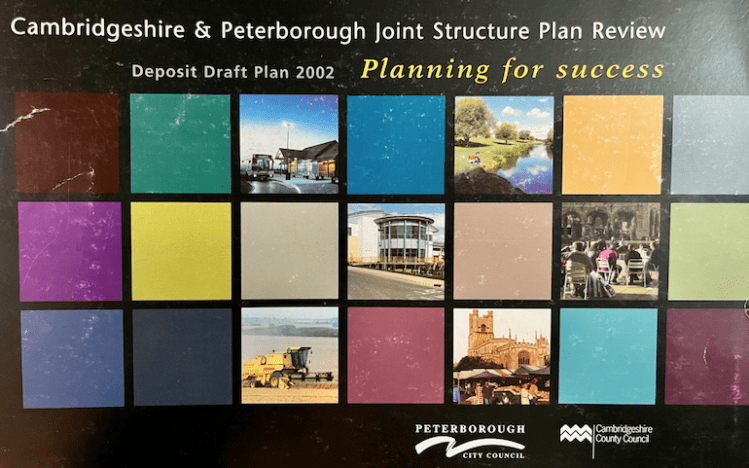
(Below – from the olden days when we planned for better public transport too!)
 The Cambridge Town Owl