
You’ll see more such reports as we get to crunch time with some very big decisions looming over the next 12 months.
I tried to put things together at this evening’s meeting at The Guildhall in this thread. Alternatively search for @CamCitCo on birdsite on 06 Dec 2023 and you’ll see more. You can also see the State of the City Report here. Furthermore, the All Party Parliamentary Group for the East of England published their report on Levelling Up the East of England.
“Who funds them?”
Who funds who?
“The East of England APPG. The MPs and Peers sign up for it, but someone has to pay for the secretariat functions and the research functions. Who pays up?”
Some familiar names.

***Hang on a minute!***
Let’s go through that list and pick out some issues.
- British Sugar – issues with lobbying on food policy and obesity?
- London Stansted Airport – Aviation emissions issues – and tax breaks
- Anglian Water – unlawful sewage discharges
- Cadent Gas – fossil fuels
- Freeport East – massive tax break from ministers (Harwich & Felixstowe) plus shipping fuel emissions – bunker fuel is ***highly polluting***
***Can’t we have such things being supported by institutions that are not involved in screwing up the plant?”***
Welcome to Lobbying 101. You have just learned one of the ways in which big firms can influence policy-making.
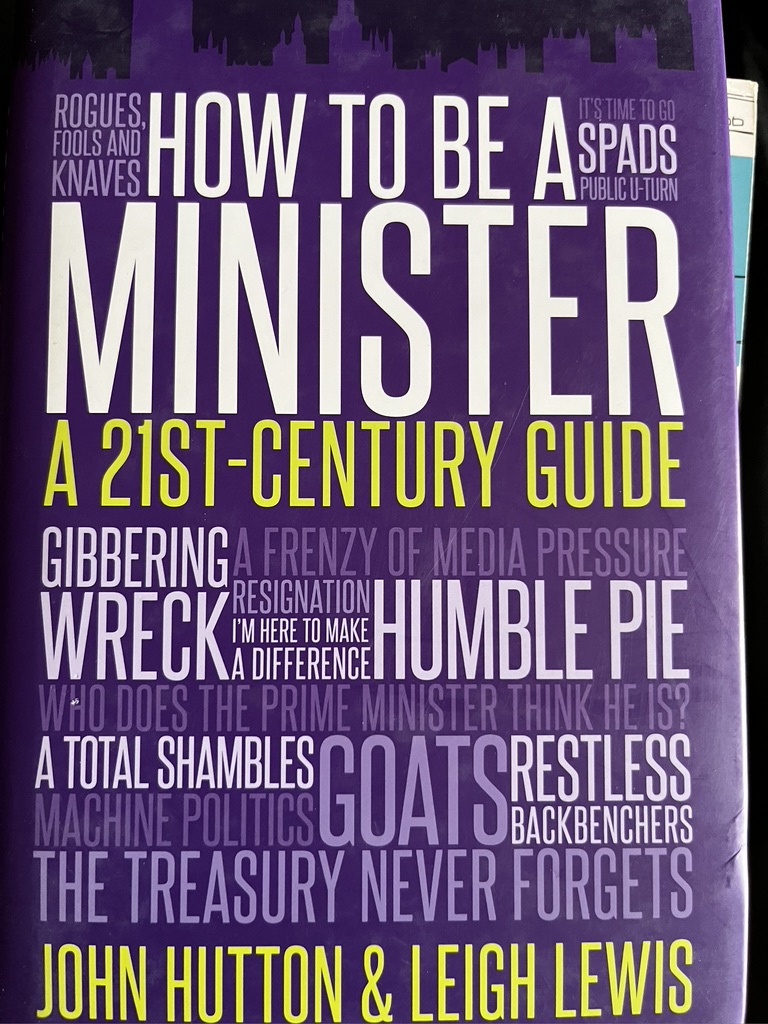
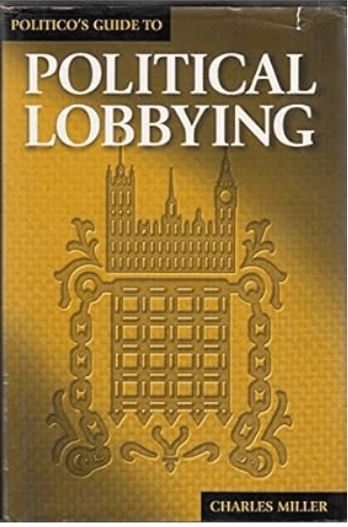
Above – a couple of recommendations including Political Lobbying which although dated, still covers the essentials at a cheap-as-chips price
“Does it invalidate the entire report?”
No – rather it’s a bit like a content note to make people aware of the context in which the report is written in. So for example if you’re hearing things about de-growth (eg here), that new economic paradigm (and supporters of) are unlikely to find much to be supportive of in a report where the word ‘growth’ appears 59 times.
Growing the cake vs redistributing the cake
This came up in Cllr Mike Davey’s speech as Leader of Cambridge City Council. If only because the cuts the city is having forced on it by central government are grim – and furthermore the fraction of the business rates revenue that Cambridge City Council retains was made all the more clear for people to see.
Above: Cambridge City Council estimates it will collect £122.8m in business rates revenue for 2023/24. Of that, it only keeps £11.2m – less than 10% of the total.
“Sounds fair given the inequalities across the country”
The problem is that business rates have this mythical tag attached to them – the myth that all of the business rates revenue is spent locally. The same goes with council tax revenue – that the two combined make up the total funding that councils have. Which, as hardly anyone knows, is nonsense.

Above – from Cambridge City Council – where their money comes from
My points are the same as before:
- The City of Cambridge is a globally-recognised city run like a large market town
- The City of Cambridge will not be able to solve its own problems or be in control of its own future while it has next-to-no powers to raise revenues from the wealth made within its boundaries
There is a separate conversation to be had on extending those boundaries and extending the legal and tax-raising powers – the Cambs Unitaries Campaign being best placed to facilitate that debate. But until then, as a city we’re stuck.
‘Ministers treating Cambridge and its people with contempt’
That ministers chose not to inform local politicians of all political colours and none about their proposals for the city (in my view) speaks volumes about their attitude towards both the city and the sector.
It’s astonishing that membership of this Cambridge Delivery Group still remains a mystery to the councillors democratically elected to serve our city.
Yet as news trickled in of another ministerial resignation – the ex Communities Secretary and St John’s College old boy who previously got himself embroiled in a property lobbying scandal, we were also reminded by Cllr Davey that in the run up to the general election, what Labour’s Shadow Cabinet think of Cambridge will become just as important – with the electorate in the seats surrounding our city having to think very carefully about the different visions for our city offered by the national political parties.
On consultations.
Some of you may recognise the diagram below
The full version was on display A2 size on each table – and I asked councillors and officers to ensure a copy of these was displayed in community centres & public libraries across our city – and ideally at places where people wait. (Eg bus stops and GP surgeries).
Those exchanges got people talking about having a QR code on such posters linking to a Menti-style questionnaire. Furthermore, it was interesting to hear from council officers of how people from different income levels and social backgrounds. That took be back to an old blogpost from 2015 and how to encourage people from different backgrounds to get involved in civic life and community action. In the case study I mentioned in the blog here, the case study of the time poor, passion-rich, and also high intellectual calibre people who can pick up complex issues quickly via succinct briefings (a competency required of ministers and senior civil servants!) and how to meet the needs of that cohort.
“You have a resident who is extremely skilled in a niche area, and who has perhaps an hour a week at home that they can devote to ‘something’ that can help make an impact on the city. How do you make it easy for such people to:
- Identify the issues they are most passionate about?
- Identify the functions/actions that they have the right skills sets for?
- Identify where their input will have the greatest impact?
“…and in a way that means they do not have to read through hundreds of sheets of paper? The concept I often use is the filters used to book hotel rooms. How about using the concept for:
- Booking community rooms
- Finding regular activities
- Finding one-off events
- Finding charities or local causes to support
…but instead of having to go from one website to another working separately in silos, have them co-ordinated.”
Above – from my old blog 30 March 2015
At the same time, we also discussed the different relationships our residents have with public services. For example people living in council housing have a very different relationship with the council and their councillors versus someone who owns their home outright and, refuse collection and bills aside can afford to have a hands-off approach to councils and their services.
At end though, we couldn’t get away from the paralysis of Westminster politics as everyone waits for the general election.
“Is the same the case with the East of England Levelling Up Report?”
Not really because these are big institutions talking about long term strategic level decisions covering a large geographical area. The problem is how to scrutinise such things – starting with knowing that they exist! See https://eastofenglandappg.org.uk/ and browse through the East of England PPG.
In the report, they list a series of levelling up missions – and their confidence.
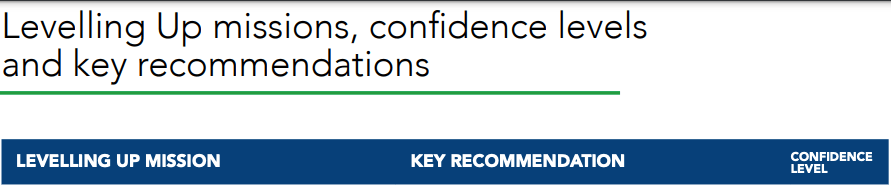

“Why such little confidence in transport connectivity?”
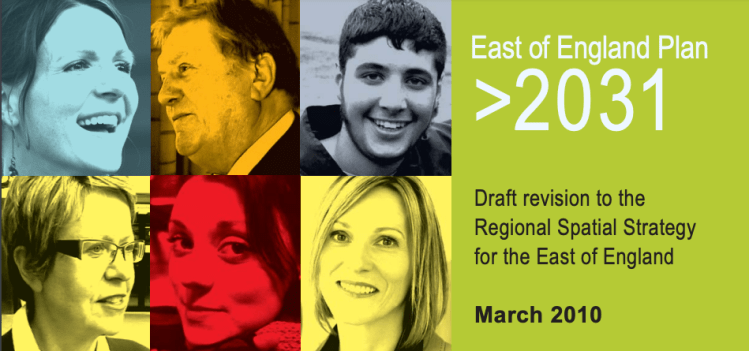
See the history of the Greater Cambridge Partnership. Or the history of long term regional planning – for example the scrapping by the Coalition Government of the old East of England Regional Plan March 2010 less than six months after it was published. Years and years of expensively-collated work zapped with the quick stroke of the ministerial pen.
Above – I tried to explain using the above why not everything needs to be in Cambridge
This was something that was mentioned by former Cllr Sam Davies MBE and former Chief Planner of Cambridge City Council Peter Studdert. Furthermore, the collapse of local and regional bus services was exposed by Friends of the Earth recently – as I mentioned in an earlier blogpost here. No one can plan in the face of such policy instability. In the meantime, Rail Future East published their 2050 vision for rail in the East of England – the below image being the west-anglia side of things.
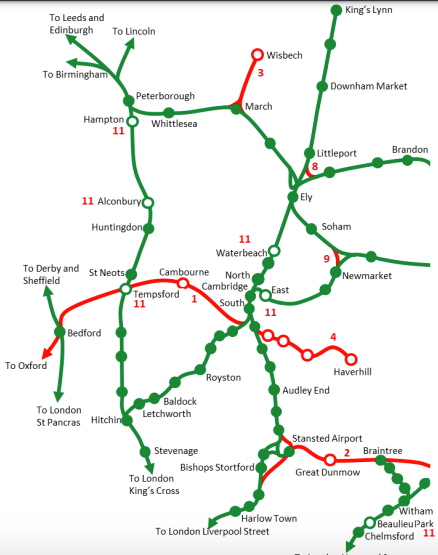
Above – West Anglia 2050 by Rail Future East, RFA 200, November 2023
Can you see the possible link up between Anglia Ruskin’s campuses in Cambridge and Chelmsford? (As well as building more resilience into the rail network between Cambridge and London if the Liverpool Street line goes down between Cambridge & Bishops Stortford.)
“Which of the ambitions are within the gift of the institutions concerned?”
This is my problem with the current approach: It’s not clear *where power resides* when it comes to responding to each challenge. Let’s take an ambition shared by both: Rental housing.

As things stand, there is no regional or local tier of the state that can have a significant impact on that levelling up mission. The powers and policy levers reside entirely with central government. With the frequent turnover of ministers, is anyone *really* in control? Having been a housing policy adviser in my civil service days, I can testify to the complexity of the policy area. It took me almost a year just to get my head around the basics before the demands of the Fast Stream programme moved me sideways some 15 years ago. Furthermore, civil servants are up against *huge* vested interests that can make fortunes from the changes in land value from simple paper-based exercises.
Above – want to know why so many wealthy firms and speculators throw expensive consultants at the Greater Cambridge Local Plan processes?
See the #LSEPlanning hashtag for more.
“So…what are we left with?”
The former Attorney General for the Tories Dominic Grieve just described the Rishi Sunak’s administration as a ‘Zombie Government’ on BBC Newsnight just now (06 December 2023) which re-enforces the point about policy paralysis. If this is the state of central government, the whole operation of the rest of the state risks grinding to a halt outside of keeping the essentials going.
The general election cannot come soon enough.
Food for thought?
If you are interested in the longer term future of Cambridge, and on what happens at the local democracy meetings where decisions are made, feel free to:
- Follow me on Twitter
- Like my Facebook page
- Consider a small donation to help fund my continued research and reporting on local democracy in and around Cambridge.

 The Cambridge Town Owl