
The report was commissioned following complaints from MPs on a number of issues. Broken regional governance structures are at the heart of some of the problems they found.
“Improved communication and joint working between central government and local bodies are needed to overcome barriers to progress and achieve the goals of the project over the long term.”
National Audit Office, EWR 13 Dec 2023
Not the most exciting headline in the world. But given the £billions committed to it, and the extra £1billion needed to go with the electrified version, it’s an important intervention by the NAO.

Above – East-West-Rail’s preferred route
Dragon breathes life into stalled rail link – 2013
Back in the early 2010s I had taken a coach trip to Oxford and back from Cambridge. Never again I promised myself at the time, at which I started making inquiries about East West Rail which had done off the boil due to austerity.

Above – from before 2010, a New Labour-era ‘ambition’ to reconnect Bedford with Cambridge by rail
I managed to persuade Cambridgeshire’s Liberal Democrat and Labour Parties to include clauses in their county council manifestos of 2013 about an Oxford-Cambridge Rail. So when Ed Miliband – then Labour Party Leader – showed up in Cambridge, I mentioned it to him and asked him if he supported the local party’s policy. He couldn’t really say ‘No’ with all of those people (and the press) watching. Knowing some of the basics of how Whitehall press offices work, I knew that this would be picked up on by press monitoring sections in Westminster. I just didn’t expect it to turn into a policy announcement from ministers six months later.
“As part of this support [for Tech Connected] the DfT is developing proposals for the construction of a new railway line from Bedford to Cambridge. This would build on the ongoing work on the East-West Rail project and complete the London-Cambridge-Oxford tech triangle.”
Department for Transport Press Release 06 Dec 2013
“So East-West-Rail is all your fault then?”
No. Chances are it has got more to do with Cambridge’s then Lib-Dem MP Julian Huppert making the case to the then Transport Minister Norman Baker to get civil servants to at least re-examine the case and recommend accordingly. At best, press coverage of my Q to Ed Miliband might have generated a few progress update requests if I’m lucky, but that’s about it.
East-West-Rail – where we are now
In June 2023 Ministers confirmed their preference for a southern entrance into Cambridge for East-West-Rail.
“On 5 June 2023 the Secretary of State for Transport, Mark Harper, made a written statement to Parliament regarding the EWR route announcement, and said the following proposals would be taken forward for further development [including] confirming a preferred route alignment between Bedford and Cambridge, including new stations which would serve Tempsford and Cambourne, and a southern approach to Cambridge.“
House of Commons Library 09 June 2023
This confirmed the creation of a newtown at Tempsford and the massive further expansion of Cambourne. I also picked out that land speculators had already got hold of agricultural land north of Cambourne in expectation that it will be re-designated as development land, making a very tidy profit for someone! Which is why ministers should have brought in a punitive land value uplift levy on such speculators to ensure the paper-based financial benefits are invested in infrastructure and local communities, not expropriated and exported for the benefit of a very wealthy few.
Statutory Consultation for East-West-Rail 2024
National Audit Office noted that the Department for Transport and Department for Levelling Up, Homes & Communities are working together to align their plans for ‘Cambridge’ – however defined. I don’t think even they are clear what the definition is – whether it be The University of, the City of (as per its 1935-era town boundaries), Greater (City and South Cambridgeshire), or the economic sub-region.
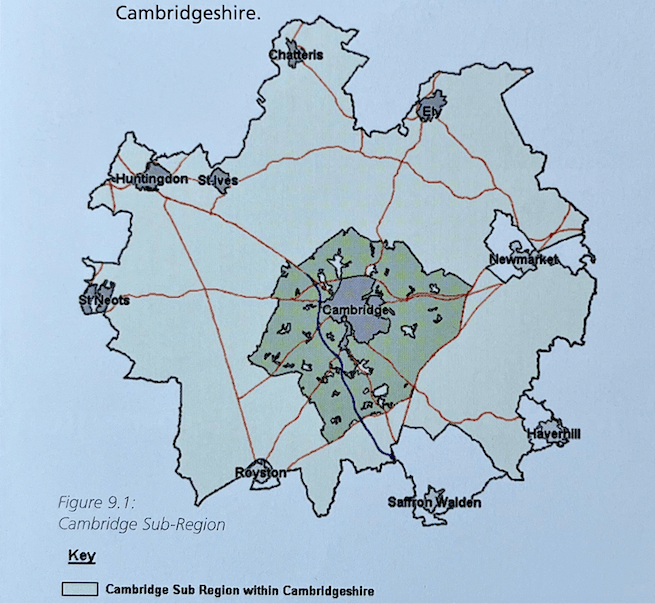
Above – the Cambridge Economic Sub-region as per the Cambridgeshire & Peterborough Structure Plan 2002 Note the city surrounded by the Green Belt
Now compare that with the proposals from Cambridge Connect below:

Above – Cambridge Connect’s latest iteration
Now compare this with what Nathaniel Lichfield considered Cambridge’s economic sub-region to be in 1965.

Above – Cambridge’s economic sub-region with surrounding market towns as per Lichfield 1965
I’ve tried to make the case for light or suburban rail services linking Cambridge to its surrounding market towns – for example using the Chatteris Reservoir as a means for creating twin Fenland towns that can connect to both Peterborough and Cambridge by rail. Thus making a nice place to relocate or establish a business that needs to serve both cities, mindful of the current poor transport connections and economic problems Fenland generally faces.
Benefit-Cost Ratio.
This has been a particularly controversial issue:
“Even when including wider benefits associated with land use change, DfT and EWR Co assessed the benefit–cost ratio to be below 1”
National Audit Office, EWR 13 Dec 2023, Full Report p9
Which is enough to make even me go ***Eeek!*** But given the issues we’ve had with the Greater Cambridge Partnership over BCRs…
…exactly.
One stronger view is that with East West Rail building a Cambourne railway station, it negates the need for a busway.
Which I’d be more than happy to see. Furthermore, the rail corridor between Tempsford and Cambourne could be used to link St Neots to Cambourne by light rail, before linking up with the proposed under-the-city tunnel that Cambridge Connect propose. Failing that, a northern entrance into Cambridge over a new light rail route could link up Cambourne with Bar Hill, Northstowe, Cottenham, Waterbeach Newtown, Cambridge North, and then through to the Biomedical Campus and onto Haverhill. (See the map in this blogpost).
Governance remains broken – with more forums, boards, and groups being added to an over-complicated picture
“DfT continued with the project without formal cross-government arrangements. HM Treasury has recently established the cross-government East West Rail Economic Growth Board to coordinate central government activity and support local development. The Board is intended to accelerate and maximise the wider social and economic benefits of East West Rail. It met for the first time in September 2023”
National Audit Office, EWR 13 Dec 2023, Full Report p10
The hand of Sir Humphrey?
“Bernard, what happens at the moment if there are some pieces of available land between say Oxford & Cambridge and there are multiple proposals for using them?”
“Precisely! Months of fruitful work – leading to a mature and responsible conclusion!” (Sir Humphrey Appleby, Cabinet Secretary in Yes Prime Minister)
In the grand scheme of things, the establishment of a cross-departmental board doesn’t particularly alarm me in principle – I’ve sat on a few myself in my civil service days. What matters is what decisions they take, and what information and data they base their decisions on.
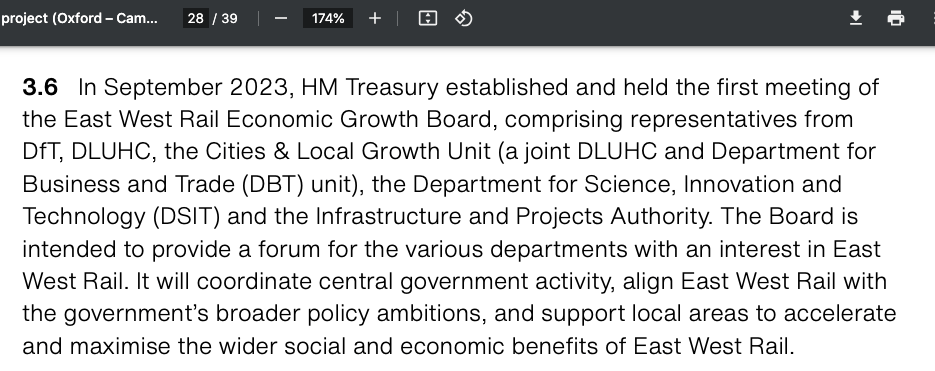
National Audit Office, EWR 13 Dec 2023, Full Report p28
The lack of a regional office in Cambridge like in the olden days means there is a gap between central and local. But let’s not be Cambridge-Centric about this. The greater impacts will be in the rural districts and towns *between* Oxford and Cambridge, not the two ancient university cities themselves – both of which are still governed as market towns. (Their city councils are lower tier district/borough level councils). Earlier on, former Cambridge City Council Leader Lewis Herbert highlighted the ridiculousness of him having to trapse all the way to Alconbury to ask a public question about potholes in Cambridge. The move by the then Tory-led county council to move the institution out to west-of Huntingdon to Alconbury without providing public transport links is one I feel was done driven by pure spite against and party political reasons. Furthermore, the written response I got from the County Council indicates that it does not look like it will be reversed – not least because the 1930s-era building no longer meets sustainability standards.
“Alongside this initiative, the Oxford–Cambridge Supercluster Board has been set up by local business leaders, universities and investors, to promote scientific and technological
National Audit Office, EWR 13 Dec 2023, Full Report p28
innovation in the region. The Board strongly supports the East West Rail project.”
I didn’t know we needed a supercluster board.
Noting their members are listed here. Some of them being members of both the Supercluster *and* ‘members of members of the supercluster. ‘
“How can you be a member of a member?”
Like this.

Above – three of the corporate members of Cambridge Ahead

Above – Cambridge Ahead – one of the members of the Supercluster *alongside* three of its members (The same three mentioned above it).
This is an example of an organisational diseconomy of scale. With so many people and firms being members of each others institutions and organisations, it makes it harder for anyone to work out where power and influence actually resides. For a start, there’s the inevitable risk of duplicating meetings. Do you go to a meeting of Cambridge Ahead to debate what their corporate position should be, or do you go along to the supercluster meeting as a member in your own right? Or do you go to both?
And that’s before you consider how to hold that power and influence to account by insisting on clear and transparent systems and processes. Who has the time to get their heads around who is influencing whom? This is one of the (many) issues I have with the University of Cambridge – its own over-complicated systems of governance means that few actually know where real power resides. Therefore it’s all-but-impossible to hold its power to account – as generations of Cambridge student climate campaigners have found out. (Hence some town and gown members of Cambridge Resilience Web are trying to unpick this).
“A Transport Working Group sits underneath the Cambridge Delivery Group”
National Audit Office, EWR 13 Dec 2023, Full Report p29
“Who is on the transport working group?”
We don’t know. Ministers refused to tell local councils in and around Cambridge who was on the Cambridge Delivery Group. Michael Gove even omitted to give local government and the Combined Authority Mayor Dr Nik Johnson any advance warning about his Cambridge 2040 vision.
“DLUHC told us that plans for development in Cambridge are still in their infancy and it will have a clearer idea of specific issues relating to the vision for Cambridge at a future date.”
National Audit Office, EWR 13 Dec 2023, Full Report p30
Pre-embryonic – even pre-conception at this stage. Consider Michael Gove’s announcement over the summer as the equivalent of someone who had found this splendidly attractive individual and decided to tell everyone about it – with said individual being the last to know. There’s a farcical romantic comedy in there somewhere!
Young Michael Gove: “Oh Miss Cambridge! What such attractive economic assets you have!”
Miss Cambridge: “P*ss off back to Miss Oxford, creep!”
(The Secretary of State being a graduate of ‘the other place’ – Not that this makes the slightest difference to us town people!)
“So, what happens now?”
We await Peter Freeman’s conclusions in his report about Cambridge’s future to Michael Gove – due in the next week or so. Then it’s the statutory consultation on East West Rail. Then we head into local election territory in April 2024 – with the possibility of a general election too should the PM have not called one by then. Otherwise it’ll be a long old 2024.
Food for thought?
If you are interested in the longer term future of Cambridge, and on what happens at the local democracy meetings where decisions are made, feel free to:
- Follow me on Twitter
- Like my Facebook page
- Consider a small donation to help fund my continued research and reporting on local democracy in and around Cambridge.
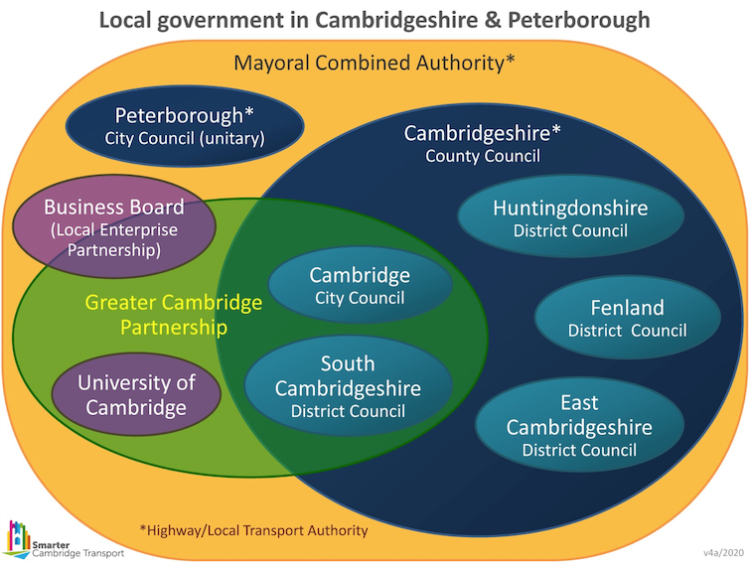
 The Cambridge Town Owl
One thought on “National Audit Office criticises lack of joined-up working on East West Rail”