On why adult education and lifelong learning needs to be front and centre of practical responses not just to the call for ‘a million green jobs’ but also for a host of other challenges across our villages, towns, and cities.
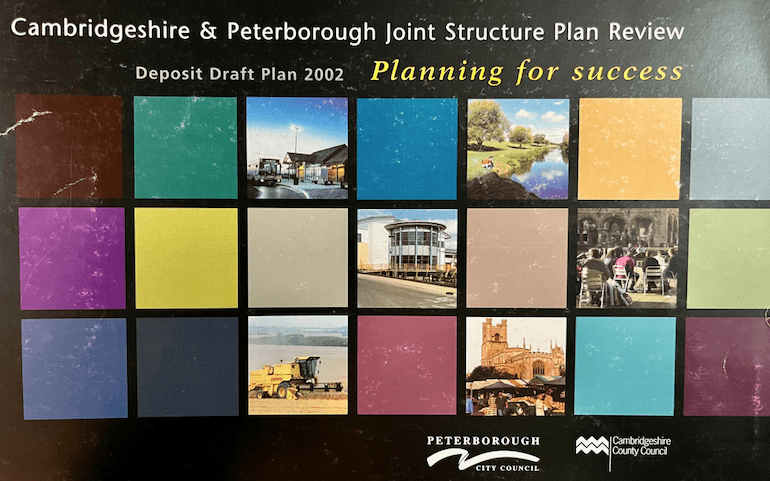
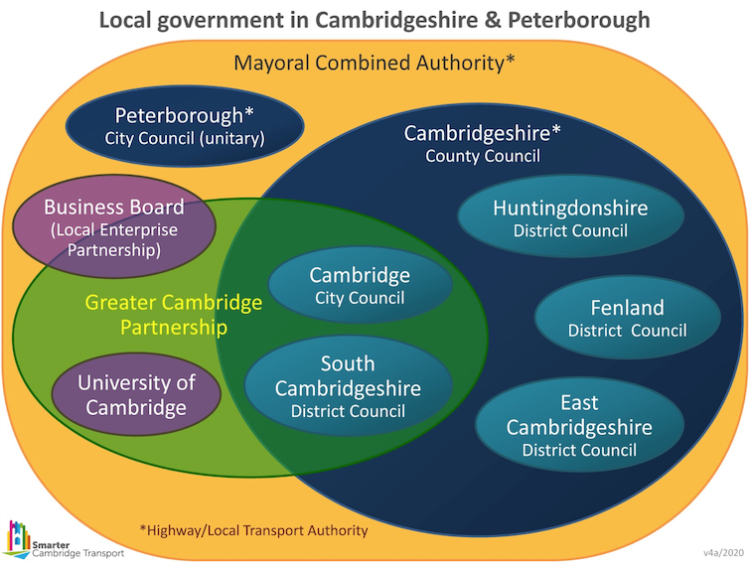
Image: Cambridgeshire & Peterborough’s Structure Plan Draft Deposit Plan 2002 which you can read here …as it was meant to have sorted out more than a few of the issues below!
Lining up my previous three blogposts sparked something about public policy failings of adult education and lifelong learning policies of successive governments.
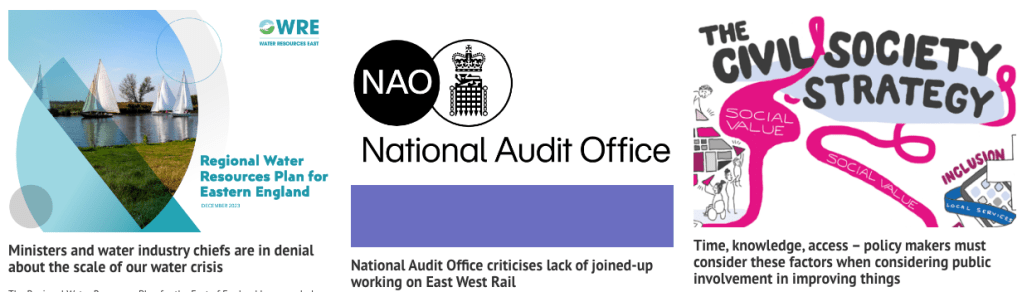
Above – posts from mid-December 2023
At the same time, the book Civic Affairs – Leicester 1939/40 that I wrote about here, reminded me of how the responsibilities of local councils used to be all-encompassing, even though their ability to meet those responsibilities was inevitably limited by limited revenue-raising powers and limited government grants.
As mentioned in one of those posts, one of the seemingly inevitable consequences of the wars in the 20th Century was the growth of the centralised state – in particular the need to gather resources and co-ordinate industrial production for the prosecution of the war. The speech by the then Deputy Prime Minister Clement Attlee to Parliament on 22 May 1940 transcribed here explains the rationale behind the move as he tabled a motion for the Second Reading of the Emergency Powers (Defence) Bill – a move that gave the newly-appointed Minister of Labour and National Service (Ernest Bevin – until then the General Secretary of the Transport & General Workers Union) the most draconian of powers that any minister of the Crown has had over the general public (i.e. not the military).
“The Minister of Labour will be given power to direct any person to perform any services required of him. That does not necessarily mean services in munitions or factories. It does not apply only to workmen. It applies to everybody.”
Clement Attlee to Parliament – HoC 22 May 1940 vol 361
Above – The Minister for Labour and National Service, Ernest Bevin, May 1940 (British Pathe)

One of the themes that Bevin repeated was the elimination of war profiteering – a problem during the First World War. Hence it was one of the first issues that they dealt with.
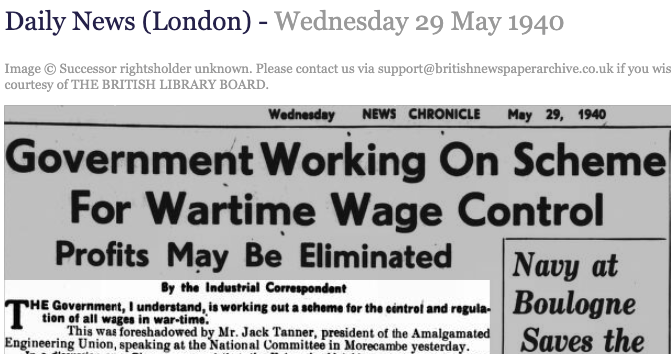
Above – News Chronicle 29 May 1940 in the British Newspaper Archive
How this contrasts then with the profiteering over PPE in the early 2020s when CV19 hit.
Above – Carol Vorderman (formerly of this parish) picking up on the looming interview with two of those accused – the two under investigation by law enforcement authorities (at the time of blogging)
“What’s all of this got to do with responses to the climate crisis and other stuff?”
Everything.
The first is that we used to have a grassroots system of lifelong learning centres which against many barriers the local institutions managed to raise money and local councillors and employers managed to support, before being taken over by an all-centralising Whitehall operation. The Leicester book covers what became the University of Leicester here.
“The site for the University was donated by a local businessman, Thomas Fielding Johnson, in order to create a living memorial for all local people who made sacrifices during the First World War. This is reflected in the University’s motto Ut vitam habeant – ‘so that they may have life’.”
History of the University of Leicester – founded as Leicester, Leicestershire and Rutland University College
Which is also why the closure of the old Vaughan College of Lifelong Learning in 2020 was such a sad move given its history as a lifelong learning college for well over a century.
Cambridge’s version was CCAT – have a look at their course brochure of 1954/55 here. In the late 1980s/early 1990s it was the Conservatives that effectively broke it up into two institutions – the higher education bit became the Cambridge Campus of Anglia Polytechnic, now Anglia Ruskin University. The further education bit became Cambridge Regional College. On top of that, changing ministerial priorities under the Labour Government that brought in tuition fees from 1998 for higher education, new policies that influenced the decision for CRC to focus on vocational/skills-based education, getting rid of all of its academic courses and more than a few leisure courses too.
‘If they can throw money at PPE profiteers, why can’t they throw money at real problems?’
One of the things that radically changed my thinking on everything political was going through the Banking Crisis of the late 2000s during my civil service days. I was going around the country on behalf of central government talking about what I thought was a huge sum (over £8billion over three years I think it was) being spent on social housing, only to find out how much the banks had been bailed out by. (See National Audit Office’s summary here – noting that at the time there was no guarantee that the taxpayer was going to see any of that money back).
The limits of centralisation
As the law currently stands, local councils and combined authorities cannot open their own lifelong learning colleges. As the now Education Secretary informed my local MP Daniel Zeichner in writing, they have neither the funding nor legal powers to do so. Which seems like a pointless bureaucratic loophole to jump through. Why not give local councils far greater revenue-raising powers to pay for the founding and running of such lifelong learning colleges?
That same blogpost further down lists the sorts of things that could be built on the site of a lifelong learning college. The point here being that such an institution should have the sorts of things that would make people want to spend time there, as well as being a place where they can get essential things done – and conveniently, that are also in their interests. Things like a GP surgery, dental practice, creche, public library, and things that enable people to active. ie not just a gym and artificial sports pitches but wide open spaces and tree-lined walks.
Designing in active travel and public transport access
One of my longstanding complaints about local transport policy is how the mindset has been based around commuting from the outside to the inside. The aim being to reduce A-to-B commuting in peak hours. What this approach fails on is it assumes people only want to travel in to work or study. It doesn’t account for other multiple activities, whether from dropping children off at school to going to medical appointments to going to evening classes or leisure events. What would our transport networks be like if they were co-designed with residents that make up a city (i.e. including in-commuters) to get a picture of what needs to be where, and what transport infrastructure could both serve the needs of those institutions, services, and facilities while at the same time making the funding of the transport network as sustainable as possible?

Above – City of Leicester 1939
Take Leicester’s tram network in 1938 (you can see the map here on Wikip) and the data from the council below.

Above – Civic Affairs, City of Leicester 1939/40, p93
Note the bottom row: “Percentage of working expenses to receipts: 88 percent”
That’s pretty impressive for a public transport network. You can see more about Leicester’s trams here.
Designing a city so that its amenities and institutions interact with both an active travel and public transport network
My point for all of this is that for a public transport system to pay its way, you cannot design it for a commuter base only and for peak routes and times. Civic leaders have to commission them to serve the people of the city. This means getting the co-operation of a host of private institutions within the city to co-operate as well. For example
- Changing their shift times and/or moving towards more flexible working hours so that the peak demand can be spread out over the rush hours. Which workplaces can have people starting & leaving early, and starting/leaving late?
- Contributing towards a ‘beyond the basics’ tram/bus stop that serves their staff/business
- Engaging with transport providers in designing timetables so that services depart/arrive at convenient times for all, and that there are enough early morning / late evening services to enable staff and customers of leisure services/night time economies to use public transport safely
- Working with town planners to ensure that in residential areas there are some properties/areas of land closest to transport stops that can be designated as suitable for increasing the population density of them to increase the financial sustainability of services. (And thus enable new businesses to relocate there). This is already happening around the new Cherry Hinton Library due to open in early 2024 where lower density, lower energy-efficient 1960s-era council housing has been replaced by new council houses at a medium density and higher environmental standards (See GMaps here).
- Identifying parts of the city where in the longer term new facilities not yet in existence can be located and built with active travel and excellent public transport access already designed in. (It’s why I’ve suggested a new lifelong learning college could be located either where the existing Hills Road SFC is, or at the Marshall’s Airport site where such an institution could function as a district anchor institution for East Cambridge.)
The lifelong learning college as an anchor venue for social improvement and meeting the skills needs of our city and economic subregion
This was something Cambs News picked up when Shadow Employment Minister Alison McGovern visited Peterborough recently.
Above – how can a city have both high unemployment *and* a skills shortage in key industries?
This is a symptom of long term public policy failures at local and national levels. The challenge for the next government is to come up with something that acknowledges this and has radical proposals that break out of the existing failed policy mindsets (eg more loans for people to train) and persuade if not compel more employers to pay for the skills and training costs of their staff.
Peterborough’s potential for co-ordinating lifelong learning with good regional public transport access
For politicians of the city looking at a medium term plan for Peterborough, how could you make the path between Peterborough Railway Station and City College Peterborough a more direct route by walking/cycling/e-scootering? Note as well that this site also has a small park next to it – something that I think a new Cambridge venue should look to include for its own – ideally on a larger scale for both college and green space.
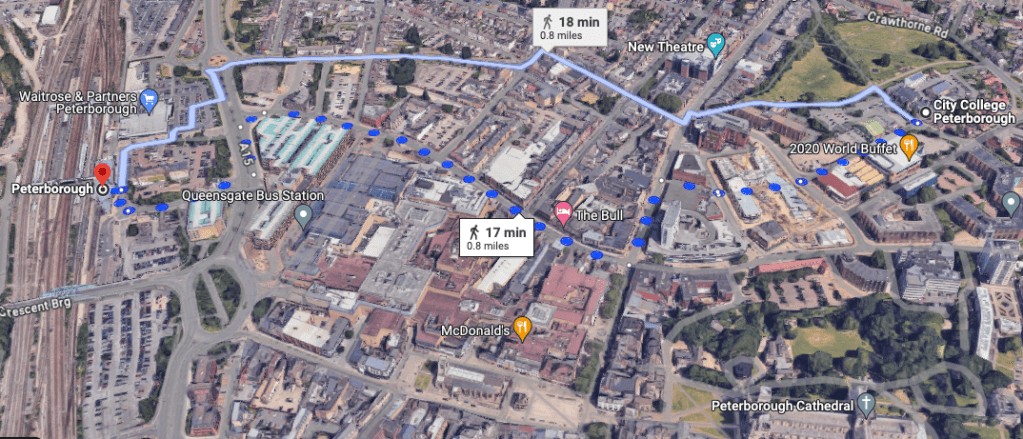
Furthermore, are there additional sites along the GNER Railway Line that might make for more suitable commuter stations and/or economic hubs to enable the more efficient and beneficial use for the land around the existing city station – a fair amount of which is currently used as uncovered car parks? (I’ve mentioned in previous posts and questions to the Combined Authority how the new ARU Peterborough should build new schools of dentistry and town planning to meet the regional skills shortages of both – but again the legislative and ministerial barriers mean these have gotten nowhere).
One other thing Peterborough benefits from is more accessible riverside space

Above a funfair at the Embankment on G-Maps
Looking at some of the buildings around there, could more imaginative uses be made in the very long term compared with what is there now? Especially if the country has to move away from an automobile-based, fossil-fuel-powered economy.
Food for thought?
- Follow me on Twitter
- Like my Facebook page
- Consider a small donation to help fund my continued research and reporting on local democracy in and around Cambridge.
 The Cambridge Town Owl
