
Establishing a development corporation is not something that can happen overnight. Which makes the announcement today all the more interesting given election timetables
“A development corporation to deliver upwards of 150,000 homes around Cambridge over the next 20 years has been announced by Housing Secretary Michael Gove.”
Gemma Gardner, Cambridge Independent, 19 Dec 2023
Above – summary from Gemma Gardner. You can scrutinise both Gove’s speech and the written statement to Parliament.
- Transcript of Michael Gove’s speech 19 Dec 2024 to RIBA
- Written Statement to Parliament by Baroness Penn, 19 Dec 2024
Also, read the joint response from Cambridge City Council, Cambridgeshire County Council, South Cambridgeshire District Council, and the Mayor of the Combined Authority.
If anyone wants to discuss this announcement with other people. I have a couple of free events coming up in the next few weeks.
***Hang on – shouldn’t Gove have made his statement to the Commons first?!?!***
Yes – and Deputy Speaker Eleanor Laing tore into Gove in a statement to the Commons, reminding *everyone* of the Ministerial Code. Have a watch of Deputy Speaker Laing’s speech here.
“It really must be noted that it is *not* a trivial matter”
Deputy Speaker Eleanor Laing to House of Commons, 19 Dec 2023
“Why is it not a trivial matter?”
One of the core pillars of our [imperfect] democracy is that MPs are accountable to their constituents, and that Ministers are accountable to MPs in Parliament. Therefore whenever Parliament is in session, MPs must be able to cross-examine ministers about government policy. Whenever there is any significant change of government policy, the minister responsible for that policy area should come to the House of Commons and make themselves available to MPs – in the form of making an oral statement and taking questions on it *at the first available opportunity*. Under no circumstances should ministers be briefing the media with leaks etc, let alone making what should have been a ministerial statement to the House of Commons, to journalists or anyone else outside.
The whole point is that if MPs cannot scrutinise ministers, they cannot fulfil their democratic duties to their constituents.
The lack of MPs from Cambridgeshire was striking. This in part is a reflection of our imperfect democracy where MPs are expected to form the pool that party leaders select most of their ministers and shadow ministers from. For Cambridgeshire and Peterborough, we have three ministers and one shadow minister in the ranks, with one former minister as well. The incumbent MP for Peterborough is the only MP without ministerial or shadow ministerial experience. The problem is that each role is more than a full-time job. (I’ve watched ministers find this out the hard away). But such is our political system (unlike say the USA where you cannot be a member of Congress *and* a member of the government at the same time. Separation of powers as a check and balance on the power of an executive – an important constitutional principle.
“Under what legal powers can Michael Gove simply decide to set up a development corporation for Cambridge?”
The Local Government, Planning, and Land Act 1980 (as amended by subsequent legislation, including the Housing and Planning Act 2016).
“What does it say?”
134 Urban development areas.
(1) “If the Secretary of State is of opinion that it is expedient in the national interest to do so, he may by order made by statutory instrument designate any area of land as an urban development area.”
HPA 1980 S134 (1)
This is why he has stated the growth of Cambridge is in the national economic interest – the law requires him to state that this condition has been met in order to to designate areas of land in and around Cambridge as urban development areas.
Then…
135 Urban development corporations.
(1) “For the purposes of regenerating an urban development area, the Secretary of State shall by order made by statutory instrument establish a corporation (an urban development corporation) for the area.”
HPA 1980 S135 (1)
“Is that all he needs to do?”
No – there are checks and balances on those powers. In particular both Sections 134 and 135 require the Secretary of State (Gove) to consult with those affected by the decisions – in particular:
- “(a) persons who appear to the Secretary of State to represent those living within, or in the vicinity of, the urban development area;
- (b) persons who appear to the Secretary of State to represent businesses with any premises within, or in the vicinity of, the urban development area;
- (c) each local authority for an area which falls wholly or partly within the urban development area; and
- (d) any other person whom the Secretary of State considers it appropriate to consult.”
Above – the Government *must* consult with representatives of those groups – for example local councillors, trade associations, and constituted community groups such as Cambridge Past, Present, and Future, otherwise they risk a High Court Challenge against any Order that creates a new development corporation. And there are a lot of opponents who have the means, motives, and knowledge to fund such a legal challenge. That is why ministers must ensure their processes are lawful and legally watertight.
He *could* go out to public consultation and enable people to have their say, *or* he could – for expediency’s sake completely ignore that stage – noting that his party’s candidates may well take an electoral hit as a result. That would be a Political consideration outside the scope of both the law as I read it, and also of any advice civil servants could give – the civil service code blocks them from advising on such things. Thus Gove has some interesting conversations looming with his fellow ministers the MP for South Cambs at the Parliamentary Undersecretary at the DfT, and the MP for South East Cambs, the Culture Secretary.
If you have a strong opinion on a public consultation, contact your MP and ask them to make representations to the Secretary of State on your behalf https://www.writetothem.com/
“How long will a consultation take?”
If they do it properly, it should take three months, but I predict they’ll try to chop it down to less than that because of the election timetables and political expediency.
“Doesn’t the consultation require them to designate the area of land that they want to build on?”
Yes – it does. Which is why they have to get cracking with the detail because unless they have already done the work, the process of identifying what plots of land might be available is not something that happens overnight.
“Can’t they simply use the submissions to the emerging Greater Cambridge Local Plan?”
Exactly.
So if you’re looking at sites around the edge of Cambridge, you have a look at the offers that came in back in 2020/2021

Above – from the Greater Cambridge Shared Planning Service
Blue means empolyment land, purple means residential land, and red means mixed
“That’s all inside the Cambridge Green Belt!”
Hence the comments in the statement about changing Cambridge’s Green Belt. And also what denotes ‘green belt’ in the first place.
At a wider district level, the map looks like this:
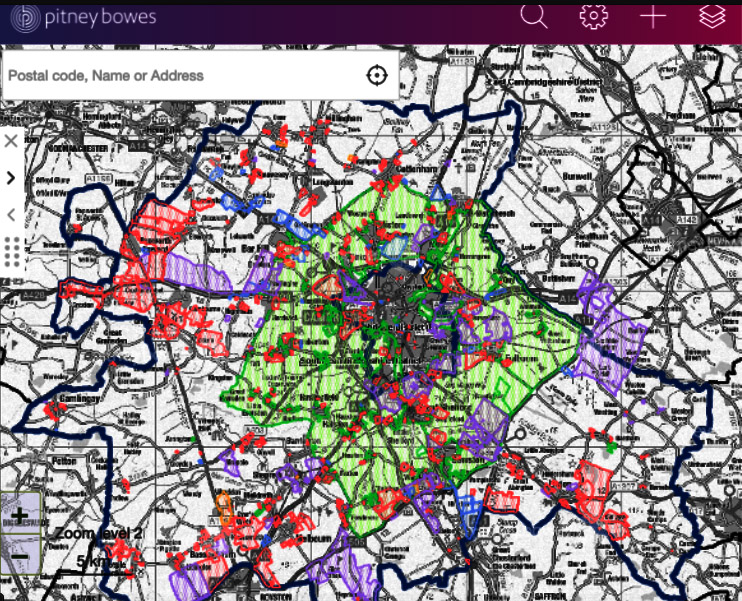
Above – from the Greater Cambridge Shared Planning Service 2021
Not surprisingly, the Chairman of Homes England who Gove commissioned to investigate the options for growing Cambridge has been visiting some local property professionals.
Which wouldn’t surprise me in the least given that said firms are also acting on behalf of land owners and and speculators regarding future possible developments. Which explains why so many speculators have taken up various options and hedging positions on land if/as/when it becomes available for development. If ministers were sensible, they would bring in a land value uplift tax to capture the financial/paper gains from the change in the land status, and use that revenue to pay for infrastructure. (Feel free to lobby your local party political representatives to get something like this in their election manifestos.)
“This all sounds like they want to build ‘Cambridge Neustadt'”
I’ve borrowed the term from Austria where I visited on several occasions in the mid-2000s. ‘Vienna Newtown’ or “Wiener Neustadt” was a city built with the ransom money Duke Leopold of Austria squeezed out of the people of England in return for having Richard the Lionheart back because the two fell out on the Third Crusade over whose banner should be the highest at the port of the recently-captured Acre.
Will we see a sort of ‘Cambridge New Town’ built with the proceeds of money from somewhere? And where?
If we look back and the South Cambridgeshire District map above, the main large areas of land offered by landowners included:
- Land north of Cambourne near the old Papworth Hospital (which someone snapped up the development rights for ***ages ago***)
- The Bassingbourn and Thakeham proposals
- The Six Mile Bottom proposal
“Do you think they’ll build all of them and then some?”
That depends on what Labour and the Liberal Democrats think – both locally and nationally
The challenge for Labour and the Liberal Democrats
“Have they said anything?”
Yes. The joint responses from the Labour leaders of the City Council and Combined Authority, alongside the Liberal Democrat leaders of the County Council and South Cambs District Council is below.
“Despite working hard to engage constructively with Government officials since the Secretary of State’s initial Cambridge 2040 announcement in the summer, it’s deeply disappointing that once again Government plans for Cambridge seem to be being negotiated through the press.
[It goes on to state]
“Clarity is also needed as to who is involved in the ‘Cambridge Delivery Group’, what it will do, and how it will be governed. Devolution works best when local politicians are empowered to lead and deliver sustainable development and we will continue to work hard to represent our residents and ensure that Cambridge and its surrounding villages grow in a sustainable and carefully planned way.”
Cambridge City Council 19 Dec 2023
Cambridge’s Labour MP Daniel Zeichner was also dismissive of the way ministers had avoided working with local councils.
“Once again, Michael Gove and the Tories are arrogantly pronouncing plans for the future of Cambridge without involving local people or their representatives. What the Government needs to do is address the pressing water issues and unlock the funding for transport and housing projects that are ready to go and urgently needed – until then, this is just more hot air.”
Daniel Zeichner to Gemma Gardner in the Cambridge Independent, 19 Dec 2023
“But Labour and the Liberal Democrats will need a more substantive response than this in the run up to the general election”
Carrying on under the existing local planning process is one option. In which case it’s up to Labour’s Deputy Leader Angela Rayner – responsible for housing and local government policy to decide what her party’s response should be. This could include simply stating that if elected at the general election, they would strike out Michael Gove’s plans (including the Cambridge Delivery Group, the Development Corporation and the governance structures with them), and either carry on as normal or set in plan their own alternatives, such as unitary councils for Cambridgeshire & Peterborough (which was the manifesto policy under Harold Wilson’s Government in the 1970 general election).
There are other regional policy options for a future Labour Government
These include:
- Designating neighbouring county towns as investment sites for firms that grow too big for Cambridge, and building the transport and infrastructure corridors towards them, starting with Bedford then onto Northampton, or Haverhill onto Colchester.
- Building a light rail to serve Cambridge’s economic sub-region, with each town being supported in creating its own unique attraction to serve the sub-region, on the grounds that not everything has to be in Cambridge.

Above – the latest iteration of Cambridge Connect Light Rail, supported by Rail Future
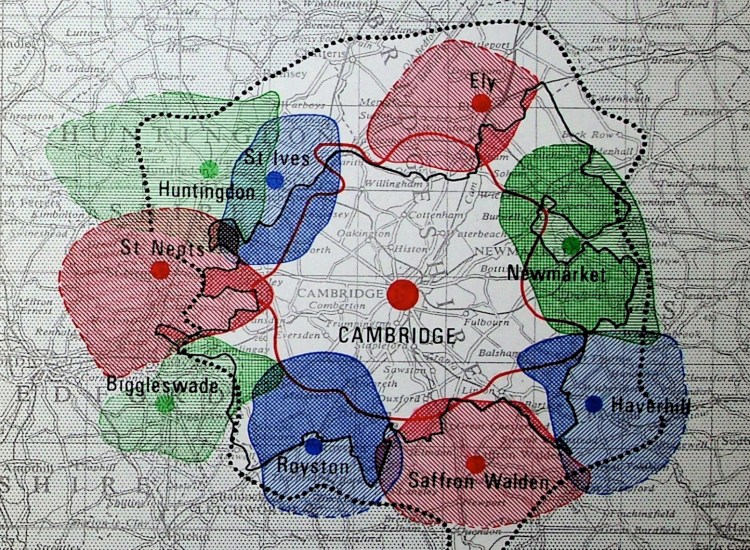
Above – Lichfield (1965) on Cambridge’s sub-regional economy and the market town economies of the era – all of which indicate what a nice network of light rail services and cycleways might be like.
What could the lead arts/sports/leisure/tourist attraction be for each town that does not need to be in Cambridge? Ely has the cathedral, Newmarket has its horses, so what might community and grass-roots-inspired solutions be like for the remaining towns to attract visitors from Cambridge and neighbouring towns and villages?
That’s enough for now – if anyone wants to discuss these issues with other people, I’ve organised a couple of events either side of the Christmas and the New Year. Same conditions as before, no party politics, no controversialist preaching. It’ll be looking at legal powers, evidence bases, local history, and due process. Save any party political questions for the election hustings – which will be on us in the next 12 months!
If you are interested in the longer term future of Cambridge, and on what happens at the local democracy meetings where decisions are made, feel free to:
- Follow me on Twitter
- Like my Facebook page
- Consider a small donation to help fund my continued research and reporting on local democracy in and around Cambridge.
 The Cambridge Town Owl