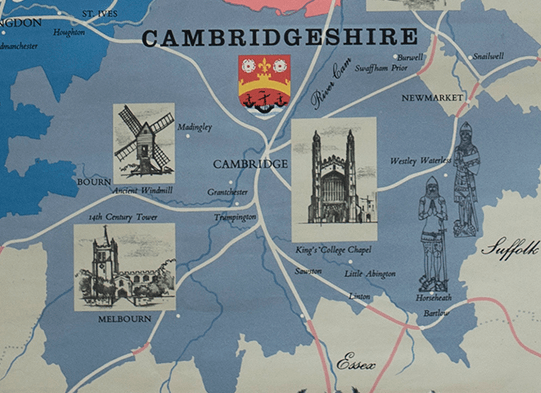
Kind of a rhetorical question because that involves some basic awareness of the local and social histories of settlements with shorter municipal histories than somewhere like Cambridge – sadly the histories of which can be easily looked down upon and/or dismissed.
Some new (to me) old (they were published ***ages ago*** pamphlets arrived earlier which I’ve digitised and uploaded for people to read here. The one in the middle is a short study by members of a Workers’ Educational Association evening class in late 1960s Basingstoke, while the other two – by the same institution – are wartime pamphlets inviting the reader to ponder what the country should do after the war in terms of overhauling politics and democracy – only people were more than familiar with the politicians and the politics that led to the outbreak of war again in the 1930s.

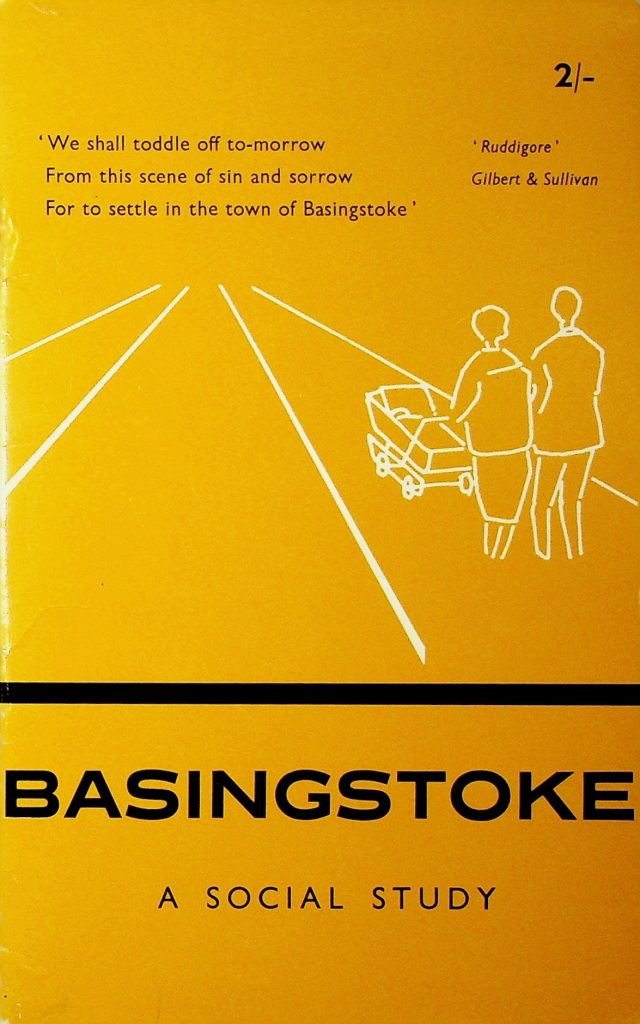

Above: 1) People and Politics, 2) Basingstoke – a social study, 3) Adult Education for Democracy.
“Basingstoke?!? What’s Cambridge got to learn from smalltown London overspill?”
Umm… a better attitude? Also, given how much Cambridge is promoted in various parts of the property press, you could be forgiven that parts of the city *are* London overspill because of the London property bubble that has hit anywhere within commutable distance by train.
“How bad is the London bubble?”
This bad.
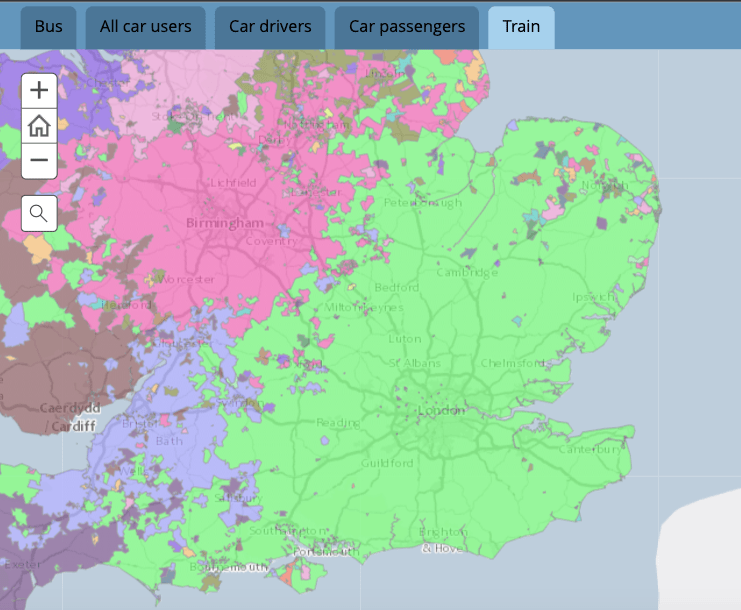
Above – from March 2023 on how Cambridge cannot solve its housing crisis until London solves its own one.
“Well, you can’t say Gove’s proposals are not radical!”
To what extent are Gove’s proposals radical, and to what extent are they pure unrealistic fantasy politics? Comments on a metaphorical postcard please.
Given that both Labour and Conservatives at a national level are proposing more big growth (the city has grown in population by 50% since I started secondary school in the early 1990s – so I’m under no illusions that the city I grew up in is not the same one as today – not necessarily a bad thing either), the pre-election period should be a chance to take stock on that past growth, and prepare challenging questions for candidates and parties for the debates in 2024.
“Otherwise?”
Otherwise you’ll get daily election news reports with some privately-educated political correspondent on TV News saying:
“And the debate in the general election today moved to [insert bland topic] with insert name of party leader] making a keynote speech in [somewhere not in London] that is expected to [generate lots of meaningless comments from the same talking heads from the same think tanks and print publications you’ve heard lots from anyway, so haven’t got much new to tell you]”
“A bit like this blog?!?’
Oh! You’ve wounded me!
Actually, the 2024 General Election could be one of the most decentralised election campaigns for decades because this will be one where:
- There’s no big single issue being promoted relentlessly by the party in government plus their print press backers
- The party in government is split all over the place – whereas previously the them PM BJ was able to exclude many of his opponents from standing for Parliament/forcing them to stand down, and replacing them with loyalists from a limited talent pool
- Labour as an opposition party have provided far fewer targets for the Conservatives to attack them on – mainly due to the relentless late-1990s-style discipline (that is not without its critics – just as in the 1990s)
- With years in power comes complacency, corruption, and the inevitable scandals – which given what we’ve all experienced with the pandemic has concentrated the minds of the public. And finally….
- With so many targets to choose from nationally and locally, the social media video generation has reached a critical mass where every hustings is likely to have someone on hand ready to film the exchanges – or even clips of the exchanges, which given their unscripted nature makes them perfect for viral footage able to crash even the most expensive & carefully-prepared communications strategy in a matter of hours.
Chances are there will be someone, somewhere who will have memorised the back catalogue of speeches and social media posts of high profile candidates ready to jump on them with recording in progress to hit them with a contradiction or a “Well I’ve got a post here from you where you’ve stated the complete opposite!” remark followed by shaky footage of a zoomed-in reaction shot. But then even when such things were put to the now former PM back in 2019 in a live prime time TV broadcast, it did not stop him from winning the election.
In and around Cambridge there are now *four* constituencies, not three as before, for the looming general election – and Cambridge 2040 will be a big issue.

Above – you can see where the new St Neots and Mid-Cambs fits in (53 in blue), and how both Cherry Hinton and Queen Edith’s wards in Cambridge City Council find themselves in the re-oriented South Cambridgeshire Constituency.
As I mentioned in my previous blogpost, I wouldn’t be surprised to see Gove designate a large plot of land west of Cambridge to be his new ‘Cambridge Neustadt’. That said, relying on the responses to a call for sites is not necessarily the best method for designating a new town.
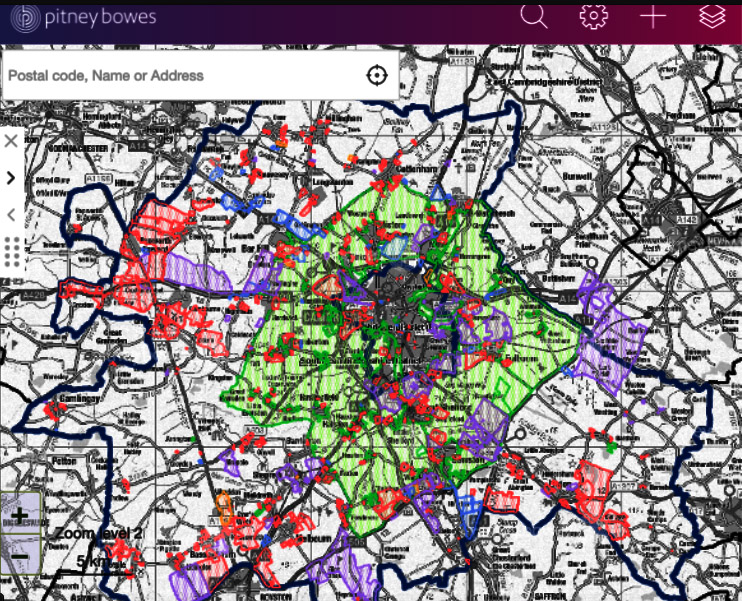
Above – just because land speculators and developers have offered sites, does not mean that the infrastructure will be easy to build.
“Are there any supporters of Gove’s plans?”
Absolutely – and opinion does not separate down party political lines either. For example the response to my social media post below has been endorsed by some young Liberal Democrat activists even though the response from their party’s elected local councillors has been more hostile.
Above – when Cambridge Student Paper Varsity covered the local government reaction, some spoke in favour of the Secretary of State.
In the case of Tom Spencer’s comment, I’m not going to do a takedown of a single tweet on what is a complex policy issue – not least because he’s pointed to some more interesting public policy proposals at Priced Out UK here which actually deal with some very tough public policy issues that successive governments have refrained from touching. Such as changing how local councils are funded. One of the most sensible ones in their summary (in my view) is “Releasing greenbelt protections from land within walking distance of train stations.” A case study where this could work? Dullingham just outside Newmarket.

Above – from GMaps here – the reasons it takes so long to cross just over 10 miles of railway line is because the line was downgraded to a single line for most of the Cambridge-Dullingham route, and accordingly it’s a diesel chugging service that serves that line.
Rail Future East has been campaigning for years to get the track dualled and electrified.

Above – from Rail Future East Feb 2023
Kennett is another example. It’s close to the A14/A11 junction, it is close to a number of outdoors attractions (which improved local public transport services brought in as a result of housing growth around the station) would more than benefit – and which city dwellers might appreciate.

Above – Kennett Station just east of Newmarket via G-Maps here – under 20 miles so a half-decent electrified train service should get people into Cambridge in half an hour.
As Basingstoke tells us, ministers cannot simply leave it to developers to build communities. They build houses, not towns.
The cartoons inside the Basingstoke Pamphlet illustrate the challenges fast-growing settlements face.
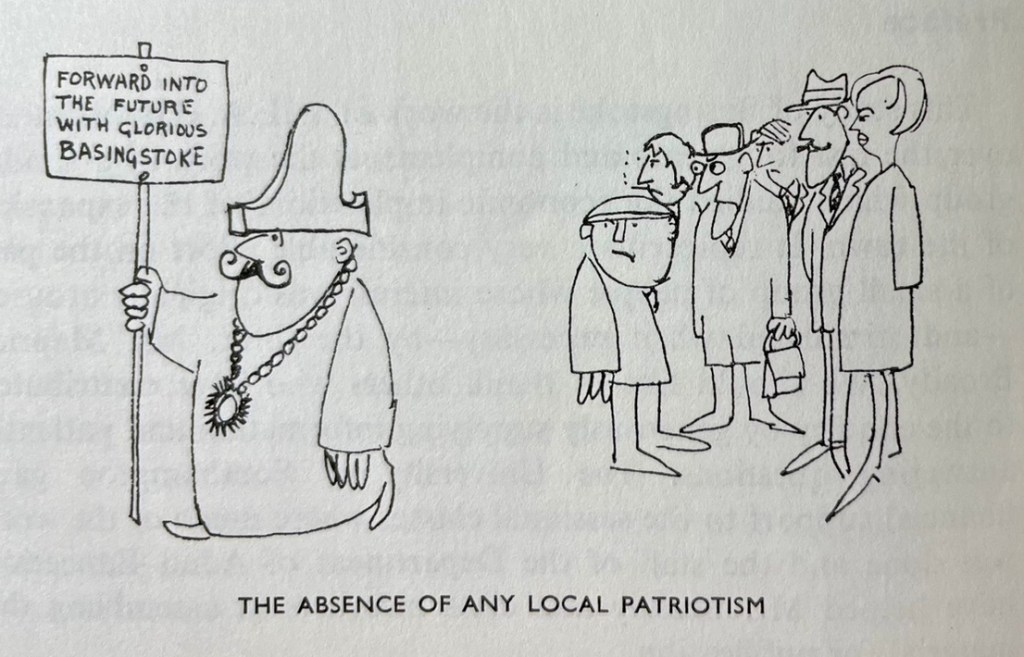
Above – what capacity does local government have to integrate people who have moved to the area?
I’ve been scathing about political failures over this for longer than I care to remember. In the case of Basingstoke, the pattern of migration was very different to what Cambridge has and is experiencing.
“In the ten-year period from 1951 to 1961, the population increased by over fifty per cent. The bulk of that increase was by private immigration, mainly from the London area. In 1961, however, an agreement was reached between the Borough Council, the Hampshire County Council and the London County Council, which provided for the development of the town as an over-spill reception area. As a result of that agreement, the population of Basingstoke is planned to grow by 1977 from the present figure of 30,000 to 75,000.”
Basingstoke – A social study circa late 1960s, WEA. P4
In Basingstoke’s case, they were dealing with internal migration from post-war inner city to small-town unfinished newtown. In Cambridge’s case it’s a mix of highly academic to technical specialist skilled people from a wide range of distances – from villages over the county boundary to megacities on the other side of the world. (I was treated by people from such backgrounds during my last stay in hospital, when I asked them about what working in the hospital under semi-lockdown conditions was like!)
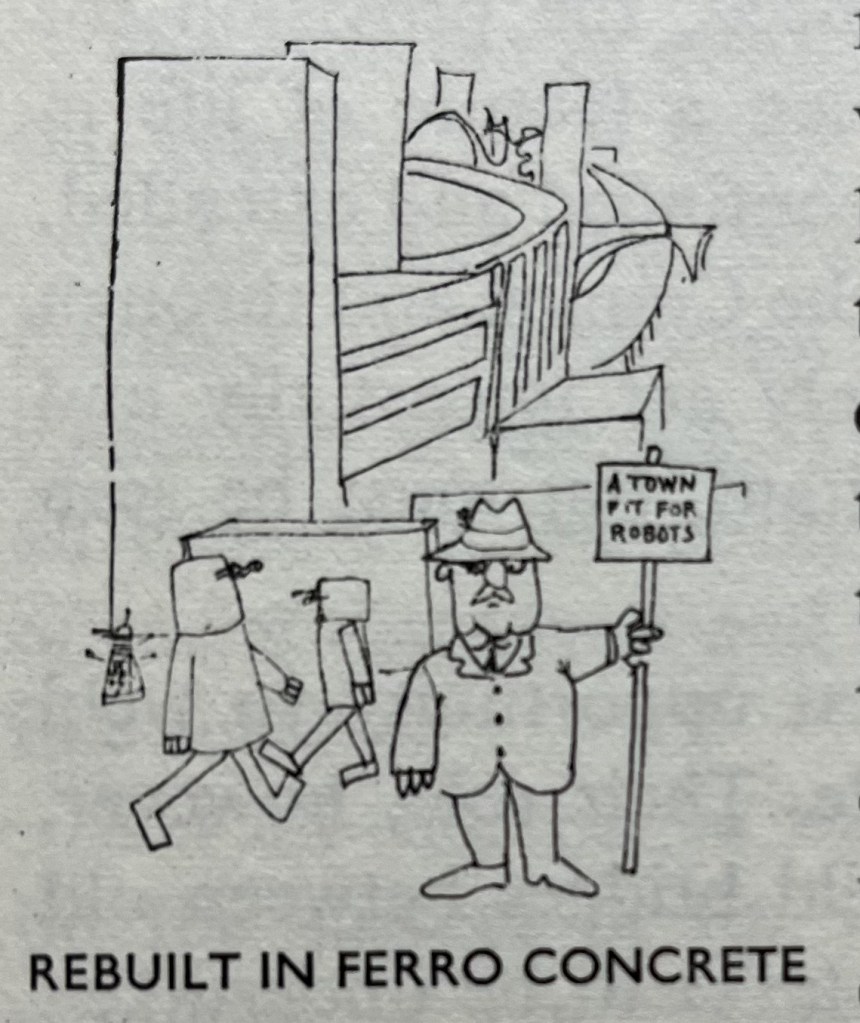

Above – cartoons by David Austin
The man holding the sign on the left – which states: A town fit for robots. As for ugly buildings, it will be interesting to see what future proposals Labour and the Liberal Democrats come up with in response to Gove’s agenda. Will a future government stick with it?
Stronger and more empowered local government (esp on local taxation) is better placed to respond to the social and environmental needs of the villages, towns, and cities they are responsible for
The problem is that Brand Cambridge is too tempting for ministers to devolve and delegate to. There are strong party political reasons why Gove wants to be involved in imposing his vision on Cambridge – not least because the people in the city since the 1990s developed a habit of rarely voting in Conservative councillors – one that was picked up by the people of South Cambridgeshire in the late 2010s. Don’t think similar accusations by councillors in rural parts of East Anglia were not thrown at Labour’s ministers in the early 2000s in response to proposed house building targets. I recall Stop Harlow North from my civil service days – it’s still going.
One problem Cambridge has is that the local councillors on the whole want Cambridge to become an inclusive city. Yet there are strong commercial forces that want Cambridge to be an exclusive city – something that can then be packaged up and marketed to those with the deepest wallets. Hence I asked Whose Cambridge is it anyway?
I’m not pretending that a purely local approach will solve Cambridge’s problems
Cambridge is a city with a globally-recognised name. Yet it has always been treated as a market town by monarchs and later, governments. Building up the capacity and competency needed for a thriving and empowered unitary council to function properly is not something that can happen overnight. (See Cambs Unitaries if you’re interested). Cambridge has to develop positive working relationships with its neighbouring towns – including the county towns over its county borders. Not everything has to be in Cambridge. The lack of a regional tier however makes it hard to co-ordinate moves that might spin out growing firms in Cambridge that could relocate along fast rail corridors to places like Bedford, Northampton, to its west, Peterborough & Wisbech to its north, Mildenhall, Thetford, Norwich and Great Yarmouth to the north east, and Haverhill, Sudbury, Colchester and Ipswich to the south east. Whether Cambridge gets a Cambridge Neustadt or not is irrelevant to this – those working relationships with neighbouring towns need to be strengthened.
The problem is that we’re just not seeing the levels of institutional leadership in particular from University (of Cambridge) circles or national political circles that demonstrate an understanding of, let alone the importance of those regional relationships. I hope the general election hustings serve as a wake up call force at least some of these issues to the top.
Food for thought?
I’m running a couple of events for people to discuss Michael Gove’s announcement on Cambridge 2040. See https://cambridgetownowl.com/workshops/ for details.
If you are interested in the longer term future of Cambridge, and on what happens at the local democracy meetings where decisions are made, feel free to:
- Follow me on Twitter
- Like my Facebook page
- Consider a small donation to help fund my continued research and reporting on local democracy in and around Cambridge.
 The Cambridge Town Owl