
Some of you will have noticed some uncomfortable differences between the responses of local government leaders in and around Cambridge, and that of the University of Cambridge.
The University of Cambridge responded as per Pro Vice-Chancellor Andy Neely
Above: University of Cambridge quoted by Mark Williamson
“It is pleasing to see the plans recognise the need for sustainable growth and local engagement”
Statement published 20 Dec 2023 by Cambridge University
Yet only 24 hours earlier, local council leaders responded:
“Despite working hard to engage constructively with Government officials since the Secretary of State’s initial Cambridge 2040 announcement in the summer, it’s deeply disappointing that once again Government plans for Cambridge seem to be being negotiated through the press.”
The leaders of Cambridge City Council, Cllr Mike Davey, South Cambridgeshire District Council, Cllr Bridget Smith, Cambridgeshire County Council, Cllr Lucy Nethsingha, and the Combined Authority Mayor of Cambridgeshire and Peterborough, Dr Nik Johnson. 19 Dec 2023.
If anything, Prof. Neely could have been more clear about the Secretary of State’s reluctance to work with local government in and around Cambridge. It would have been far more positive if (irrespective of policy) a joint statement from them all agreeing to a common line had been released.
The Greater Cambridge Partnership Board meeting on 04 Jan 2024 at Cambridge Guildhall
The meeting papers are here. I think there is a strong public interest in tabling public questions in asking what conversations GCP partners have had with ministers regarding the announcement by Gove, and also what indication he has given on the GCP’s future. (See here for guidance on tabling public questions)
“Can Cambridge University be held accountable by the public in the Cambridge City Deal meetings?”
This was a question I asked of the GCP ***nearly nine years ago*** at the now old Shire Hall.
Above – ‘I put the question to Professor Jeremy Sanders CBE at the January 2015 meeting of the Greater Cambridge City Deal Board – 25 Jan 2015, Shire Hall, Cambridge’
The first Great Cambridge Crash Course event looking at Cambridge 2040
There were around ten of us at Rock Road Library earlier today (23 Dec 2023) looking at both the Cambridge-specifics of the ministerial statement tabled on 19 December 2023 (scroll to the end) and also examining the historical context too. (The next one is on Sat 06 Jan 2024 at Cambridge Central Library by the Cambs Collection on the 3rd floor)
We had to spend much of the time exploring the historical context because in the view of most of the participants, there was so little policy content to scrutinise. It wasn’t clear to them the geographical areas most likely to be zoned into a development corporation, nor was it clear what powers would be granted to the development corporation or on what form the development corporation would take. Furthermore, there was deep scepticism as to whether Gove would still be in office within the next year to see the further development of his proposals.
“Labour and the Liberal Democrats will need a more substantive response than this in the run up to the general election”
I made this point in my previous blogpost, and this was something that many participants wanted to explore further – but again were not able to because the opposition parties in Parliament have not published their alternative proposals. That said, Sir Keir Starmer has indicated he is also willing to create new development corporations.
“[Labour in Government would create] New development corporations with the power to remove the blockages. New infrastructure to support families and communities to grow.”
Labour Party 11 Oct 2023
Katie Scuoler has written more on the planning law blog about the options available to the Secretary of State on the types of development corporation available. Whether the Combined Authority is in the fit state to run a development corporation is also a question that needs asking given that both the two largest political parties have indicated they intend to make use of such powers.
What local history tells us
We had a look at John Parry Lewis’s report on the Cambridge Sub-Region from around 50 years ago (have a browse here) – the maps below giving a real sense of scale given that his proposals had the target of increasing Cambridge’s population to 200,000 by the Millennium.
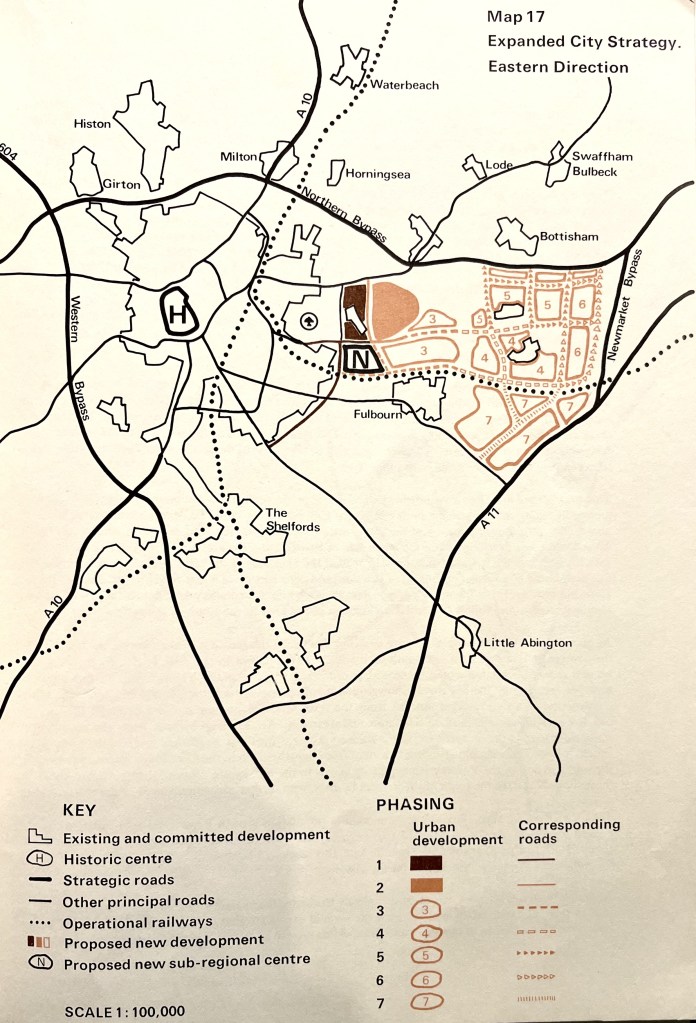

Above – John Parry Lewis (1974) pp68-70 – the need for a new urban centre (one still yet to be defined by ministers) was also raised, alongside noting that The Grafton Centre was eventually chosen as that new urban centre by that previous generation of politicians – one that turned out to be very short-sighted historically.
Whether it’s 50,000 new homes by 2040 or 150,000, the existing local government structures cannot remain as they are now – stuck in 1974
One of the things the book on Civic Affairs by Leicester City Council 1939-40 reminded us all of was how great the range of local services that local councils used to be responsible for.
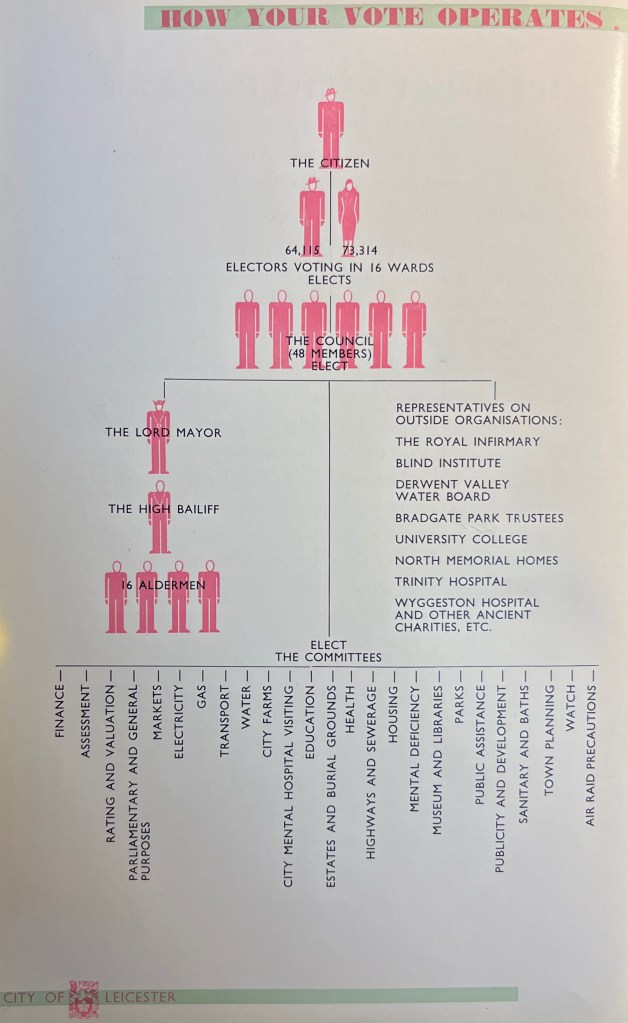

Above – Leicester City Council (1939) noting the very important historical context of the recently-enfranchised women citizens who had only gained equal voting rights some ten years previously – with the men having only gained Universal Male Suffrage just over a decade before that.
Therefore adult education was essential to educating the local population not just on how to vote but to learn how the public services that they paid for through taxation were run, and how they could use their votes to hold the councillors responsible for local policies, accountable. Which is why I said I’d love to see a modern version of that guide created for Cambridge – something that would make for an ideal piece of coursework for any students out there!
How to co-ordinate public service delivery of what the public see as front line services that successive governments have fragmented, privatised, outsourced, or shut down.
Looking at the list in the top-left image from the Leicester guide, many of the functions that were previously run by the city council/corporation were long-since regionalised then privatised. How many of those public services remain the responsibility of lower-tier city/borough councils in England? Yet for services like dentists and GPs, local residents in any growing town inevitably complain (and sadly, all too often blame the newcomers) when there are not enough essential services to go around. Yet there is no mechanism provided for by ministers to alleviate this tension. Opposition parties will be expected to have comprehensive answers to those problems come the election hustings, whether on things like pay rates for the areas with the shortages, to building new training schools, or even to reduce planned growth until the skilled workforces and infrastructure is in place.
The session today taught me the importance of local councillors holding more regular, meaningful community meetings that involve shared problem-solving
One of the things that we risk losing is agency to create new things for our neighbourhoods and communities – especially if things are outsourced and then become ‘not part of the contract’. This was very much the sense I got from another recent arrival from over half a century ago, Essays in Local Government Enterprise from 1964.


Above: Essays in Local Government Enterprise (1964)
The story of the civic theatre project in Hackney is particularly interesting for me – and Cambridge given the number of recent studies on arts facilities (and the lack of) in and around Cambridge.

I can also think of several people who would be interested in this as well given the lack of an arts centre in North Cambridge (which I think the Cambridge Science Park should be putting some serious money behind).
And finally…
In the run up to the general election, I think it’s essential that community groups in and around Cambridge start organising discussions on the future of city, county, and sub-region – similar to those that took place towards the end of WWII.

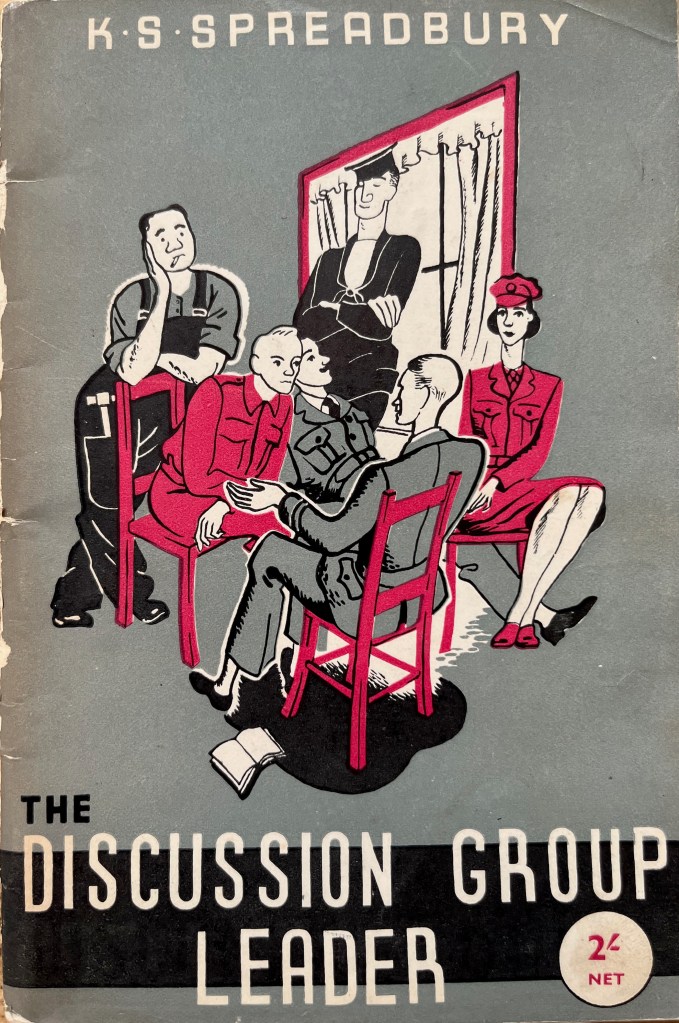

Above: 1) People and Politics, 2) Discussion Group Leader, 3) Adult Education for Democracy. All three publications were published during wartime.
It’s also all the more important that such debates cut across class lines. The risk is Cambridge in particular repeats the pattern of previous general elections where wealthy and influential groups invite candidates from the top three parties and ignore everyone else, and have what is a private discussion to the exclusion of everyone else. This for me is not good for democracy – the people of the city should be able to scrutinise the people asking the questions as much as the people answering them – especially where there is a massive power imbalance between those asking the questions vs the residents of the city.
Those pre-election community events should also cut across town-gown lines too – not least because for many of the students voting perhaps for the first time, they might get a feel for what issues local residents have, issues that they might not have been aware about before but may wish to take action on at a later date. Especially if it involves holding their own university and colleges accountable for the decisions they take.
Food for thought?
More events will follow in 2024 – including a new set of online mini-courses as requested by several of you. Keep your eyes posted on https://cambridgetownowl.com/workshops/ in the meantime
If you are interested in the longer term future of Cambridge, and on what happens at the local democracy meetings where decisions are made, feel free to:
- Follow me on Twitter
- Like my Facebook page
- Consider a small donation to help fund my continued research and reporting on local democracy in and around Cambridge.
 The Cambridge Town Owl