
Their first meeting is on 09 Jan 2024 and they have two ongoing consultations – but they need to remind the public of who created it – Otherwise it’s left to people like me to carry out this task and that’s not right.
- You can read the meeting papers for Overview & Scrutiny on 09 Jan 2024 here
- You can read about their various proposed projects and schemes here (which includes feedback details)
- You can suggest new and better bus routes in this consultation.
Given the lack of public political and democratic literacy, more public sector organisations could be putting front and centre of their ‘about us’ page the essentials on accountability. The CPCA does not do this either on its about us page, or for the Your Say Your Future consultation page screengrabbed below.
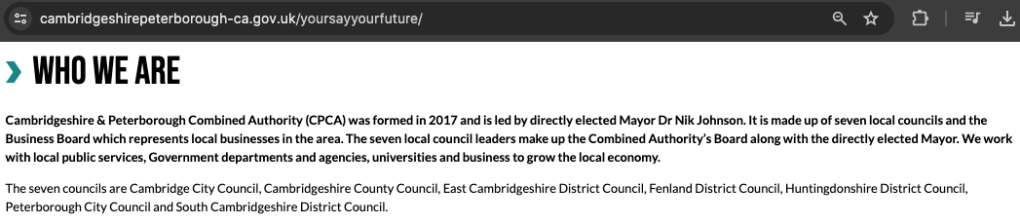
Above – who the CPCA are
“What should it say?”
Something that reads like”
“The Cambridgeshire and Peterborough Combined Authority Order 2017 established the CPCA under powers contained in Local Democracy, Economic Development and Construction Act 2009, the Order being made on 2nd March 2017 under ministerial authority.”
Furthermore, subsequent paragraphs could include:
- text/links stating that if people have issues with the powers, policy remit, and competencies of the Combined Authority, they should contact their MP stating what they are, and ask their MP to forward them onto the Minister responsible for Combined Authorities at the Department for Communities and Local Government.
- text/links stating that if people have issues with *any decisions* made by the Combined Authority, to contact the CPCA directly or contact one of their local councillors (eg via https://www.writetothem.com/) to lobby the CPCA on their behalf.
The reason being that in my case at least, many of my concerns about the CPCA are more to do with its existence rather than its policy decisions.
Furthermore, the quality of the consultations alongside the frequency and uncoordinated manner at which they are being published by local and county organisations is potentially causing more problems than it is solving. Take for example this from the printable copy of the consultation on its objectives (click here, scroll down a little, click on the download here tab) and you’ll find this multiple choice example on the second page that doesn’t really provide anyone with anything useful.

Above – S = Support, US = Unsure, NS = Not Supportive. How many people are going to be *against* nice things in their area? (aside from the strange terminology?)
It’s a ‘non-sultation’ in the same way that campaign groups of old stereotypically passed motions about issues on the other side of the world, ultimately having zero impact on the problems concerned – ‘resolutionary socialism’ as lampooned in Monty Python’s Life of Brian.
The start of the consultation goes to show how few powers and resources combined authorities (not just Cambridgeshire & Peterborough) actually have. If achieving the CPCA’s top aim involves asking the public to support lobbying ministers to deal with issues, it has problems. In this case, the problems are out of the control of the CPCA.

Above – from CPCA Your Say, Your Future print consultation Dec 2023 p2
The fact that CPCA officials and councillors along with the Mayor felt moved to include such a question speaks volumes about what the Government and its ministers have been doing for the past nearly 14 years. Water shortages *and* not generating enough electricity to power the homes and businesses – including the new science/tech parks? ***Really???***
That to me reveals a level of gross negligence by successive Cabinet Ministers on long term industrial strategy – one reflected by the actions of past and present owners of utility firms to load up companies with huge debts (mindful they were debt-free when the Conservatives privatised them in the 1980s & 1990s). One of many scandals that the We Own It Campaign has been relentlessly trying to bring to the public’s attention. The problem the CPCA faces is that it has no powers to compel the responsible firms to do anything substantial.
Cambridge – a city with a globally-recognised name that is run like a market town
It didn’t always used to be like this with local councils. As I mentioned in the case of the City of Leicester just before the WWII storm clouds arrived on British shores, they published a civic guild which reminded us of how local councils were responsible for locally-produced and locally-run public services and public utilities.
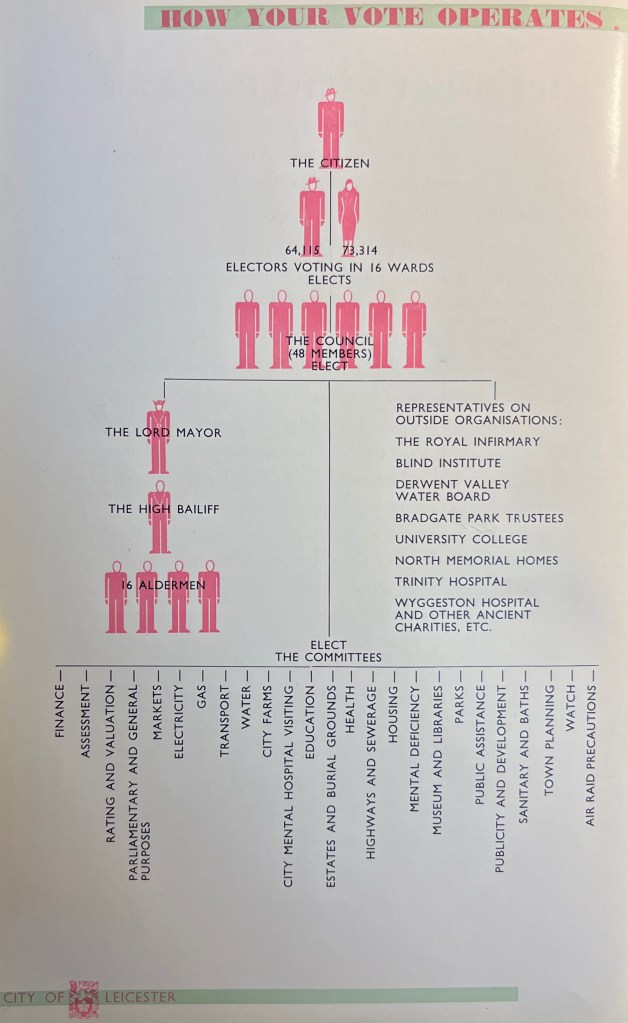

Above – Leicester 1939 digitised here – note the sheer quantity and variety of locally-run public services, and also the running of a co-ordinated transport system using trams and buses.
Can you imagine what a single local council with a series of committees and sub-committees might be like running or at least co-ordinating the provision of integrated public services rather than the fragmented, austerity-hit, uncoordinated, outsourced, and privatised set up that ministers imposed on local and regional government today? Which is why MPs on the Public Administration and Constitutional Affairs Select Committee concluded that the system of governance in England needed an overhaul. A major one. Am I hopeful for one under the next government? Not particularly.
Another example – OfStEd missing the big picture with our sixth form colleges
One of the local papers published a list of schools and colleges that OfStEd rated as Outstanding. One of them was Hills Road Sixth Form College – you can read their reports here. It was as if the inspectors had not opened their eyes to the packed out Cambridge Leisure Park across the road – something I wrote about back in June 2023. Again, the problem wasn’t particularly the fault of the college administrators or governors – the fault lay with a succession of ministers. The latter chose to create funding mechanisms to encourage further education colleges (and universities for that matter) to get ‘bums on seats’ for courses while not providing the much needed funds for all of the other studying facilities and support services that young people need. We see some of the worst examples of this in the student housing sector where all too often ministers ‘assume’ universities and local councils will solve the problems between them. Neither have the resources, the institutional structures, or the expertise. Yet if we look back at Leicester, we see (on paper at least) the local council having a seat on the decision-making body of what became the University of Leicester.
Now let’s look at Hills Road’s sister institution, Long Road Sixth Form College. (Prior to the 1970s restructures, both were the County High School for Boys, and the County High School for Girls respectively).
Long Road Sixth Form College‘s last full inspection was several years before Hills Road’s one – you can see the list for Long Road here. The College got penalised over ‘punctuality issues’ (Students being late at the start of the college day). But there is nowhere in the inspection that accounts for the chronic bus service crisis that has affected the college for years. This became more than clear when Stagecoach pulled a number of bus services that students were dependent on, causing a political row. It turned out that in 2021 the further education colleges were spending nearly £2million per year on subsidising bus services for students. Given Cambridge’s traffic problems, Long Road Sixth Form College can hardly be blamed for the poor punctuality of their students if ministers have utterly failed with their transport and local government policies.
“What should Labour do?”
Not micromanage it from Whitehall. They tried that in the 2000s and I had a front row seat. Diseconomies of scale apply to such things. Far better to create a system and structure of local government that enables as many towns and cities to resolve the problems for themselves – even if, and especially if it means giving councils far wider and greater revenue raising powers from rich economic sectors and interests, and have ministers establish a mechanism to support those economically-deprived areas that need the financial support.
Refresh those old regional spatial strategies!
I wrote about the one the last Labour Government completed in March 2010 here
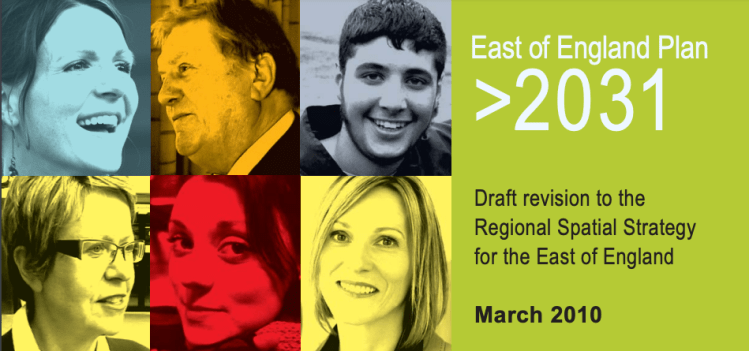
Above – Not everything needs to be in Cambridge
That above blogpost followed on from a previous one trying to make county and sub-regional links here. The principle being the market towns surrounding Cambridge including those over county borders (below right) are incorporated into a new unitary council (below centre) and are connected up by a light rail system of which Cambridge Connect would form the first part.
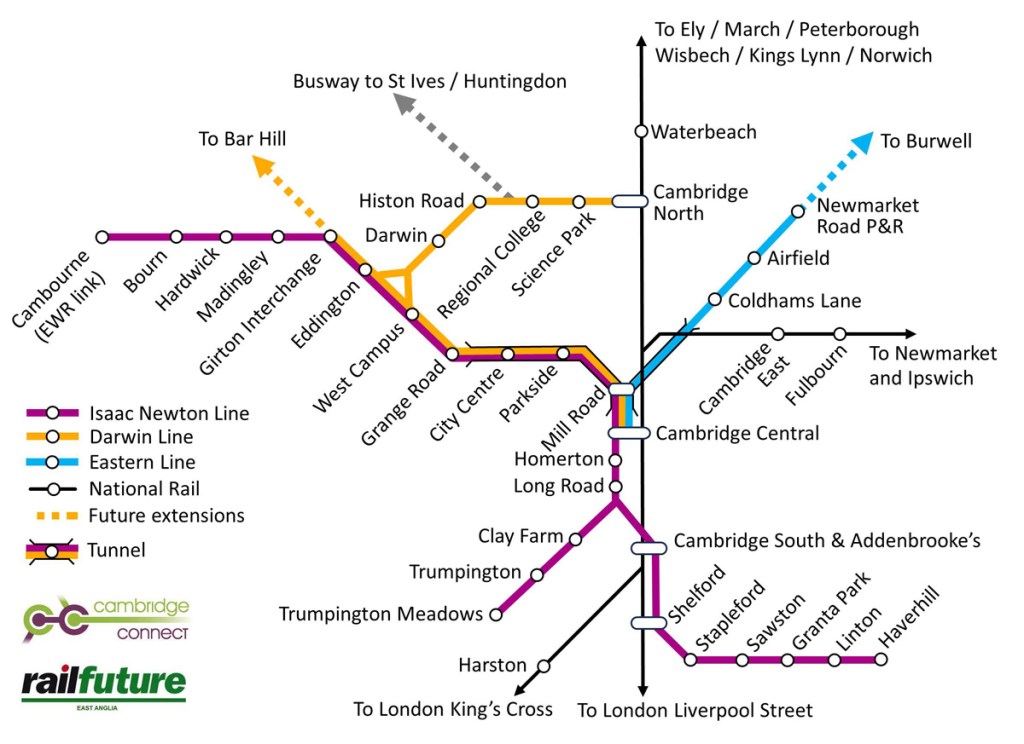


Above – this is where I tried to make the case for co-ordinating Cambridge Connect Light Rail with a unitary council that would create a public transport strategy connecting up to the market towns.
What I proposed the Regional strategy should do is to designate county towns such as Bedford and Northampton as landing points for growing firms that needed more space than Cambridge could provide. And provide Government funding for much-improved infrastructure (transport, housing, social and so on) so that relocation for growing firms can happen as smoothly as possible, enabling both Bedford and Northampton as county towns to then incorporate and mould them into their own civic culture and life rather than being dormitory towns for Cambridge overspill.
Similar also applies with Transport East – the East of England’s sub-national transport body whose remit seems to end just at the edge of Cambridge when really both it and the EEH one that Cambridge is part of, should both cover the city. It’s too big an economic magnet to be outside one or the other. One of the reasons it currently is, is because local government is so poorly funded that the councils don’t have the staffing capacity to co-ordinate both.
My case for Transport East – similar to calls from Rail Future East, is to upgrade significantly the rail network – with a particular focus on getting some of the old seaside resorts reconnected so that rail-based day trips and weekend breaks to Great Yarmouth, Hunstanton, and Lowestoft suddenly become attractive again.
The problem is I don’t think our local government institutions have the capabilities to deal with any of these things alone. It needs considered and thoughtful central government intervention – one that accounts for the chronic problems and challenges, and one that involves co-operation, co-ordination, and transparency. I.e. the opposite of the top-down imposition that seems to be coming from the present Secretary of State for Levelling Up. Hence why Cambridge and the surrounding constituencies need to debate these issues and cross-examine the candidates over them at hustings for the general election.
Food for thought?
Want to discuss the the Government’s Cambridge 2040 plans? Sign up to the Cambridge 2040 event at Cambridge Central Library on Sat 06 Jan 2024 from 11am.
If you are interested in the longer term future of Cambridge, and on what happens at the local democracy meetings where decisions are made, feel free to:
- Follow me on Twitter
- Like my Facebook page
- Consider a small donation to help fund my continued research and reporting on local democracy in and around Cambridge.

 The Cambridge Town Owl