
The Council’s has published a draft Cultural Strategy document, which will be debated on 18 January 2024 at The Guildhall – get your questions in!
You can read the report at Appendix A of item 8 here. Now, before I tear it to bits comment on it, remember that this is not the final version. The nature of these things is to scribble all over them and suggest improvements. Even if that means striking things out. Which reminds me – there are a few other consultations out at the moment:
- Cambridge City Council’s budget consultation (Closes 14 Jan)
- Cambridgeshire & Peterborough Combined Authority’s budget consultation (Closes 15 Jan)
- Cambridgeshire County Council’s budget consultation (Closes 16 Jan)
***Who has the time to read and fill out three sets of consultations?!?***
One of the reasons why the Cambs Unitaries Campaign was established – that’s three sets of consultations which means three separate organisations to be familiar with and that’s before anyone learns anything about how local government in England functions – or malfunctions as is all too often the case in this structure. It doesn’t have to be like this. Interwar Leicester published their civic affairs guide in 1939 on how their city functioned prior to subsequent governments stripping them and the sector of a host of powers and responsibilities.
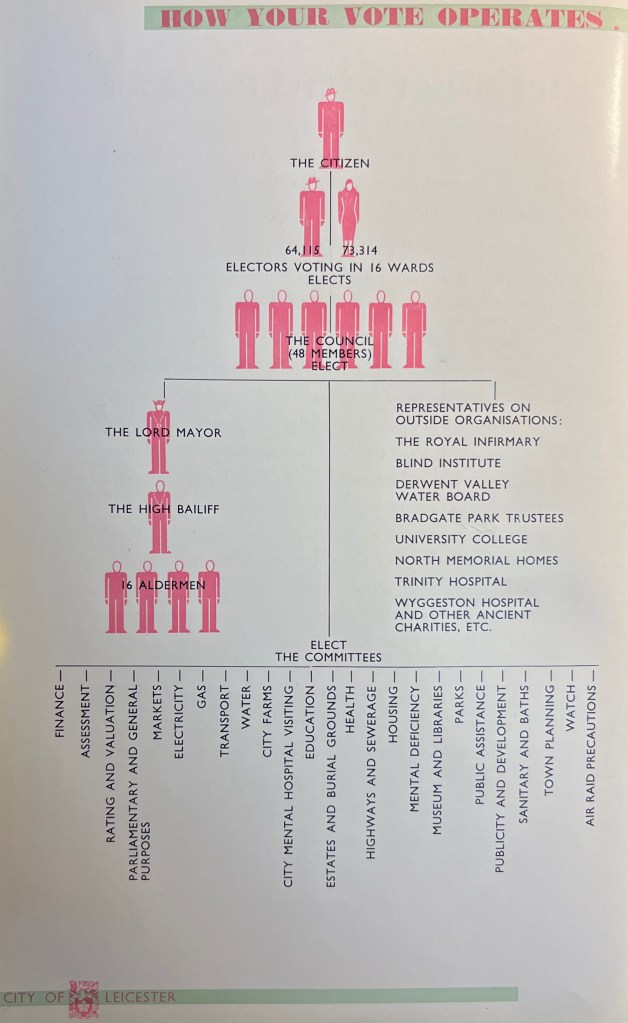
Above – the City of Leicester 1939 and the responsibilities with their own committees
“Cambridge – it’s full of culture and things what with the university and the colleges and the students and the dons and the college gardens and the punting and the tourists and…so on?!?”
According to ministers and the stereotype of the city.
Therein resides the problem: the massive imbalance of power, influence, and resources means that the civic leadership that the city council can provide is not much greater than that of a market town. Successive ministers have created problems by insisting on weak civic institutions that have to carry out ceremonial roles meeting dignitaries from foreign states who assume that the municipal authority is some big decision-making organisation when it doesn’t even have the powers to regulate traffic on its own side streets!
“You mean the city council doesn’t oversee parking tickets?”
Nope. That’s a county council function – yet with the creation of George Osborne’s combined authority few people know who is responsible for what – which creates its own non-financial costs and inefficiencies. And that is particularly the case with the City Council’s cultural strategy where they simply do not have the personnel or the resources allocated to them to produce not only a brilliant plan, but also the means to deliver it.
“So, what is the city council’s role?”
To quote them directly:
- “To be an anchor
- “To engage and empower local communities and provide a great place to live, learn, and work
- “To enhance the city’s reputation, economy and identity”
Now, all the executive councillor (with policy responsibility) is being recommended to do by officers is: ” [To] Agree the strategic principles for Creativity and Culture for all: Cambridge
City Council’s Cultural Strategy” (see item 8 the main paper here)
“Can’t see any problems with those three”
The problem is that there are two core pillars missing if the City Council is to meet those requirements: These are:
- Local history
- Lifelong learning
The other problem that it has is that it’s hard to see where the council can generate a financial return on its cultural strategy, let alone secure long term financial support from the wealth the city supposedly generates.

Above – p10 of item 8 Appendix A.
The above-mentioned ‘cultural dividends’ are all well and good but what’s the point in bothering if all that councillors and council staff are rewarded with is a requirement from ministers:
“to reduce our net spending by around £6 million in the next three financial years.
Cambridge City Council budget consultation 2024/25
“Why?”
As the council states:
“This is due to the increasing demand for our services as a result of the cost-of-living crisis and the growth of the city, which are not matched by increases in our funding from government.”
Cambridge City Council budget consultation 2024/25
Which reminds me – I need to digitise my recently-arrived copy of this:
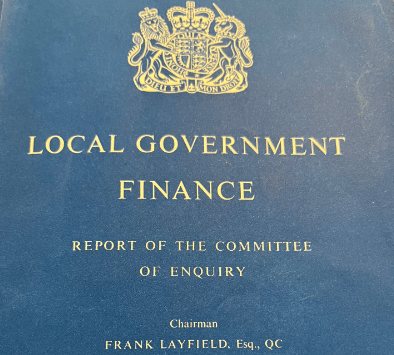
…because national politicians don’t like talking about changing how councils should be financed. It’s like the Poll Tax riots of 1990 scarred Westminster for life. For those of you who want a crash course in the detail, see this guide from the Local Government Information Unit from 1993


Above – the LGIU’s crash course in local government finance from 30 years ago.
Despite repeated recommendations to overhaul local government finances from their own MPs, ministers have repeatedly refused to do so. The present government’s response to MPs is here – make of it what you will.
“So basically the council has little money to allocate for nice things?”
That all depends on what it wants to do with very long term capital investment. Which you need the equivalent of a degree in accountancy to get your head around. That or there are no local community education providers that can show local residents how to scrutinise local council accounts. Which brings me to local history and lifelong learning. Because there’s a risk that Cambridge is about to lose ownership of a major piece of town history. Again. The Mill Road Library is being put up for sale by the County Council.
If you want it to stay in local hands, see https://millroadlibrary.com/ and/or fill in the county council’s consultation here.
What’s particularly frustrating is that it was the old Cambridge Borough Council (the city council prior to King George VI giving it city status in 1951) was the institution that paid for its construction in the first place. (See the speeches transcribed from its opening in 1897). The only reason it is in the county’s hands is because Westminster transferred the ownership of library assets from city to county under a previous restructure in the major overhauls of the 1960s & 1970s. I.e. it shouldn’t be their asset to sell off.
If you are going to be an anchor institution, what better foundation to anchor yourself to than over a thousand years of local history?
“What does ‘being an anchor’ mean?”
Let’s quote the city council again using their sub-headings
- Use of Assets & Cultural Designer
- Audit of Infrastructure
- Place Making, Development and Growth
- Public Art
- Establishment and Development of Communities
- Facilitator and Enabler (via funding)
- Advocacy and regional and civic leadership
- Civic role and ability and skill to respond to national events initiatives
- Networks, Advice, Support and Compliance
Now, with all of the above you could pick out a local history link for each of them. Use of assets? We could start by ***not losing the Mill Road Library*** given that it is one of the oldest borough-council-built buildings in our city. The Free Library around the back of the Guildhall dating from 1884 – now a restaurant – pre-dates it, and was commissioned by the same council officer: Borough Librarian John Pink.
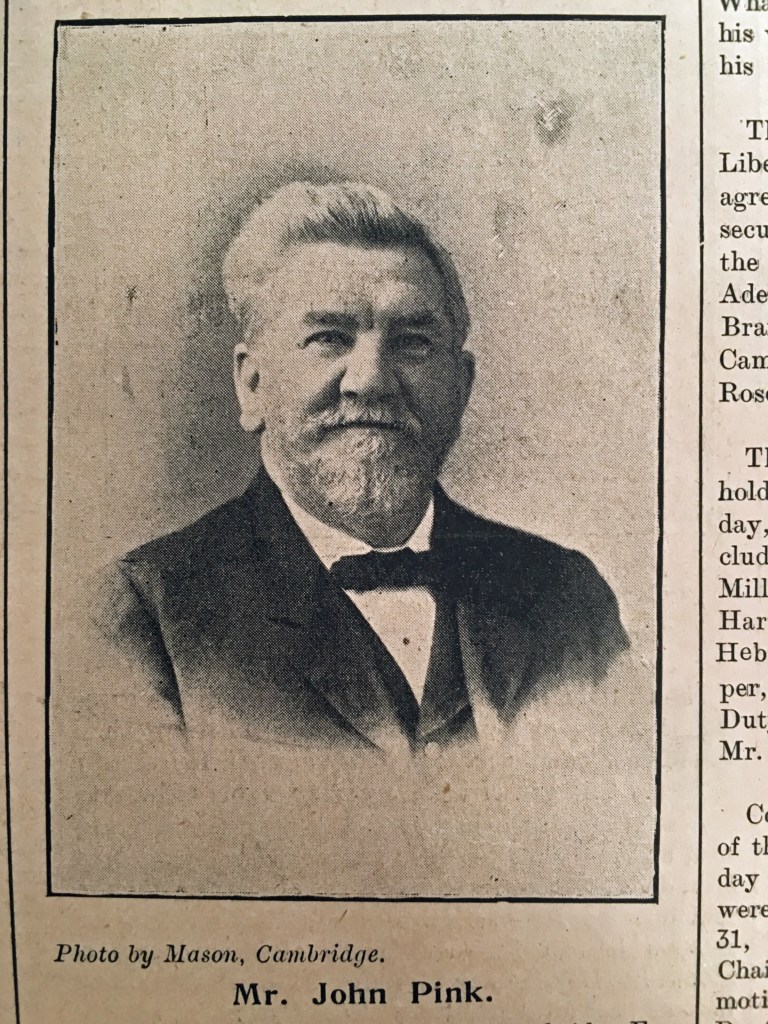
Above – happy chap Mr John Pink, the founding father of our municipal library service (From the Cambridge Graphic, 1900 in the Cambridgeshire Collection, which he founded and you can go and visit in the Central Library in Lion Yard)
Another historical town building still at risk is the old Hobson Street Cinema that the owner wants to flatten and ‘maximise the financial value of the site. What’s the point on having a cultural strategy that seeks to make use of our town’s historical assets if the city council has neither the funds (despite the wealth generated within its boundaries) nor powers to protect and enhance them? Responsibility for that resides with Ministers of the Crown past and present. With a general election coming up within the next 12 months, now is the time to ask your local political parties what changes they would make to the law to give councils more powers and resources that they could use to protect local historical buildings. https://www.writetothem.com/
On lifelong learning
You’ve seen me post repeated blogposts about a new lifelong learning centre for adults in/around Cambridge. (This being from October 2023). The institution founded to provide for young adults and later for lifelong learners, the Cambridge College of Arts and Technology (CCAT) was, like the municipal library, founded locally. Its fate? Ultimately dissolved by the swift stroke of the Secretary of State’s pen in 1989.

‘What the people maketh, the parlement can taketh away because parlement is sovereign’
Or words to that effect.
The impact was to create what is now Anglia Ruskin University as a higher education institution, and to create Cambridge Regional College which in the mid-2000s became a purely vocational provider, getting rid of its provision of A-levels. So if anyone wants to go on a course to learn how public services are provided for, and how the institutions that provide them actually function, tough. No one seems to have the vision to recreate a modern version of CCAT whose course catalogue from 1954 makes for interesting reading, and no one has the desire or means to found a lifelong learning college in Cambridge that is actually accessible by excellent public transport to people from outside as well as within the city boundaries, meets their needs, and is a place that learners ‘want to be’. Back in 1968 Derby WEA had a go at designing one such institution – have a read of their results here.
Audit of infrastructure
Back in 2014 during Puffles the Dragon Fairy’s campaign I published a manifesto for the city (inviting councillors to pick and choose the bits they liked to implement) and it included:
“A sequenced plan of action including: A community mapping exercise – where we collect information on all of the venues and facilities that are available to the community.”
Theme 7) On public buildings and public spaces
The confirmation of an audit of infrastructure – to record what city and district (i.e. South Cambridgeshire) have, as part of the joint cultural strategy delivers on the dragon’s policy.

Above: Pest. Puffles lobbying/gatecrashing local Cambridge Labour activists back in 2014 outside the old Budgen’s (now Co-op) store on Perne Road/Adkins Corner, Cambridge.
Place-making, new communities, and growth
For a city whose population has grown by 50% in my lifetime, and which has grown by a town the size of Haverhill (circa 30,000 people) in the past couple of decades, this almost goes without saying. The problem is national policy makers are very poor at evaluating their previous policies – not least because of high turnover of staff alongside every bright young graduate twenty-something (of which I was one) coming into new fields thinking they invented everything. That’s not the fault of the bright young graduate twenty-somethings – that’s the failure of institutions to provide proper inductions – in particular policy inductions for each area that new staff work on. Furthermore, the ideological prison that ministers have imposed on the public sector since Thatcher has also prevented councils from doing really basic things like building council houses. As a result, we take it for granted on how local government ‘commissions services’ from the private and voluntary sector rather than having in-house council employed staff to do the work for them.
That’s why local history matters with the communities that are created by the people who move into the new built homes. I’m not just talking about looking things up in books and archives, but also about ***making history*** and creating new traditions. Ten years ago some crazy bloke (me) put the name of Puffles the Dragon Fairy on a ballot paper for Coleridge Ward (at a time when my Twitter account of that name had thousands of non-spam followers including MPs from six different political parties, a handful of peers and dozens of councillors, and who had been named in parliamentary debates.). Ten years prior to this BBC video clip being recorded at Cherry Hinton Hall for the Old Grey Whistle Test, a local fire fighter called Ken Woollard and his wife Jean came up with the idea of having a music event in the park. Known across the folk music world, The Cambridge Folk Festival turns 60 in 2025. So part of the cultural strategy for our residential communities both at neighbourhood and urban-district level has to involve the establishment of annual events with the foundations needed for the communities to take them in whichever direction they choose. (As opposed to having someone like me saying “Here! you’re going to have an annual sporting festival and over there, you’re going to have an annual…” …and so on). Furthermore, there’s a role for the city council – and perhaps more so the University with its prestige that every firm and their contractors try to associate themselves with, to ensure long term business and corporate support for such events – similar perhaps to the long term deal that Cambridge United have secured with ground naming rights. (Something I lampooned originally!)
Above – are you simply ‘goin’ up United/The Abbey’? or are you ‘about to be immersed in the new spectator experience for the 21st century as you are indulged in the soccer sensation that only a globally-famous and historic city brand name can provide?!?‘
Separated by a common language?
It’s a useful reminder that one of the biggest burdens the voluntary and charity sector have is having to apply annually for funding. The administrative burden is huge – and for what benefit? The same goes for council funding settlements – also annual. Far better to have multi-year agreements for larger and repeated events so as to stabilise them.
The loss of the Big Weekend
Even though it has been pulled from the programme because of a lack of council funding *and* a lack of corporate sponsorship coming through, a photo was still used in the brochure – something that attracted criticism.
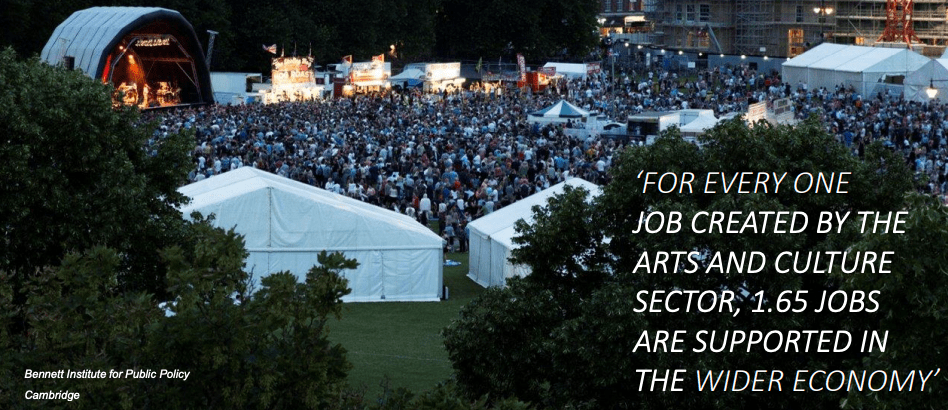
Above – p26 of item 8 Appendix A.
This leads me onto my final point about the data that the council included in Appendix B – the references and sources. This included some stark and depressing data on how unequal our city is. You’ll be familiar with things like the over-ten-year life expectancy gap between residents in Newnham Ward vs Abbey Ward.
“…a joint study between the Universities of Nottingham and Nottingham Trent…put Cambridge’s gini coefficient of income inequality at 0.41, well over the total UK figure of 0.34.
“It was also the joint-highest of the cities chosen for the analysis. Notably, amongst the most unequal cities, it was one of the most income-segregated, meaning that wealthy people and poorer people in the city live more separate lives than in comparable cities (Cauvain et al.,
2022).“This is reflected in our event attendance – the poorer North Cambridge postcodes
p4 of item 8 Appendix B.
are underrepresented in 2023 Corn Exchange bookings, while the wealthier SouthEast of the City and South Cambridgeshire villages are overrepresented.”
‘Wealthy people and poor people in Cambridge live more separate lives than in comparable cities’.
Welcome to my childhood everyone. That was my experience of 1990s Cambridge – especially at secondary school. So much so that when cultural opportunities were opened up when I got to sixth form college, I and others were simply not in a position to grab them with both hands. Exams culture you see. And yes, it still hurts. It’s one of the things that drives me today.
Note too the data on the Corn Exchange – which seems to correspond with The Junction’s postcode data – i.e. both arts & entertainment venues have a catchment area far, far larger than local government structures allow for. The analysis on the Corn Exchange data about north Cambridge residents being under-represented provides supporting evidence for what I called for back in 2020: A North Cambridge Arts Centre. Think of it as a sister venue to The Junction. Ditto the swimming pool which could have a huge positive impact on health indicators in the north of our city.
The problem is that these nice things all need money and that does not look like happening under what’s left of the present administration. The challenge for Labour and other opposition parties is whether they’ll have the courage to come up with a new settlement for local government that enables them to tax more of the wealth generated locally to spend on much-needed local infrastructure while at the same time supporting those areas whose economies unable to provide the financial base, those that have become drained by a decade and a half of broken macroeconomic policies and central government failures.
Food for thought?
If you are interested in the longer term future of Cambridge, and on what happens at the local democracy meetings where decisions are made, feel free to:
- Follow me on Twitter
- Like my Facebook page
- Consider a small donation to help fund my continued research and reporting on local democracy in and around Cambridge.

 The Cambridge Town Owl