One of the things about democracy education is ensuring we have an active civic society that knows what to look out for, when, and how to flag things up.
Basically it shouldn’t be left to a small committee of councillors or some sad schmoo like me to pick up on these things. Furthermore, if done well then a properly functioning system would result in a reduced workload for local government (or a more interesting and varied one) as well as better compliance by developers.
“Another meeting?”
Yep – and another set of papers.
Cambridge Planning and Transport Scrutiny Committee
You can read the papers for January’s meeting here. This is the meeting where the public can ask questions about local planning policy and planning systems as opposed to individual planning applications. (Although they can put points about them here too – it’s just that the council cannot respond with anything that might pre-judge an application). With this meeting publishing their AMR – Annual Monitoring Report, I’m interested in…
Community facilities, green spaces, and arts, sports, & leisure facilities

There are a few things worth picking up on:
Former Cllr Sam Davies scrutinised some definitions and found them wanting.
“The context for this part of the AMR is Policy 73 of the 2018 Local Plan, which covers a wide range of facilities under the D1 (community use) and D2 (recreation and leisure use) classes. The intention of the policy is to encourage the delivery of these in suitable locations and to protect existing facilities where possible.”
Former Cllr Sam Davies MBE – 22 Jan 2023
“That above bit? Sounds complicated and boring”
It basically means: “The council has a policy that means developers have to build nice things for the neighbourhood and for the rest of us if they want to build and make profits”
The problem as Ms Davies points out is that most people don’t know what an acre or a hectare or 100 square metres looks like, but they’re more likely to be familiar with the size of a football pitch.
“It tells us that “There has been a net increase of 3241 square metres of D1 (community use) floorspace and a net decrease of 463 square metres of D2 (recreation and leisure use) floorspace in Cambridge in the 2021-2022 monitoring year.”
Which sounds splendid. Nice big numbers of gaining stuff.
The first step is to put this in context – so let’s use that standard reference point, a football pitch, which is roughly 7100 square metres. On that basis, the city got just under half a football pitch’s worth of ‘community use’ space last year.“
Davies (2023)
Which now sound rubbish!
It gets worse.
How much of that community space was actually accessible to the public?
“The AMR then goes on to explain that over half (1770 sq m) of that D1 space came from the new award-winning library at Magdalene College. That’s very lovely for the students and staff of the college, but it’s not accessible to, or consistent with, what I suspect you or I would understand as ‘community use’.“
Davies (2023)
Which is why we can’t have nice things.
A more realistic figure net gain for the city based on *actual* public access, was according to Ms Davies, a measly 90 square metres.
***Oh F…ooglesticks! What will the net gain be for 2022-23?!?***
Let’s have a look:
“In the 2022-2023 monitoring year, there has been a net increase of 39,500 square metres of D1 (community use) floorspace and a net increase of 1,570 square metres of D2 (recreation and leisure use) floorspace in Cambridge. The significant increase in D1 floorspace is largely due to the development of academic facilities (that also fall with the D1 use class), and includes 35,200 square metres of academic floorspace to accommodate the relocation of the Cavendish Laboratory as part of the University of Cambridge West Cambridge development (17/1799/FUL)”
AMR Para 3.77 p50
The University of Cambridge West Cambridge development is hardly the place most residents are going to be heading towards for community and leisure purposes. That part of town is one of the least accessible for town people because exactly as Holford and Wright designed back in the late 1940s, the west of Cambridge was designated as an expansion area for the University of Cambridge. Next year is that report’s 75 anniversary. (Holford and Wright party anyone?)
The AMR report also says:
“However, the figures do also include the redevelopment of the Meadows Community Centre (19/1756/FUL) and new community facilities as part of Darwin Green (15/1670/REM) and at the Timber Works scheme at Cromwell Road (19/0288/FUL). There remain significant commitments, particularly for D1 uses, in the pipeline.”
On the Cromwell Road development, the nursery has opened and they have an open day on 03 Feb 2024 – see their website here for details. Their address isn’t on “Clara Rackham Street” by accident. The fruits of local historical research that!

Cllr Clara Rackham (Labour – Romsey) circa 1925 – we got a new road and residential area named after her.
As for Darwin Green, the public art strategy has a dazzling front cover.
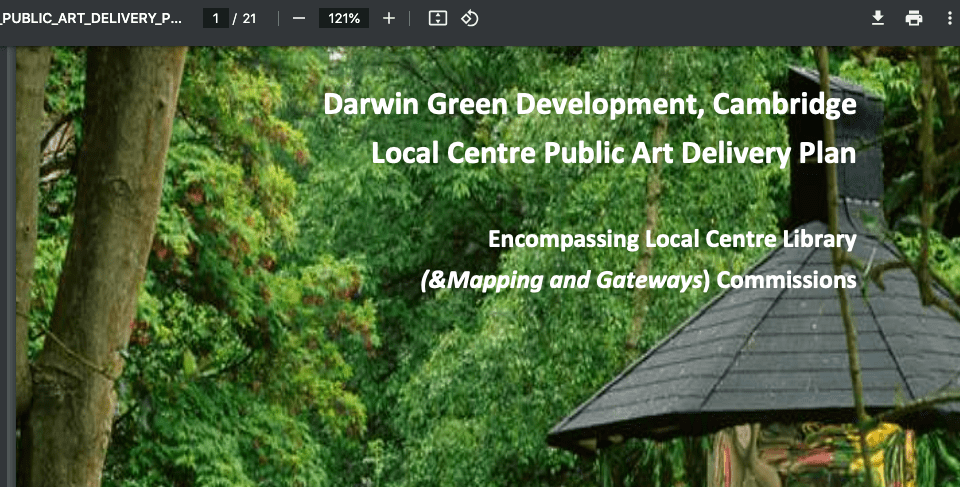
Above – the Public Art Delivery Plan from the planning application Ref 15/1670/COND15
“This thing better look like a lush tropical rain forest like on the TV adverts when it’s done or there’ll be trouble!!!”
Sadly not – it was written in March 2016 and since then we’ve had the EU Referendum and the lockdowns so you might get a square box. If you’re lucky. And if you’re really good it will be grey.
“No really, what does it look like?”

Above. ***What the F–k is that?!?!***
It gets better. This is what they’ve got for the school!


Above. ***That’s even worse!!!***
Wait till you see the library!

Above: ***What the actual F–K?!?! No! Get the kids from the Clara Rackham Street nursery to do something instead! They’ve got more imagination and will come up with a better design at a lower cost – let them spend the rest on play equipment or a big dragon slide!***
I’ve moaned about Cambridge’s woeful public art before.
“Do we have to look at the rest of the report? It’s nearly 1am!”
Yes. For we have no life.
“The Open Space and Recreation Strategy was published by Cambridge City Council in October 2011.”
AMR p48
Which means it’s due for an update.
“The Greater Cambridge Playing Pitch Strategy 2015-2031 and Cambridge and South Cambridgeshire Indoor Sports Facility Strategy 2015-2031 were both published in 2016”
AMR p49
So I’ve thrown a PQ at the Committee asking for a progress update on the swimming pool that the University of Cambridge has planning permission for on its west Cambridge site, and have asked the Council what advice it has for Cambridge University students to persuade their University to prioritise its construction. Because we have a problem with our pools.
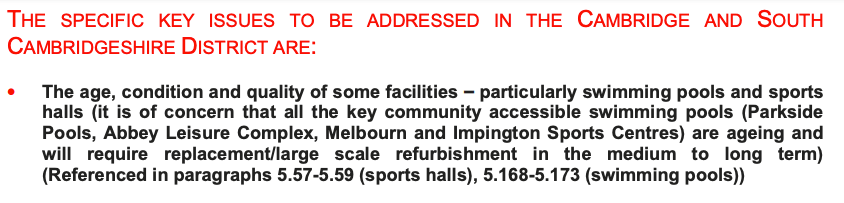
Above – p10 Cambridge/SCambs Indoor Sports Facilities Strategy <<– Don’t click here unless you want to download a 494-page document!!!!
City-wide and sub-region-wide facilities
“New City-wide or sub-regional facilities are also supported subject to there being a need for the facilities and them being in a suitable location, in accordance with the sequential test as set out in the NPPF. The loss of community and leisure facilities will be resisted unless the facilities can be replaced within a new development or relocated at least at their existing scale, range, quality and accessibility”
AMR Para 3.77 p50
Above – I maintain the strong case for a new large concert hall for the city, and one for north Cambridge too.
This is because I’ve joined up the dots between the AMR and the Cultural Strategy draft published for next week’s Environment & Community Scrutiny Committee. (I’m that sad).
““It was also the joint-highest of the cities chosen for the analysis. Notably, amongst the most unequal cities, it was one of the most income-segregated, meaning that wealthy people and poorer people in the city live more separate lives than in comparable cities (Cauvain et al., 2022).
“This [inequality] is reflected in our event attendance – the poorer North Cambridge postcodes are underrepresented in 2023 Corn Exchange bookings, while the wealthier SouthEast of the City and South Cambridgeshire villages are overrepresented.”“
CamCitCo ECSC – Item 8 Appendix B p4
Our income inequality is so high that our communities are living separate lives side-by-side. But then that’s how it was in my childhood and there are enough people within the University of Cambridge who are quite happy to keep it that way judging by the chronic inequality that still persists in our city. That or they are not motivated nearly enough to carry out the radical changes they need in order to deal with it. Note also the postcode data speaks volumes too.
The case for both a new large concert hall *and* a North Cambridge Arts Centre
It’s the postcode data that justifies why I think we should build both the arts centre for North Cambridge, and a new large concert hall for at least 3,000 people – see Cambridge City Council’s Architect Gordon Logie in with his assessment in the 1960s here. In the grand scheme of things they are serving different audiences. The North Cambridge Arts Centre is effectively a sister institution to The Junction – just somewhere that children/teenagers in the north of the city can walk or cycle to safely, while the new large concert hall is effectively a sub-national venue pulling in potential customers from London by train. (Also the Levelling Up Secretary mentioned museums and concert halls plural!)
“What’s happened with the old police station – the one supposedly becoming a hotel?”
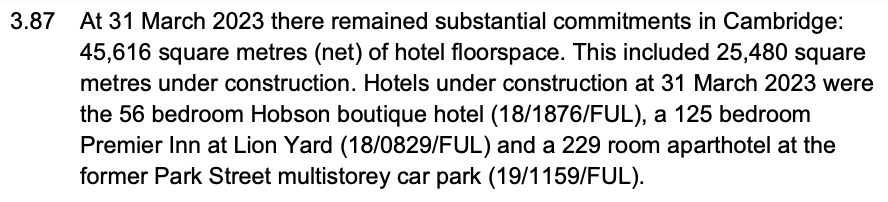
It looks like the developer is in some sort of financial difficulty with the investment firm that stumped up the cash. Understandable given the jump in construction costs and Liz Truss’s disastrous tenure as PM that led to markets panicking and interest rates jumping.
Transport monitoring
The report covers this from p57.
But…there’s nothing new in there that you didn’t already know – it just lists the things that are already in existence.
Scrolling through the list of things
This is where we get to risk assessments against the local plan policies. Start scrolling from p62. RAG = Red, Amber, Green. If it’s red, there be trouble!

Above – a snapshot of the table
Beyond the risks, there is some very interesting time-series data on a host of indicators. Start from p173 of the pdf which is Appendix 2 – tables and charts

Above – this is general election stuff: Why, under the Conservatives has the house-price to earnings ratio risen so much? What will Labour or the Liberal Democrats do differently if elected?

Above – affordable home completions – what accounts for the differences?
Earlier on I noted Ms Davies’ concerns about community space. This from p269 (A2.97 – table 93) needs disaggregating. Because I have a hunch that there are some nasty surprises hidden inside that aggregation.
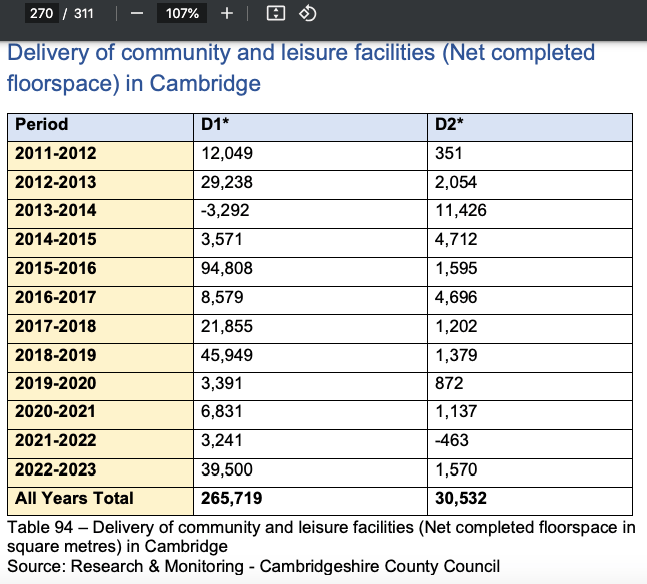
Above – has Cambridge ***really*** constructed over 265,000ms^2 of community and leisure floorspace since 2011?
Note the definitions too:
*D1 uses (Non-residential institutions) include clinics, health centres, crèches, day
nurseries, day centres, schools, art galleries (other than for sale or hire), museums,
libraries, halls, places of worship, church halls, law court. Non-residential education
and training centres.
*D2 uses (Assembly and leisure) include cinemas, music and concert halls, bingo
and dance halls (but not night clubs), swimming baths, skating rinks, gymnasiums or
area for indoor or outdoor sports and recreations (except for motor sports, or where
firearms are used).”
Also, ministers scrapped the definitions with a catch-all ‘sui generis’ – someone will need to explain to me why this was done and in whose interest.
As you can see, the definition is so wide-ranging that to the general public it’s meaningless.
The same goes for Section 106 funding

This reminds me of one particularly controversial application by the Cambridge Station developers which Ms Davies, long before she became a councillor, spoke out on here way back in 2017.
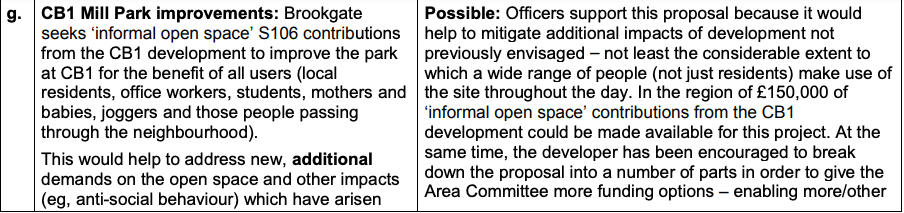
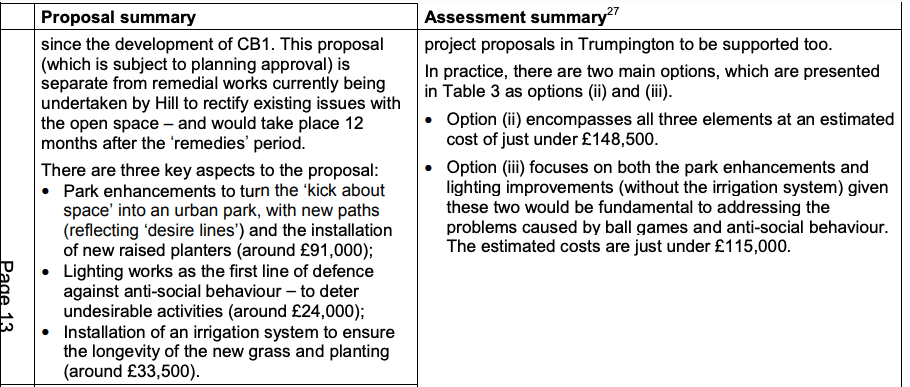
Above – from Mon 24 April 2017
The objection was a big rich developer (you can browse through their accounts here) applying for S106 money that’s supposed to be for community use, to pay for the negative consequences of their own original poor designs. As former Mayor of Cambridge Cllr Rob Dryden (Lab – Cherry Hinton) said in response: “They shouldn’t be allowed to do that”
So…I hope that gives some idea of the things to look for and also the things that really need further digging into. Oh – and I haven’t given up on the possibility of a swimming pool for North Cambridge either.
If you are interested in the longer term future of Cambridge, and on what happens at the local democracy meetings where decisions are made, feel free to:
- Follow me on Twitter
- Like my Facebook page
- Consider a small donation to help fund my continued research and reporting on local democracy in and around Cambridge.
 The Cambridge Town Owl