
If you are a child of the 1980s/1990s, time to read up in before the general election campaigns start!
TL/DR? Have a browse through some of the 21st Century books on Citizenship here – it’ll give you a crash course on the essentials of politics in the UK. Want a cheap paper copy that pre-dates Brexit so covers the EU and the rights we lost? Click here.
The book is called You and The State (digitised here) and one of the people involved in creating it was Ralph Miliband, the left-wing intellectual and tabloid newspaper hate-figure because of who his sons were. (Labour Cabinet Ministers David and Ed Miliband).

Above – You and The State (1949) by Furth and Morison
I think one reason why I found it so interesting (so did someone else – who is borrowing my copy!) is that when I started school, the Tories were halfway through dismantling what we used to know as the Welfare State – something that really came into being around the time this book was being written. Therefore from a Political perspective, the governments of the 1980s and 1990s didn’t really have much of a use for a book like this – it went against so many of their ideological dispositions. The problem was they never replaced the citizenship and civics books with anything. The result was that too many in my generation were not educated about things that are central pillars in a democratic society such as:
- The rule of law (despite the saying: ‘Ignorance of The Law is no excuse!’)
- How our political institutions function – and our place in our democracy
I come back to the point made by Cambridge Headteacher Ryan Kelsall made at the Form the Future conference in December 2023 on how school, college, and university taught him so little about life in the real world. This was – and is a big deal to me not just because he’s an expert in his field, but because between the ages of 5-18 our lives shadowed each others in the same classes in the same educational institutions. Therefore it’s not just me that has issues with ‘being educated to be ignorant’ under the Thatcher and Major governments. Others that I’ve become reacquainted with after I left the civil service in 2011 who I was at school with in the previous Millennium said similar.
Ignorance of the law: *I took him home and gave a good thrashing!*
I wouldn’t recommend such a course of action – certainly not today as chances are you’d get prosecuted! But in this Scottish book on Brighter Citizens from 1947, ‘damn good thrashings’ were recommended responses from parents according to this book!
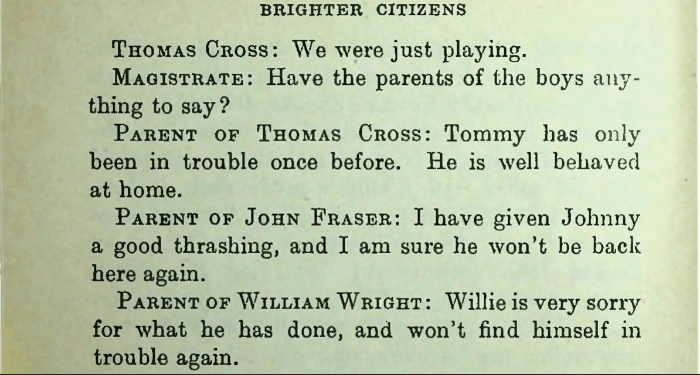
Above – Brighter Citizens (1947) John Cormack – p82
What’s particularly interesting about the Brighter Citizens book is the tone – one that starts from the contents page. Imagine Scottish non-conformist preacher with a booming voice reading out the contents below:

Above – Brighter Citizens (1947) p3
For sections I and III it’s like both are statements with no room for negotiation or discussion.
“We are a debating society!”
*Debating society? I thought we were a school and that was why we have to go to lessons?!*
**You’re deluding yourselves – we’re living in a brutal autocracy where dissent is not allowed and class attendance is a non-negotiable. As is national service!**
(I think what the book means is that the UK as a whole society is one where people are free to hold opinions – and must accept that those opinions can be challenged by others who have different views…As opposed to the country being the Oxford Union!)
The presence of drama scripts in the Scottish text book are particularly interesting – simply because it means that the children can act out those scenes in their lessons, making things that little bit less boring. (Although that depends on the teachers and the quality of the build environment of the school – the late 20th Century being famous for mobile classrooms becoming semi-permanent teaching rooms!)
“Why wouldn’t Margaret Thatcher’s Government have liked the book You and The State?”
The opening page’s title: “From Cradle to Grave” spells it out. Hers was a government that wanted to scale back the role of the state as a provider of public services alongside the transfer of economic activities then in the state sector which her and her ministers viewed as being ones that should be in a competitive market. It was her government that started the process on a very large scale. One of the most high profile former state industries currently in the news is Royal Mail – one of the last to be privatised as recently as the 2010s as the Commons Library summarised here.

Above: You and The State (1949) p2
“What’s a youth centre?”
I’ve lost count of the number of social-policy-related media shows that have someone calling for the return of council-run and council-funded youth centres. The mindset of ministers in the 1980s and 1990s was that such things should be run by the voluntary sector and charities. That’s what church-linked uniformed societies were supposed to be there for. One group that was founded in response/opposition to the ‘militaristic’ nature of institutions like the Scouting movement was the Woodcraft Folk – which celebrates its centenary in 2025.
I’ve digitised a series of early/mid 20thC civics and citizenship books here as they make for interesting comparisons with what much of my generation completely missed out on – I had graduated by the time schools and colleges were bringing in anything to do with citizenship education. Which is why I think a new generation of adult education colleges and lifelong learning centres (as recommended by the Commons Education Select Committee in 2020) is ever so important – and not just for the need to re-skill our economy and society to face the climate emergency. The problem is that while the main UK institution for lifelong learning is so vocational-focused (‘Learn Work UK‘ sort of gives it away!), we’ll miss out on the much wider learning opportunities that our communities need and want. Furthermore, some will actually save money in the longer term. For example educating people on the importance of public health (See what Cambridge was like in 1968 here)
Above – it’s not just about healthy lifestyles but also educating people about the symptoms of medical emergencies. Where are the places that people can go to that offers more than ‘ad hoc’ advice?
The same goes for home improvements – whether empowering residents living in rented accommodation to providing the practical skills training in DIY for home owners untrained in/unfamiliar with practical improvements so that they stay safe when making improvements. (Hence I like the concept of the courses Cambridge Regional College has here which is an opening to more extensive skills learning. But how many people know it exists, and how accessible is it transport-wise for those of us living on the other side of the city? Thus the need for neighbourhood/urban district level provision) Note one of the other contexts here is the need to retrofit entire villages, towns and cities in the face of the climate emergency. How much can be done by people themselves, and how much can only be done through state intervention?
This is why adult education & lifelong learning are so important in democracy education – especially for those of us denied access to it when we were at school.
Food for thought?
For those of you interested in community organising, CitizensUK is running a training session on 29 January 2024 at St Paul’s Church on Hills Road – see here for details.
I’ve also got my first Great Cambridge Crash Course intro session happening online – with more to follow. See my workshops page here.
If you are interested in the longer term future of Cambridge, and on what happens at the local democracy meetings where decisions are made, feel free to:
- Follow me on Twitter
- Like my Facebook page
- Consider a small donation to help fund my continued research and reporting on local democracy in and around Cambridge.

 The Cambridge Town Owl