
See the details here – do you know any local groups in your area who could organise similar debates, whether on specific local issues or on a wider range of things?
See the meeting details here – do let the organisers know if you are going!
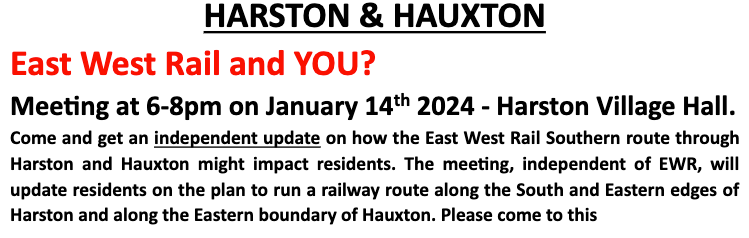
Above – Harston Village Hall’s website is here
The debate will be on East West Rail’s Bedford-Cambridge route which as you may recall, The Chancellor of the Exchequer confirmed the Government’s support for a southern entry route into Cambridge in his Autumn Statement 2023. A number of residents living close to the proposed route have opposed the proposals and have formed the Cambridge Approaches Campaign. They will be represented on the panel alongside two confirmed parliamentary candidates for the general election, Pippa Heylings for the Liberal Democrats, and Chris Carter-Chapman for the Conservatives – who will both be contesting the new South Cambridgeshire constituency that now includes the Cambridge City Council ward of Cherry Hinton, alongside Queen Edith’s. You can also read the latest from the campaign group Rail Future East on their campaigns for improved rail connections which include East West Rail. Rail Future East’s main website is here. Any questions or comments, please put to the candidates standing for election, or to your local councillors and MP via https://www.writetothem.com/
Hey! You can organise public debates too!
Or you can ask an existing community or campaign group if they are interested (see Resilience Web Cambridge here for some existing groups). Only political parties can’t really do it themselves. And if you’re short of ideas on what to discuss, see the list of book titles from Great Shelford-based Independence Educational Publications here as each book provides photocopiable materials that groups can use if you don’t want to have the ‘BBC Question Time’ format.
Above: “Hey! I gotta great idea!” Donkey from Shrek (voiced by Eddie Murphy)
The Queen Edith’s Community Forum’s annual election debates.
Chris Rand wrote a guide on how to organise one back in 2016 having got the hang of the job of chairing them – something he’s continued with ever since..
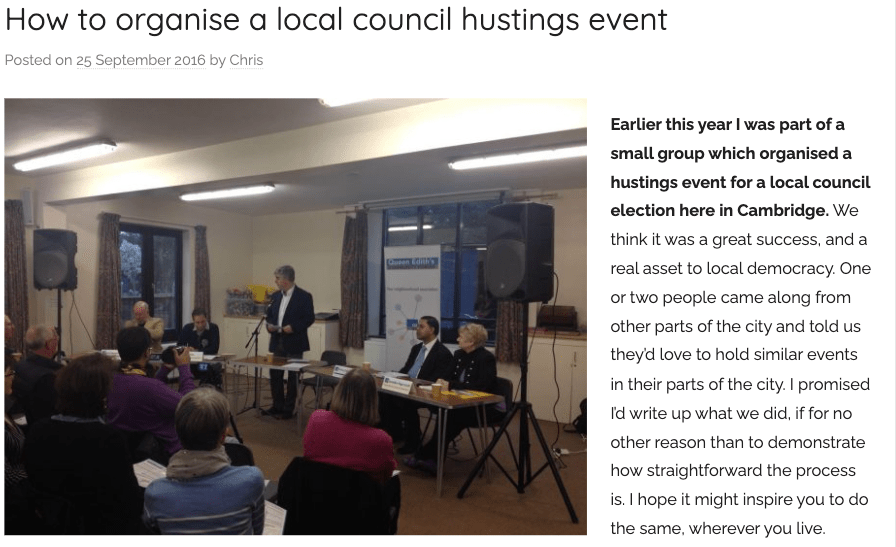
Above – a guide on how to organise a hustings/debate by Chris Rand.
Venues – Cambridge Carbon Footprint’s Circular Economy guide has a list of suggestions

Above – See Circular Economy’s links here and click on the one that says ‘Find the best venue’.
For those of you who want to start small, the cheapest venues to book aside from any free rooms that cafes may have, are in local branch libraries (See Cambridgeshire Libraries rooms here) where you can book a room for as little as £14 for a couple of hours.
If you want group discussions rather than audience vs panel interrogations…
When large numbers of people turn up to a discussion event, I often find it sad that there’s little interaction between the audience when faced with a BBC Question Time-style format. Hence why I like the concept of having such gatherings in two halves – the first where (as with the Queen Edith’s hustings 2023 videos here) the speakers respond to pre-submitted questions without interruption, and then a second half where the audience separates into multiple groups and each of the candidates gets cross-examined by each small group for around 15 minutes each. Groups can self-select either on a specific issue (eg East West Rail), theme (public services for young people) geographical areas, or simply who individuals prefer to be with.
Some people may want the chance to explore a topic without the party political spin. As I’ve mentioned in past posts, during WWII a number of such guides were published to facilitate debate on what a post-war UK might be like.

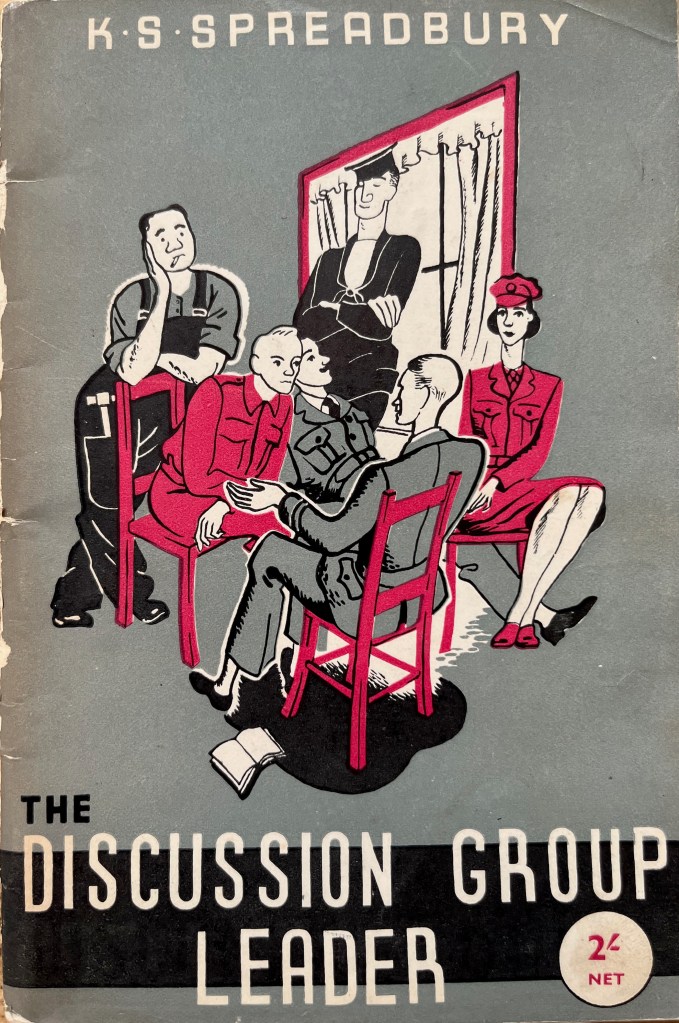
Above – examples of discussion guides
You can read the digitised versions as follows:
- People and politics (1943)
- The discussion group leader (1944)
Informal social reading groups
One of the things I want to try out when it warms up/from April 2024 are informal reading groups. I have no idea whether it will work, but the idea is to book a neighbourhood community hall with the essential facilities, bring along a box full of pamphlets and not-too-heavy-reading publications (ones that could include guides to local public services, or consultations), and invite people to pop in and read, have a cuppa, have a quiet chat.
They could be done on weekend afternoons, weekday evenings – something that doesn’t involve a long journey in the cold, and is also an alternative to spending the evening in front of the telly or doom-scrolling on social media. One of the most local-to-me venues on the Coleridge/Queen Edith’s border is the original New Cherry Hinton Free Church Hall (now part of St Athanasios) – which at various points the city council provided building improvement grants to in return for community access. Only there don’t seem to be nearly enough community groups aware that it’s available at a discounted rate.
The point being that it has to be low cost, low resource, low burdens on the organisers – something that a couple of people at most can make happen while at the same time knowing there is a critical mass of people who will also be there to support in case of problems.
Start the conversations with each other now
…so that when the general election is called, there’s less to do for organising public debates. In the meantime, while it is still cold, I’ve got a new set of online events for the Great Cambridge Crash Course coming up in the next few weeks – see https://cambridgetownowl.com/workshops/ and with huge thanks to the half-dozen of you who have already signed up to what will be the first online session on Wed 17 Jan 2024, the introduction to how Cambridge (The town) got to here!
If you are interested in the longer term future of Cambridge, and on what happens at the local democracy meetings where decisions are made, feel free to:
- Follow me on Twitter
- Like my Facebook page
- Consider a small donation to help fund my continued research and reporting on local democracy in and around Cambridge.
 The Cambridge Town Owl