Despite the withheld papers for the meeting on 29 January 2024, the published items reveal just how badly broken our governance structure is, and why the next government has to overhaul them if Cambridge (however you choose to define it) is to get the public infrastructure that cities need in order to function properly.
This follows on from my previous post about the proposed civic quarter here.
My PQ which I tabled for the previous Strategy and Resources Meeting was put back to the meeting now coming up. It reads:
“Back in 2022 I wrote a blogpost with some thoughts on how the guildhall could be revamped at https://cambridgetownowl.com/2022/10/16/revamp-cambridges-guildhall-in-time-for-florence-ada-keynes-mayoral-centenary-1932-2032/ which included lifting the existing council chamber up a level to create space for a state-of-the-art lecture hall for the conferencing industry, creating a rooftop cafe, and revamping the facade of the guildhall in time for Florence Ada Keynes’ mayoral centenary.
Furthermore, over the years I have also suggested converting the Corn Exchange to enable both a top floor open space as well as either start-up space or an indoor market in return for building a new concert hall opposite the Catholic Church, part-financed by the University as Sir Ivor Jennings QC, the former Vice Chancellor, committed the University to doing on 31 May 1962 (see https://lostcambridge.wordpress.com/2021/10/06/vice-chancellor-sir-ivor-jennings-qc-says-cambridge-university-has-a-duty-to-improve-the-city-and-says-university-will-contribute-50-of-the-cost-of-a-new-large-public-hall-1962/)
In commissioning RIBA to undertake a design competition, please could the council ensure that the parameters take into account the proposals that I’ve put forward so we don’t end up with a design that was as unpopular as the present guildhall’s design was back in the 1930s – see here https://lostcambridge.wordpress.com/2017/08/29/florence-ada-keynes-gets-it-in-the-neck-from-cambridge-over-new-guildhall-designs/
Thank you”
Now, of course I don’t expect anyone to take my pie-in-the-sky ideas seriously. I’m only doing it because a former local resident told me to do so back in the Year 2000.
Above: Dare to dream – John Farnham and former Queen Edith’s resident the late Dame Olivia Newton-John at the Sydney 2000 Olympics.
Having been at the talk by Prof Mary Joannou on Cllr Clara Rackham at the Museum of Cambridge earlier, I was reminded of Clara’s influence on the old Cambridgeshire County Council’s education committee – the committee that selected and approved the appointment of Olivia’s father, Brinley Newton-John as the Headmaster of the County High School for Boys – today’s Hills Road Sixth Form College. Given the number of concerts the latter sang in (he was a prominent baritone/bass vocalist in and around Cambridge) across city and district. If you want an example of breaking town-gown barriers, both Clara Rackham and Brinley Newton-John provided numerous examples of how to do this. Cambridge University’s Musical Society performing Handel’s Solomon on a shoestring budget due to continued post-war austerity, at Cambridge’s Guildhall (the large hall of 1862) with an orchestra of over 50 musicians and a chorus of over 100.
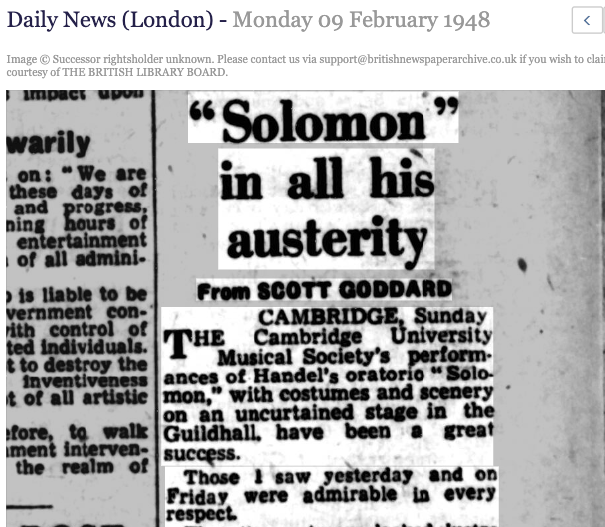
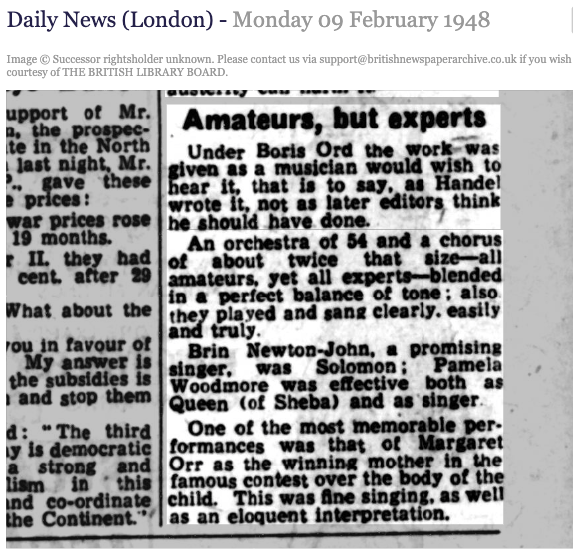
Above – The London Daily News 09 Feb 1948 in the British Newspaper Archive
An impressive review given how awful the acoustics are in the large hall of the guildhall!
Once the archive has digitised Cambridge’s local newspapers of the 1940s & 1950s chances are we will find the evidence of Clara Rackham and Brinley Newton-John being acquainted in person. As headmaster of one of the largest state-funded secondary schools in the county I’d be astonished if they were not given that Clara was the Chair of the Education Committee responsible for scrutinising their finances and voting through their budgets!
As far as naming new things goes, if there’s any large community arts centre being built for the new large developments in and around Cambridge, naming one of them after Brinley Newton-John would be a reasonable call given the work he put in over the decade or so he was in Cambridge during his lifetime that went far beyond what his day job or studies required. Furthermore, his example I hope would inspire others. And that’s before we even look at the record (and records) of his much more famous daughter.
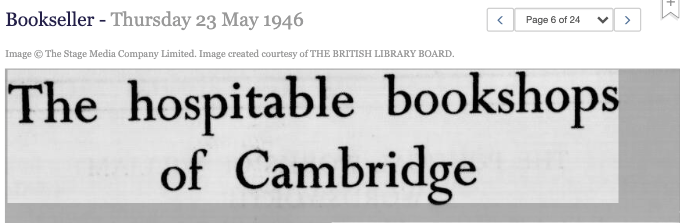
Above – Brinley Newton John was a guest of honour at the Regional Association of Bookseller’s conference dinner in Cambridge alongside the first Labour MP for Cambridge, Major Arthur Leslie Symonds, and Mayor Lady Alice Bragg, the Mayor who welcomed back the Cambridgeshire Regiment from the horrors of WW2 imprisonment in the Far East.
“All of that is still not going to get you the revamped guildhall!”
If we look at the Civic Quarter Paper we find the list of appendices – the titles of which indicate the various reasons why they are confidential. I think it’s mainly because any work will involve a large amount of public procurement or even (in the case of Mandela House – built by former councillor Herbert Robinson as a motor showroom) the sale of property assets.
- 12.1 Cartwright Pickard – Proof of Concept Study – Appendix A (Confidential)
- 12.2 CIP – Mandela House redevelopment feasibility study – Appendix B (Confidential)
- 12.3 Calford Seaden – Cost Plan and Procurement note – Appendix C (Confidential)
- 12.4 Appraisal and NPV calculations – Appendix D (Confidential)
- 12.5 LDA Design – Market Square Improvements – Appendix E
- 12.6 PRP Building Condition Survey, Corn Exchange – Appendix F (Confidential)
“They’re going to sell Mandela house?”
I hope not – but I can understand why they are commissioning the feasibility studies now.
The fact that Cambridge City Council has to consider selling one of its main offices in order to balance the books shows the contempt the Conservative Party in Westminster views local government as a whole.
Furthermore, if I was an election candidate for the local elections 2024 with a view to turning up at a public debate with voters and opposing candidates, I’d be reading up on what the Tories had done in government and be preparing to political rinse their candidate over their party’s failure to sort out local government financing and failing to provide the city council with the powers to tax the wealth being generated in Cambridge. Private Wealth, Public Squalor.
“Yeah that’s great – can we have our fountain back?”
You mean this one?
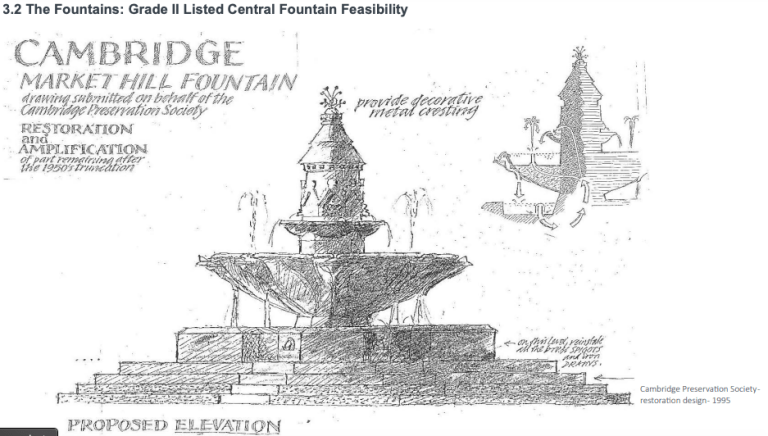
Above – the familiar text of Jon Harris’s illustrated proposal from 1995 which was brought back to prominence in the 2021 report that I wrote about here. You can view the full report via the meeting papers from 2021 here, and clicking on item 5 – the massive 28MB file which indicates it has *lots of pictures in it*. (The mercifully shorter version is at Appendix E in the Jan 2024 papers) Not surprisingly, the state of council finances means progress has been slow.
Last month, the Local Government Association which represents councils of all party political makeups, stated the following:
“Almost one in five council leaders and chief executives in England surveyed by the Local Government Association think it is very or fairly likely that their chief finance officer will need to issue a Section 114 notice this year or next due to a lack of funding to keep key services running.”
LGA 06 Dec 2023
“What is a Section 114 Notice?”
It’s often reported as a council going ‘bankrupt’ but because they cannot go bankrupt in the way private citizens can, it basically means that in the view of the Council’s chief finance officer, the council cannot balance the books – i.e. its spending is greater than the money coming in for a financial year. Which is prohibited under Local Government Finance Act 1988 (See S114 under Part VIII of the LGFA 1988 here). Note this was the piece of legislation that brought in the much-hated and quickly disposed of Poll Tax – or Community Charge.
Basically the whole system is broken and while local government institutions in and around Cambridge are banned from taxing the wealth being generated here, we cannot have nice things in Cambridge that we need in order to function as a city, let alone meet the huge potential that we have. (That doesn’t mean covering everything in concrete and building glass and steel towers everywhere. As one council officer said at the Environment and Community Scrutiny Committee, we have more work to do on what counts as success. And cumulative weight of reinforced concrete isn’t a sound metric).
Timeline of the Civic Quarter Project Planning Work
See Page 14 of the Civic Quarter Project for the full timeline
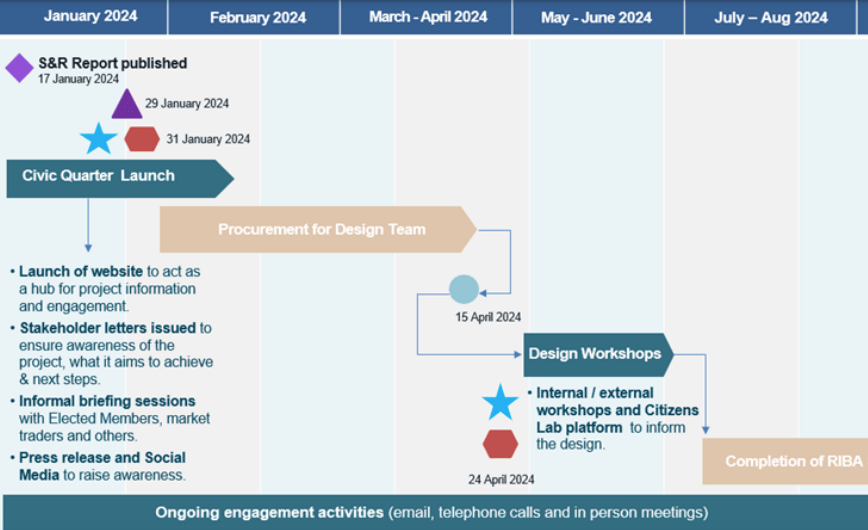
Above – detail from p14 of S&R papers for 29 Jan 2024
“It says there was a press release”
I think this is it, which Alex Spencer wrote about in the Cambridge Independent here.
“The sale of Mandela House is expected to fetch £16m and the predicted cost of the Guildhall refurbishment projects is £35m, which will be funded by the sale plus £20m of city council reserves that would also go towards the market and Corn Exchange.”
Alex Spencer – Cambridge Independent, 18 Jan 2024

Above – who the council thinks will be involved – item 7 p15
Risk Register – “Risk Management is not an item – it’s a function”
Below – from P17 of item 7 on the Civic Quarter
I’m assuming it’s a mistake because ‘Risk Management’ alone is not something you’d normally see in such a register *unless* you were seriously concerned about your organisation’s ability to risk-manage such a large project.
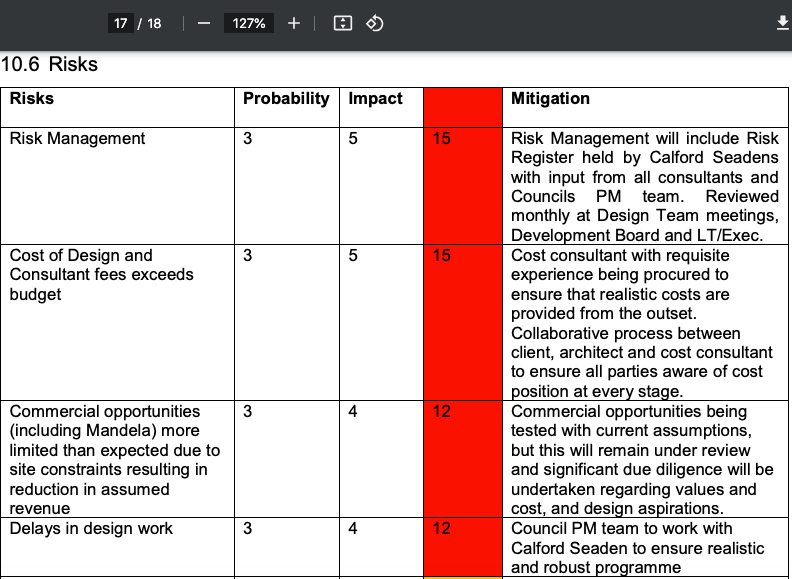
Above – there are a few more rows in the table but there are a host of other things I’d expect to see in an emerging risk register, as well as something along the lines of the sorts of things that could go catastrophically wrong with such a project.
Given the massive impact that this project will have, I’m not entirely sure what the benefit of publishing that part of the paper was other than to demonstrate that the serious work of risk management is yet to start. And that involves a basic policy risk assessment: How could this policy – the creation of a new Civic Quarter (which in principle I quite like) possibly go wrong?
We know this because Puffles stung a Cabinet Minister to make the point a decade ago. (Watch the video here!)
The flustered minister (Francis Maude MP) struggled to come up with responses both at that session, and in the written correspondence that followed. Hence the Committee concluded:
“All policy making carries risks: a lack of appetite for participation, disappointment arising from unrealistic expectations and the dominance of vested interests. Government must frankly assess and address these risks in relation to open policy making.”
Public Engagement in Policy Making – 03 June 2013, House of Commons Public Administration Committee

Above – Public Administration Committee Minutes – Wednesday 28 November 2012 – Scroll down to Q231.
The Minister Frances Maude did not think there were any risks with his proposals to outsource some civil service policy-making to the private sector.
Given where we are in the national political cycle, I think the City Council should consider some flexibility in their timelines (and make contingencies for them) if only to respond to a possible change of government following the general election in the next 11 months.
Furthermore, I also think there should be options for more elaborate, decorative civic quarter proposals that could be put to the city to see if there is any appetite for fundraising that the new proposed hospitals seem to be quite successful at so far. Does the City Council have to be restricted to austerity-level minimal and minimalist projects or can we all work together and demonstrate that our city is capable of building something that is greater than the sum of our parts?
Food for thought?
If you are interested in the longer term future of Cambridge, and on what happens at the local democracy meetings where decisions are made, feel free to:
- Follow me on Twitter
- Like my Facebook page
- Consider a small subscription to help fund my continued research and reporting on local democracy in and around Cambridge.
 The Cambridge Town Owl