You can view the strategy here, and send your views in here
I can’t write too much on this because I’m still brain-fogged up after CamCycle’s AGM (you can read the 2023 annual report here which covers things like actions achieved, income, and expenditure as is required by charity law)
The housing strategy email (see the service here) I got states:
“The draft strategy is not just about new homes. It is also about our approach to improving conditions, affordability and sustainability for people living in existing homes, supporting health and wellbeing, and enabling people to live settled lives.
“It is aimed mainly at partners involved in supporting the implementation of our priorities and others with an interest, including those directly affected by housing issues.”
The diagram on p8 of the strategy is particularly important about managing expectations
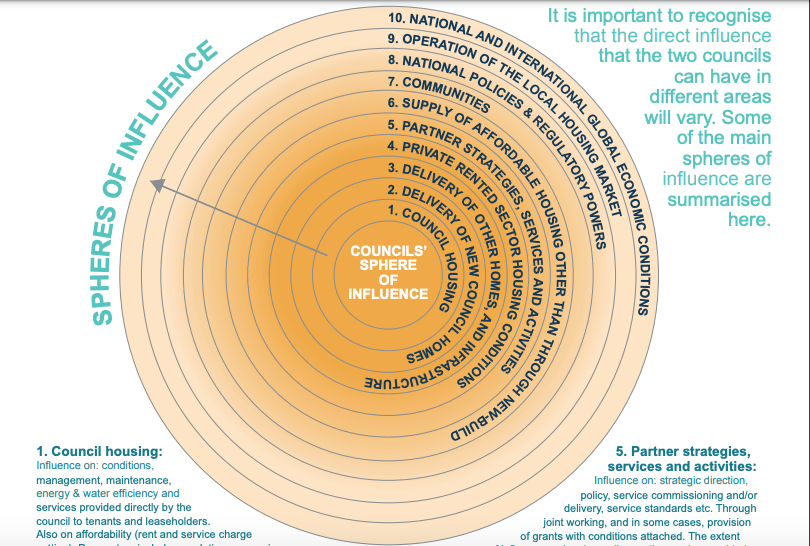
Above – Greater Cambridge Housing Strategy 2024-29
In the grand scheme of things there is little influence the city council has on the big picture because of its enfeebled state. It can only build council housing because councillors were able to extract concessions from ministers who desperately wanted their combined authority amongst other things. As I said at the time, for all of my criticism of the CPCA, I couldn’t blame councillors for voting for it as they were the ones who had to face local residents in insecure housing if the offer was suddenly pulled. Yet we know that councils are facing a major crisis – in the same way that we also know it is a general election year given that 40 Tory MPs got together to complain to ministers about the state of local government finances. The letter was co-ordinated by the County Council’s Network – you can read the press release here. Furthermore, the House of Commons Select Committee for LUHC which covers local government is also holding an inquiry about the state of councils’ finances. Expect ministers to ignore the findings of this inquiry just as they have done previous ones.
The scale of the problem
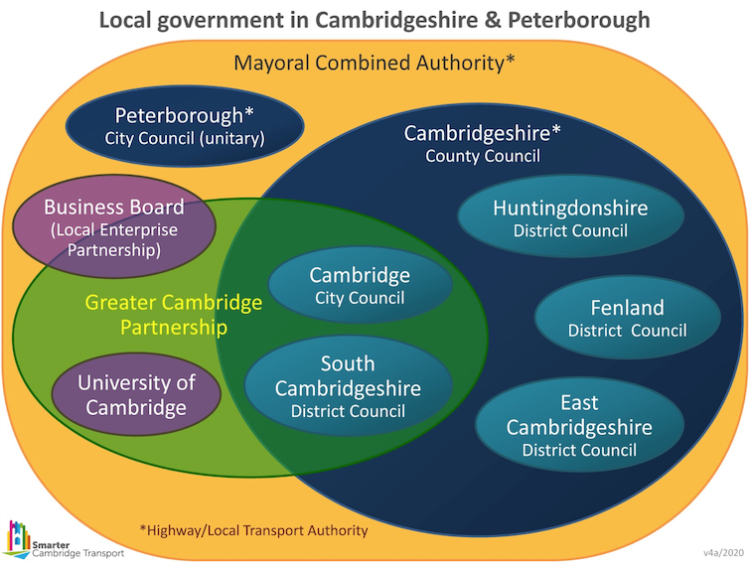
With city and district councils effectively running as a single entity in a number of policy areas, you can see just how out-of-sync house prices are to income. This is no way to run a city and further reflects on decades of broken government policies on housing, finance, and taxation. No city can function properly with such inequalities.
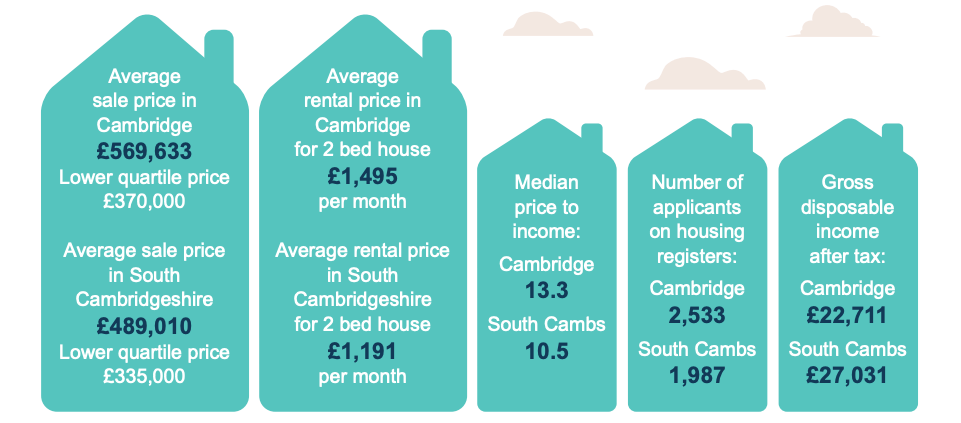
Taking South Cambridgeshire as an example, it commits to building “at least 375 new council homes between 2023 to 2028.” (p14). Yet their housing need is for nearly 2,000 applicants. Again, the problem remains with councils being prevented from taxing the excess wealth that is being generated by their local economies to spend on the much-needed infrastructure. And that is a choice The Chancellor takes every single year when presenting the Budget Speech.
Healthy New Towns
The councils are committing to “seek to integrate health and wellbeing considerations into planning, design and provision of services, including reference to the Cambridgeshire & Peterborough Integrated Care System Health & Wellbeing Strategy and the 10 principles for a Healthy New Town.”
Which I think means they’ll try, but not necessarily be successful. It’s public sector consultancy speak. But the 10 principles for a Healthy New Town are worth having a look at – not least because Northstowe, for all of its problems of late, has been designated a ‘demonstrator site’.
“What are the principles?”

Above – p9 Exec Summary from 10 Principles for Healthy New Towns
Inevitably there will be a host of very strong interests that will lobby strongly against this. After all, if big oil firms are taking this sort of action against their own shareholders, they might have something to say about transport types that don’t involve consuming their products. And don’t get me started about big food – the research by Dr Dolly van Tulleken (formerly Theis) is worth reading.
Dealing with Loneliness
I’m glad it’s on here – I just don’t think that local government has the powers or resources to deal with it. Furthermore, the mindset of central government is to establish a programme under the policy ownership of a junior minister – and allocate a team of civil servants and a budget for ‘pilot projects’ which show that something is being done. The ‘hope’ is then that the good things discovered are magically ‘mainstreamed’ into local government. Which seldom happens because of the multiple pressures on council budgets and the continued fire-fighting that such jobs entail. You don’t have time to take a step back and think, look around, and read around. I’ve been there myself.

I last wrote about loneliness as a public policy issue back in 2022 here.
““Multiple shared interests, multiple shared experiences” – and the challenge of community building”
Sound familiar? I wrote a blogpost with that title a year ago. You can’t bring lonely people together for a one off (eg the big lunch) and expect them to ‘get on with it’ or expect some lasting impact if there’s no follow-up. It’s not an easy public policy issue to solve because there are so many factors that have a host of unforeseen consequences and externalities – positive and negative. For example having people living closer to their workplaces, or building the electrified light rail could ensure that people spend less time stuck in traffic and more time free to do other things.
The same goes for centralising/decentralising services and functions. The 20th Century trend of building upwards and having huge buildings that can only be serviced/used by people commuting in from long distances are not without their drawbacks. Whether it’s the towers of the City of London to the growth of central government vs shrinking local government, the patterns are similar. How many people who commute to London from Cambridge would be willing to relocate to Cambridge if their job/profession enabled it? What would the economic models show if they had to incorporate the negative health externalities into their costs? (Similar to accounting for environmental impact and the costs of pollution clean ups – the concept of the polluter paying).
Anyway, have a ponder, and think of some questions that you could put to MP-candidates only they’ll be asking for your vote in the next 12 months.
Food for thought?
If you are interested in the longer term future of Cambridge, and on what happens at the local democracy meetings where decisions are made, feel free to:
- Follow me on Twitter
- Like my Facebook page
- Consider a small donation to help fund my continued research and reporting on local democracy in and around Cambridge.
Also, a quick note that I’ve had to cancel the online workshop for 24 Jan on central & local government due to lack of demand for that date. I will reschedule a new set of dates for February 2024 – in person and onlline.
 The Cambridge Town Owl