
It’s up to individual constituencies to make their own local contests the opposite of the stage-managed bore-fest that will inevitably be the national campaigns if contemporary electoral history is anything to go by.
Anyone who has the misfortune to remember the 2001 General Election will know what I mean by that – surely the dullest general election campaign in modern times. There is a risk, however, that poisonous exchanges and disinformation could be what makes the headlines as an increasingly fractured Tory party tries ever desperate measures to cling onto power.
Above – The author of Held in Contempt – What’s Wrong with the House of Commons?
“Isn’t history repeating itself?”
Have a listen to the incoming Treasury Ministers George Osborne (Cons) and David Laws (LibDems) back in May 2010.
Above – HMT 17 May 2010
If there’s one thing a possible incoming Labour-led Government could do to ‘set the mood’ for the whole of the next term of office, it would be to have a series of set-piece press conferences (having made the announcement in Parliament first) in parts of Whitehall that the public are less familiar with, and drive home just how much of a catastrophe that now faces everyone. And the list is long enough to ensure there is enough serious policy content to work with.
- Brexit promises, lies, and fantasies
- The Intelligence and Security Committee Report which should have been published *before* the general election of 2019 as it was a material consideration to the electorate on an issue of national security
- Covid preparedness and PPE Corruption
- Cummings and the ‘Durham Dash’
- Grenfell Tower and the collapse of standards in the construction industry
- The sewage crisis
- The housing crisis
- The energy crisis
- The climate and ecology crisis
- The cost of living crisis
- The NHS staffing crisis
- Underfunded police, huge delays in the criminal justice system, packed jails, minimal rehabilitation, the continuation of the failed ‘war on drugs’
- The polarisation of wealth
…to name but a few. I’m sure you can think of more.
I’ve pulled out a couple of books from the olden days that provide something of a crash course on the essentials of politics, and digitised them:
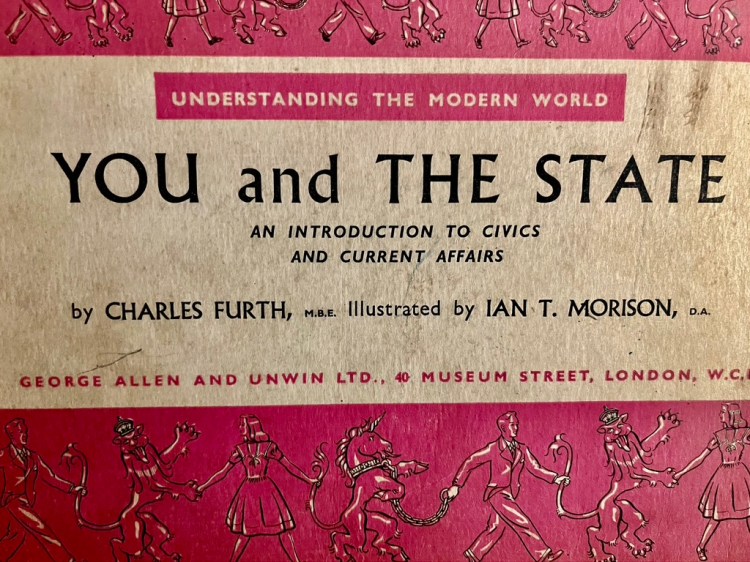
Above: You and the State, from 1949
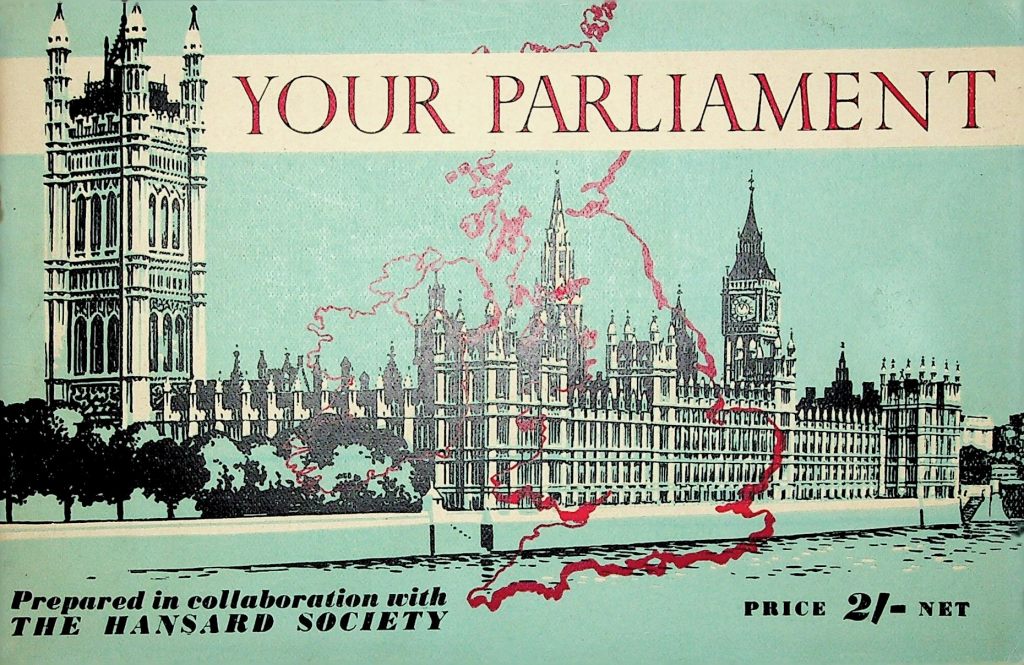
Above – Your Parliament from 1955

Above – Local and Central Government, from 1983
For a more up-to-date take, get hold of a book on GCSE Citizenship Studies – the ones published before 2016 will have coverage of the essentials of the EU – and the rights we used to have before ministers took them away from us. I use that term deliberately as unlike the Scottish Independence Referendum, there was no automatic trigger in law on the EU referendum result. It was only an ‘advisory’ referendum. Therefore any actions that followed were active Political choices by ministers, not the result of automatic actions of a referendum result because David Cameron’s Government chose a different mechanism for the two referenda.
Which underlines why political literacy is ever so important.
It’s easier to call for improvements than actually trying to make it happen yourself. I am finding out the hard way having to cancel the most recent online workshop on central and local government due to lack of demand, but I hope to be back with something more co-ordinated than ad-hoc in February 2024.
Start organising events for the local elections & PCC elections now!
“I’m convinced that there’s a much greater interest in the local council election than the fairly low voting turnouts suggest. As blogger Jack Monroe has just written rather brilliantly, “I?m not interested in politics. (But) I?m interested in my town, my family, our lives.” However, if people don’t feel they have the information on which to vote, they don’t vote. That’s why turnouts are low.”
Chris Rand, April 2016
And if you’ve never organised one before, there’s no time like the present – not least because of the state of local and national politics. Need a hand? Chris Rand has written this guide. Furthermore, as Phil Rodgers predicted in the Cambridge Independent, the 2024 City Council Elections is likely to have more wards actively contested than in recent times.
“Phil Rodgers: What I expect at Cambridge City Council elections in May 2024 – plus a look ahead to General Election and PCC poll”
Phil Rodgers, Cambridge Independent, 21 Jan 2024
What I’d like to see in terms of format is for hustings/events to take place in two halves.
First half
I’d have the first half being BBC-QT-style pre-submitted questions but *without* audience Qs. That stops the grand-standing and the lengthy pre-ambles. It allows the audience to judge what local people collectively have said are the main issues.
Second half
Break the audience into groups corresponding with the number of candidates. Have two groups covering the top two issues raised, and the remaining groups covering general issues. (One could be on national/international politics, one could be on general local issues). Give each politician 15 minute with each group, then rotate.
That way you get the benefit of multiple shared conversations over a range of issues, and furthermore the participants get a stronger sense of having been able to hold the politicians to account. It’s useful for the politicians and campaigners too because they get to meet lots of the electorate all in one place, with the second half allowing more meaningful exchanges and follow-up questions/points.
People can organise public debates outside of election time
“We are a debating society”


Above – the message from the author of Brighter Citizens in 1947
Written for a younger audience in Scotland from a previous age, the principles are still relevant to today. Furthermore, there are guides already out there from ages ago that guide people on how to run a local meeting. The techniques I’ve used at the community room meetings are similar to those described in the wartime guides below.

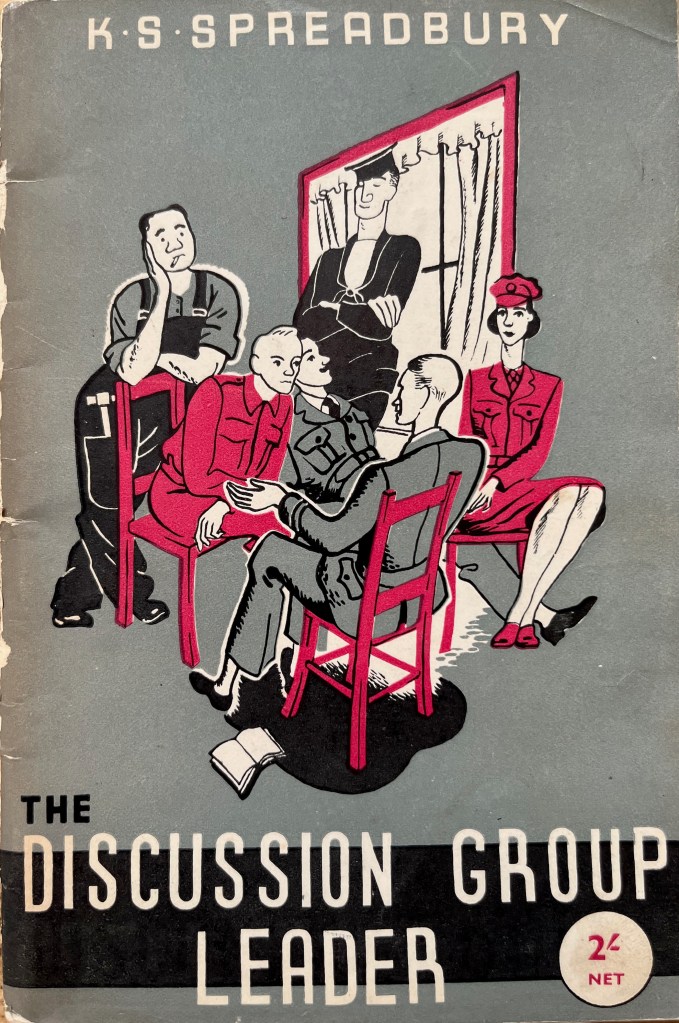
Above – People and Politics (1943) by the WEA, and The Discussion Group Leader, (1944) by K.S. Spreadbury – click on the links to have a browse.
I’m not going to pretend January is an ideal time to be debating anything unless you are paid to be in politics or public policy. As exciting as the Westminster bubble can be for the individual who is passionate about politics, I’m more than aware of how distant it can feel to people far away from it. I’m from a generation that was never taught about politics and democracy at school, college, or even university. Hence my take that adult education for democracy is something that is long overdue. For all the praise that existing politicians give the wartime generation about the sacrifices they made, they’re less good at following the calls for building a better society – in particular one that is educated and equipped with knowledge to defend democracy. <<– It’s all the more striking that such publications were being distributed while the fires of war were still raging.
It remains to be seen whether the Prime Minister calls the general election to coincide with the local elections, or whether he’ll delay until later in the year. Either way, I hope that within Cambridge at least, we’ll see more neighbourhoods and community groups organising meetings covering issues that matter to them, and learning more about how democracy in the UK functions (and malfunctions) at the same time.
“Can we expect to see improvements in and for local government as a sector?”
Above – while the rhetoric from the civil service has been for civil servants to get ‘delivery experience’ if they want to get into the senior civil service, I can’t see the civil service and local government being viewed as equals without some major cultural and structural overhauls – starting with revenue-raising powers.
But you don’t need me to repeat what I’ve posted in previous blogposts!
If you are interested in the longer term future of Cambridge, and on what happens at the local democracy meetings where decisions are made, feel free to:
- Follow me on Twitter
- Like my Facebook page
- Consider a small donation to help fund my continued research and reporting on local democracy in and around Cambridge.
Also, a quick note that I’ve had to cancel the online workshop for 24 Jan on central & local government due to lack of demand for that date. I will reschedule a new set of dates for February 2024 – in person and online.
 The Cambridge Town Owl