
Another tall building for the city – although this one sits outside Cambridge’s 1935-era boundary so will be decided by South Cambridgeshire District Council. The application raises ongoing questions about local government’s ability to govern their cities and districts.
It’s on 14 Feb 2024 and you can view the meeting papers here. In particular item 6 and also the drawings pack linked at the foot of the page. You can also see the Cambridge Independent’s summary here.
“It is proposed that the building includes a mixture of 137 hotel rooms and 80 aparthotel rooms for longer staying guests. The plans have been put forward by TLC Group and also include a restaurant, bar and cafe, as well as a gym and swimming pool.”
Cambridge Independent 06 Feb 2024
“Swimming pool?”
It’s more a standard large bath tub that you’d expect to find in your average inner city corporate gym – the design and access statement part 2 confirms that the pool is only 10m x 15m long. Having briefly been a gym member during my London days which had a pool of the same dimensions, it is far too small to make lane swimming worthwhile. It’s more for in-pool-based exercise classes where being in the water takes some pressure off of your joints while providing resistance for exercising muscles. One of the reasons I’d love to have a swimming pool that I could get to/from by bus like in the olden days when there was a regular bus service down Coleridge Road.
Applicant notes the poor design quality of early, existing developments in Orchard Park
This ***really struck me*** because I have not seen anything like this in a planning application before. Which makes me wonder whether the developers that built the properties and the professional consultants/architects/surveyors and the like evaluated their work and learnt those lessons. (Did they?)
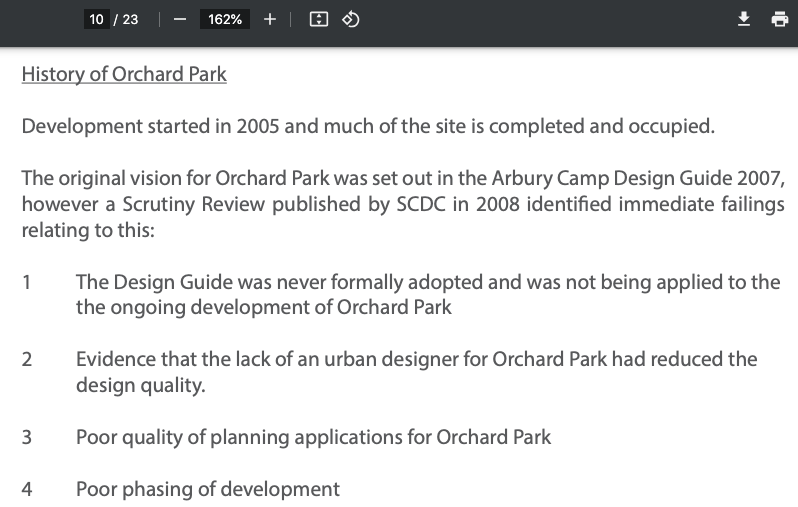
Above – Orchard Park Apart-Hotel/Hotel Application Ref 22/01632/FUL Design & Access Statement Part 2, dated 05 April 2022, p10
Not surprisingly, South Cambridgeshire District Council responded to this with a new Supplementary Planning Document for the unbuilt plots of Orchard Park in 2011.

Above – Orchard Park Design Guidance SPD March 2011, by South Cambs District Council
Furthermore, you can read Richard Taylor’s blogpost from 2008 around the time the original issues were being made. Note his comments about Northstowe.
That thing about our collective memory of our city? It applies here
Such is the time that build-outs take, and such is the depth (quantity of) and density (intellectual rigour) of the documentation involved that very few people have the time, knowledge, or persistence to persevere with the shaping of our city. In my case, it’s chronic ill-health and general immobility that goes with it (I spend most of my days at home or within my immediate neighbourhood – I’ve not been outside of Cambridgeshire since 2018) alongside my previous professional background in the civil service that enables me do scrutinise all of this. (Combined with online access and living with my parents – in my mid-40s! Which is not normal).
Changing times and economic circumstances have changed the proposed uses of the land
In the case of “COM4”, the plot was originally proposed for residential accommodation.
“2.9. Land parcels COM4 & L2 were the subject of an application by Barratt Homes for 182 dwellings, reference S/1734/07/F. This application was dismissed on appeal in November 2008 but confirmed the principle of residential use on these sites.”
Orchard Park SPD (2011) Para 2.9
I’m assuming this has been superseded by Policy SS/1: on p46/58 on Orchard Park in the South Cambridgeshire Local Plan 2018 – in fact it confirms that the 2011 SPD will need updating on p324/(336 of the PDF) in Appendix G.
I’m assuming this explains why instead of building new homes, they are building an aparthotel and hotel complex on the site instead. In one sense the height of the complex will act as an additional noise-and pollution shield for the play park in front of it.

Above – Design and Access Statement Part 2 p11
Crime as a symptom of failed urban planning and design
This comes back to the criticisms made by the applicant on the earlier developments on the site. Last summer, anti-social behaviour became such an issue that the police had to issue anti-dispersal notices.
“A 48-hour dispersal order has been put in place in Orchard Park and Arbury Court to tackle ongoing anti-social behaviour.”
Cambridge Independent, 23 June 2023
Now when it comes to developers being accused of ‘designing in crime’, sites in Cambridge have got form. Looking at the controversial Cambridge Station developers. And in that case, serious action had to be taken by a number of organisations to deal with people-trafficking. (See the statement by Insp Nick Skipworth 24 April 2017 to Cambridge South Area Committee)
I’m not going to do a hatchet job on Orchard Park
It clearly needed better planning, but also the community has been the victim of central government policies that have prevented Cambridge’s wealth from being used to provide the essential community facilities that they need. The same goes for so many other residential areas of our city and county. And it’s not like residents were not speaking out – they have been. Repeatedly. This from March 2019 after a particularly violent assault.
“Another resident I spoke to said plans need to be put in place to prevent further crime in the area. Asking to remain anonymous, she said: “There needs to be long-term plans to engage the kids.”
Cambridge News 17 March 2019
The previous day, the then headteacher of Impington Village College, Ryan Kelsall slammed ministers for their policies of repeated cuts on schools and youth facilities.
“Funding continues to be slashed in relations to costs, and this is the consequence. There is a lack of ability to intervene early enough because of a lack of resources. I can’t access the youth support officer until levels are of such high criminality that attempts to intervene are reactive.”
Ryan Kelsall to Fiona Leishman, Cambridge News 16 March 2019
“Have things gotten better or worse? Actually, don’t answer that!”
Since then, there have been two recent things of note. The first is the conclusion from the House of Commons Select Committee for LUHC which covers local government that there is an ‘out of control crisis’ in the sector. The second is the announcement from the Culture Secretary and MP for South East Cambridgeshire, Lucy Frazer MP
Above – the Culture Secretary announcing that “Young people set to benefit from 140 new or refurbished youth centres thanks to latest funding round from the Government’s Youth Investment Fund of £90 million.”
Welcome though any funding is, central government really should not be running such schemes from the centre. This should be a core part of what local councils provide, and ministers should be ensuring – as the LUHC Select Committee has repeatedly stated, that local government has the funding to provide such services. Whether that’s through direct grants to councils, a wide range of tax raising powers, and/or a range of these and other policies, the point is that central government should not be micromanaging local community grants like this. The reason? Diseconomies of scale.
I like the way Audree Fletcher explains this in her article of 2022: “When bigger isn’t necessarily better”

Above – Audree Fletcher (2022) Diseconomies of Scale
For every competitive grant funding programme that ministers launch, they have to deal with all of the applicants who themselves incur costs of putting together decent bids with no guarantee of success. Quite often this process is outsourced to consultants who specialise in such bids. You can see where this is all going. Yet ministers have a huge incentive to keep the system as it is because it provides nice photo opportunities and good news stories for local media of them opening new facilities. It’s also useful to keep backbench MPs onside by funding new projects in their constituencies – something deeply improper and potentially against the law. But I cannot think of any successful prosecutions in recent times.
“Does the city need even more hotels and apart-hotels, or does it need new social and affordable homes more?”
Part of the problem is trying to avoid the over-concentration of social housing into single large districts. The risk – especially in our current austerity-hit system, is that such areas can become ‘sink estates’ – a horrible term used in the 1980s/1990s where people with multiple needs were housed in some of the areas with the highest rates of urban poverty, which compounded individual and collective social problems.
The Cambridge Hotel Futures Study 2012
You can read the document here. I think this needs evaluating over the next couple of years. How many hotels, apart-hotels, guesthouses, and Air BnB-type units have been built/created? How many have been lost/closed/demolished?

Above – where the study recommended new hotels should be built. Note this was *before* Air BnB became a thing.
In the same year, the Eddington development commissioned a similar hotel study which you can read here. Interestingly, Cambridge University published new guidance saying Air BnB-type accommodation should not be used for University work purposes.
“University guidance states that certain forms of unregulated accommodation (e.g. Airbnb or similar) should not be used for University work purposes, due to the lack of health and safety regulation of the accommodation and other inherent risks.”
Cambridge University June 2016
Furthermore, Cambridge Ahead commissioned a study on the impact of short-term lets. The challenge as they noted, is quantifying them.
“There are clear costs to neighbourhoods with higher densities of Short-term lets that are a lot harder to quantify. Numerous qualitative studies have noted the noise disturbance, increase in waste management, parking concerns, anti-social behaviour, safety concerns, and a sense of loss of cohesion in neighbourhoods and apartment buildings.”
Ugo Dino Fonda for Cambridge Ahead (2021) p23
Furthermore, Fonda states:
“Short-term letting platforms do not publish data on listings. This makes it hard for local authorities to properly assess the extent of the phenomenon and respond with the necessary policies.”
Fonda (2021) p3
This is a central government-created problem because what ministers and Parliament did was to legislate for ‘commercial in confidence’ clauses which mean firms do not have to hand over data to local councils – data that would help them plan ahead and manage current and future supply of accommodation and building types for their cities.
Furthermore, Air BnB when first launched and lauded by politicians was advertised as a means of enabling home owners to create additional income in a time of austerity. What it wasn’t meant to do was to enable property industry types to undercut hotel and guesthouse owners by supplying competing services that did not have to comply with nearly as many regulations. Therefore we have an uneven playing field with short term lets gaining tax and regulatory advantages in the market rather than simply offering a better product in a competitive market.
Many have called on ministers to change the law. They have refrained from doing so – aided by the rapid turnover in housing ministers and also prime ministers! An issue to put to general election candidates as part of the housing debate…
Food for thought?
If you are interested in the longer term future of Cambridge, and on what happens at the local democracy meetings where decisions are made, feel free to:
- Follow me on Twitter
- Like my Facebook page
- Consider a small donation to help fund my continued research and reporting on local democracy in and around Cambridge.
Below – Cambridge Matters magazine – produced by the city council. You can read online copies here

 The Cambridge Town Owl