Wandering down the northern section of Hills Road earlier today, the grey scene didn’t inspire. And that was just the buildings from previous generations!
I was going to write something about how art seems to be excluded from architecture, replaced by a system where bland blocks of buildings have controversial and/or abstract sculptures plonked in front of them. It was off the back of this view when I got off the bus yesterday.
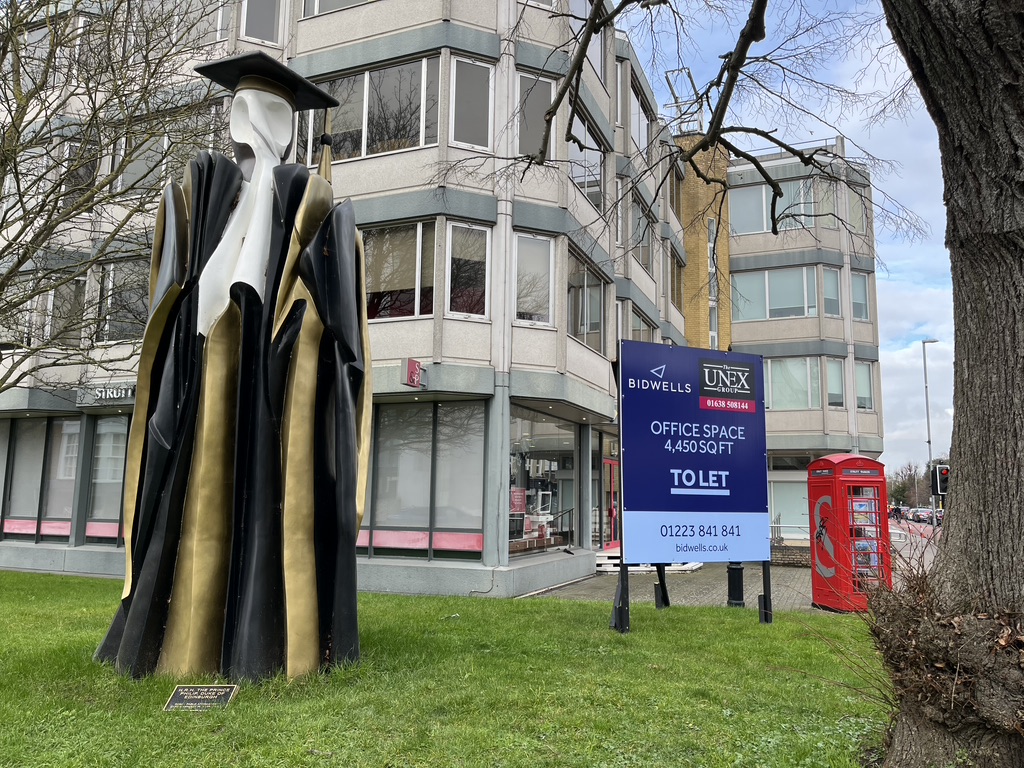
Above: ****Ooooh Ugly!!!****
You can see how the building behind the controversial Prince Philip/Duke of Edinburgh statue (which was moved up the road) replaced the old Wesleyan Methodist Chapel on Hills Road.

Above – the old Wesleyan Methodist Chapel on Hills Road, demolished in the early 1970s, via Mike Petty MBE

Above – the street scene in the pre-WWI era
It’s one of my favourite lost buildings, but I’m not going to pretend that the style is unique. The chapel is built in the style of mid-late Victorian methodist chapels that you can find examples of all over the country. But my point is that (for me at least) the art is in the building and its detailing, rather than being a specific designated piece in front of a minimalist identikit block. (Note at the time both this church and St Paul’s on the other side of the road generated controversy for their use of non-local red bricks in the mid-1800s at a time when the local economy was dependent on building projects using locally-manufactured bricks off places like Newmarket Road).
Tour guides wanted – but what the market wants is not what I’m interested in
The reason why I was walking down this part of the road was to pop into the event finding out about what being an official tour guide involves – one that was advertised in the Cambridge Independent here. It was as I assumed – primarily aimed at people willing and able to take tourist groups around the colleges and churches. These happen to be two of the aspects of Cambridge I am least interested in. Even though I am a product of both of them – indirectly with the colleges because they have dominated the city for centuries, thus deciding what town people can and cannot do in comparison to other towns, and directly with the Church. Or Churches.
To become an accredited tour guide with the right to take tour groups through colleges involves a significant amount of study, written and practical exams, and the payment of a tuition fee of over £2,000. There are pros and cons with all of this – I’ll leave you to debate them. In my case with neither the means to pay the fees, nor desire to take anyone around the colleges or churches simply because I’m not passionate about those bits of local history, there’s no real incentive for me to undertake the course if all I want to cover is town history via publicly accessible places as the late Allan Brigham did with his Town not Gown tours. (It would take a small team of us to try and recreate what he established).
“What would a post-2000 ‘town’ tour of Cambridge be like?”
If we look at the buildings that have been put up since the Millennium I think I’d struggle to find some genuinely awe-inspiring town buildings that make me go ***Wow!***. The same goes for the University ones too – although I fully accept this is a very subjective point of view and that there are more than a few people in and around the city who love the minimalist look and think that the current vernacular/style is something to aspire towards.
I just happen to disagree.
What worries me about the current movement promoted by Michael Gove on beautiful buildings (that I wrote about here) is that there are too many links and connections to people and institutions which have views on things like history, politics, and society that I strongly disagree with and/or find deeply offensive. Part of the challenge has been creating the space where people can gather together to debate what Tom Foggin below mentioned over 3 years ago:
I followed this up with a blogpost here – and out of other conversations happening in Cambridge and elsewhere emerged the proposed Urban Room for Cambridge. At the same time, the new premises on Fitzroy Street of Together Culture has opened – and it was to this group I gave my first local history walking tour of The Kite.
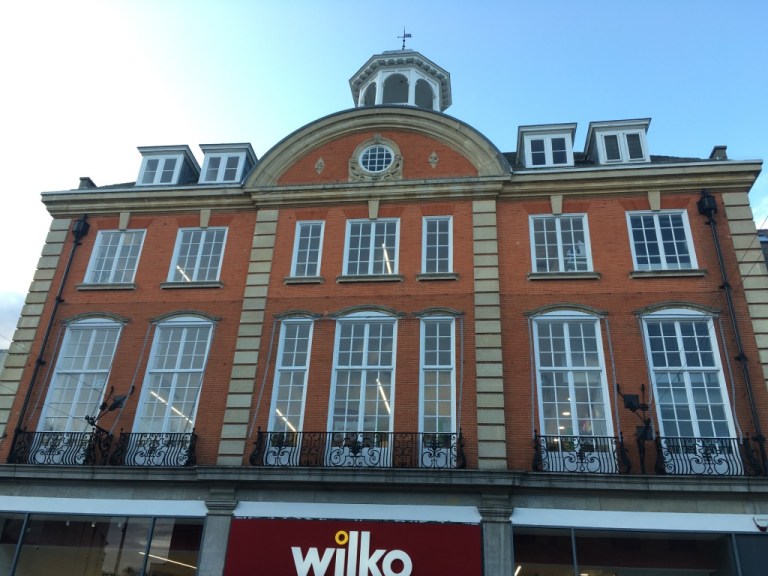
Above – the old Laurie & McConnall Building on Fitzroy Street, which I hope comes back into community or commercial use sometime soon.
The building now vacated by Wilko is an example of the sort of building that I’d like to see at the heart of communities. Not in terms of identikit designs, but one that stands out as being different, having more to it, having more care and imagination taken in the design and construction than the spreadsheet-style mass blocks we see going up far too often.
“Any updates on the Cambridge Room?”
For those of you not familiar, read Prof Flora Samuel’s article here from 01 Sept 2023. Furthermore, you can also read their charter. Since then, they’ve got a new logo – you can see the results of the competition here.
If we look at the charter, we can see how it covers a host of longstanding problems with the construction industry in and around Cambridge.
“The aim of the Cambridge Room is to raise the quality of the built environment for the benefit of all through collective action.”
Which indicates that the quality of the built environment is not benefiting everyone, nor is it of nearly high enough quality – whether for Cambridge or anywhere else for that matter.
“The focus of the Cambridge Room is local”
One of my persistent criticisms of Cambridge is that we supposedly have the best brains in the world who are working on big global problems, but whose talents are not being made use of in dealing with day-to-day problems that they also have to live with. Like traffic.
“Although its focus is the built environment the Cambridge Room will support the development of inclusive governance and transparent decision making across the region. “
This will horrify some of the chaps in the colleges!
…as played out by Sir Humphrey and Sir Bernard…!
“Bernard, what happens when a large plot of vacant land becomes available in Cambridge and there are rival proposals for its use. A hospital, a science park, or some luxury apartments?”
Above: “British Democracy recognises that you need a system…to protect the important things of life…and keep them out of the hands of the barbarians! Things like The Opera, Radio 3, The Law…The Universities: Both of them.”
“Bernard, do you want the National Theatre to turn into a carpet sale warehouse?”
*Well it looks like one actually!”
“We gave the architect a knighthood so *no one* would *ever* say that!!!”
Turns out debates on architectural tastes are just as controversial back then as they are today! And from a generation before that? Have a look at Cambridge Opinion from the late 1950s – scathing on Cambridge’s civic architecture of the interwar period!
Rebuilding our collective memory
“The Cambridge Room will act as a ‘collective memory’ for a city with a large transient population. It will work to ensure that consultations feed into one another and that valuable community knowledge is not lost.”
This is why local history is ever so important – see https://www.calh.org.uk/ if you are interested in the local histories of Cambridge and its surrounding villages. In my experience, a number of villages have got comprehensive histories written up about them – far more than the suburbs of Cambridge. Part of how Cambridge evolves as a growing city has to involve recording the histories of the early 21st Century, how our city diversified, and how its economy changed – in particular the decline of retail as a share of the cities generated wealth.
Can The Cambridge Room generate enough interest and influence to persuade developers only interested in the bottom line to engage meaningfully with the people who make up our city?
I ask because on too many occasions I’ve come across developers who are only interested in the bottom line and will do all within their powers to maximise their profits at the expense of the local communities – before extracting and exporting those profits outside of the city. While perfectly legal – perhaps even incentivised by the current economic system, it undermines the moral legitimacy of it in the face of our city being the most unequal in the country. Are developers and the construction industry going to be partners in tackling the chronic problems of inequality and also the climate emergency, or are they going to be obstacles that require Political solutions such as tough regulation to deal with them? Mindful of what we have learnt from the Grenfell Inquiry?
Back in 2021 I asked what public participation in at design stage in planning might be like. The problem at the moment is that the city does not have anywhere that provides for community learning on all things town planning, urban design, and building control. Ditto transport planning – as I mentioned in this blogpost in Feb 2022. I also looked around for books on town and transport planning aimed at children and young people. I couldn’t find any – so asked if anyone wanted to write one. Furthermore, is anyone training the teachers? There is a wider point on how both secondary education and also lifelong learning courses for adults are lacking on courses and workshops on the built environment. The same goes for forums for public debates – how many council wards have public debates/hustings on a regular basis before local elections? (Anyone organising any?)
The abuse that too many town planners face – especially in local government – is a symptom of a broken system. One that is an extension of a broken political system
Who would be a town planner in this environment?
How do you take the heat out of town planning while at the same time recognising that making collective decisions on the local built environment is inherently political – just as it is for decisions on the provision of health and education.
You can read this list of ten suggestions to take the heat out of planning by Nick Lee. In summary:
- We need a proper national development framework with a spatial dimension.
- Planning has to be seen as being as part of the chief executive’s department at council level
- Proper spatial planning at city region or other logical scale needs to return
- Local councils must then implement their required level
- Local councils must have a penalty for not preparing a local plan.
- Local councils should have fully trained members only on planning committees
- If members are to go against officer advice…appeals should start with default being in favour of overturning refusal
- Developers need to think differently about how they engage with the public.
- A proper ‘social impact’ test needs to be brought into developments that addresses specific, known local needs beyond housing alone – for example, doctors, schools, etc
- The local plan preparation process should absorb neighbourhood plans.
Now, there are a whole host of assumptions and conditions that apply to the above
Because if No.7 on its own was implemented, there’d be middle class riots in market towns. And for all of the above to function properly, there needs to be an overhaul of local government in England. In fact, Parliamentary select committees have repeatedly called for the policies needed to make the above things work – such as:
- Properly-resourced councils
- Properly trained and supported councillors
- A significant increase in the supply of trained town planners along with the ability of councils to charge cost-recovering rates for running planning services (so they can compete in the jobs market)
- The removal of policy and service silos for local public services so that we don’t end up with new housing estates built with no GP surgeries, health clinics or dentists – which in themselves require new training schools for medicine and dentistry along with increased salaries for healthcare professionals
- Citizenship education for schools and lifelong learning sectors prioritised to combat mis/disinformation and also to reduce the workloads and manage the public’s expecations
- Holding developers to much higher standards and having much stronger penalties (including jail time and hefty fines) for law-breakers.
- Developing new cultures of civic pride where developers, planners, councillors and the public work together to create something that is greater than the sum of its parts. Of which a new generation of inspiring public art can be at the heart of it.
On making our city greater than the sum of our parts, sadly Cambridge is nowhere near that point. I hope that the debates we have during the General Election campaigns will mark a high turning point in the history of our city. And county. And country too.
Food for thought?
If you are interested in the longer term future of Cambridge, and on what happens at the local democracy meetings where decisions are made, feel free to:
- Follow me on Twitter
- Like my Facebook page
- Consider a small donation to help fund my continued research and reporting on local democracy in and around Cambridge.
 The Cambridge Town Owl