As Addenbrooke’s declares a critical incident in the run up to the general election, it’s essential that the candidates have open and honest debates with the people about underfunded public services and their future in a growing county
I raised the lack of capacity in A&E at Addenbrooke’s before, placing the blame at the feet of ministers. The last time the A&E unit was expanded was in 2001. As I noted back in December 2021.
What I didn’t know was that the following evening I’d be back there, admitted to the cardiac ward having suffered a suspected heart attack. I got lucky in that I knew what to do upon the onset of the *very different to normal* pain and took sufficient medication (which I was on a lower dosage as a result of a previous scare in 2017) before arriving at Addenbrooke’s. (See NHS guidance or call 101 if you are having chest pains and/or the symptoms listed)
The solutions should not need micromanaging from Whitehall, but the over-centralised structure of the state means that we have little alternative
I’ve done the micromanaging from Whitehall during my civil service days. It’s not fun. Furthermore, it creates a culture of dependency where local councils inevitably look towards the centre for more funding rather than (and especially those that have the economic bases to raise resources from) looking towards their own communities for their own solutions. In Cambridgeshire we’re in this incredulous situation where the most affluent part of the county is getting the extra money from ministers when what it needs is the extra taxation powers to levy on the wealth-creating and speculative activities happening within the local economy. It’s places like Fenland that need the additional funding from central government precisely because they don’t have a big enough economic base from which to raise the resources within their own area.
Hospital catchments not matching local government boundaries
The catchment area for Addenbrooke’s crosses more than one county boundary. i.e. it includes bits of Essex, Hertfordshire, and Suffolk. The hospitals at Hinchingbrooke and Peterborough cover the rest of Cambridgeshire.

Above – Addenbrooke’s Catchment. If you live within the catchment area you can get involved in the support and scrutiny of the NHS Trust that includes Addenbrooke’s by joining as a free member here. (I am a member).
Not the first or the last crisis Addenbrooke’s has faced
A few days ago I bought a very old pamphlet produced by the hospital back in 1937. Turns out it was a fund-raising pamphlet because subscription donations had collapsed by 25% as a result of the Great Depression. I wrote about it here.
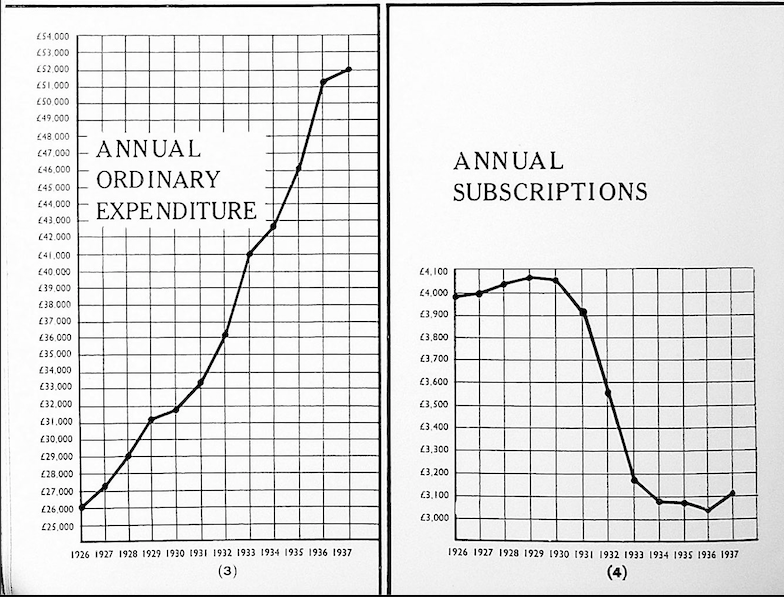
Above – Addenbrooke’s (1937) from the graphs on p26 here
That collapse in subscriptions created a massive hole in the budget of the hospital – which pre-dates the founding of the NHS. The creation of the NHS resulted in the Addenbrooke’s Board of Governors taking over responsibility of other facilities in Cambridge, with two former work houses on Mill Road and Chesterton becoming hospitals specialising in maternity care and elderly care respectively. (See the history of the CUH NHS Trust)
“So, what’s the solution?”
Whitehall traditionally would do this:
“Bernard, what happens when a large plot of vacant land becomes available in Cambridge and there are rival proposals for its use. A hospital, a science park, or some luxury apartments?”
…only Sir Humphrey would not have let Michael Gove get anywhere near such plans for Cambridge!
“British Democracy recognises that you need a system…to protect the important things of life…and keep them out of the hands of the barbarians! Things like The Opera, Radio 3, The Law…The Universities: Both of them.”
Sir Humphrey Appleby – A Very British Democracy, Yes Prime Minister, BBC Comedy Greats
…or any other minister for that matter!
Preventative public services – reducing the demand for expensive reactive services by investing in prevention much further up the line
This is now a major public policy topic which various think tanks and policy institutions are writing about:
- Exploring preventative investment in local government – CIPFA
- Prevention, personalisation & productivity are key to delivering a ‘smarter state’. – IPPR
- The Preventative State: Rebuilding our local, social and civic foundations – Demos
- What councils need to unlock place-based prevention – New Local
The challenge is breaking the Whitehall silos that have local public services hotwired up to the department of state that provides the funding. And one big reason for this is because of the way Parliament holds Ministers to account for that funding – via departmental select committees. Ministers and senior civil servants appear before MPs and account for both policies and their record on spending.
They have to demonstrate value for money for their policies. By convention, MPs – and especially select committee chairs (who are elected by secret ballot of backbench MPs, so need the backing of MPs from all the major parties) leave their party political allegiance outside the committee room door and follow the evidence. Even if it means extreme discomfort for the minister concerned. It will be very interesting to see, should they win the next general election, how Labour ministers and MPs cope under what will be a new system of parliamentary accountability compared to the one under Blair and Brown – where whips pretty much had the power to decide who would be Labour’s select committee chairs.
The argument put forward by the Liberal Democrats (who traditionally have preferred a much stronger local government sector) is where a percentage of income tax revenue is ringfenced for local councils under a new Act of Parliament with the same sort of protections that the Scottish Government has. i.e. it is a ‘devolved matter’ and not for Westminster to interfere with. The argument is that this would create a greater responsibility for councillors to ensure value for money, require much stronger local structures/systems, and create a greater incentive for the public to get involved in local democracy.
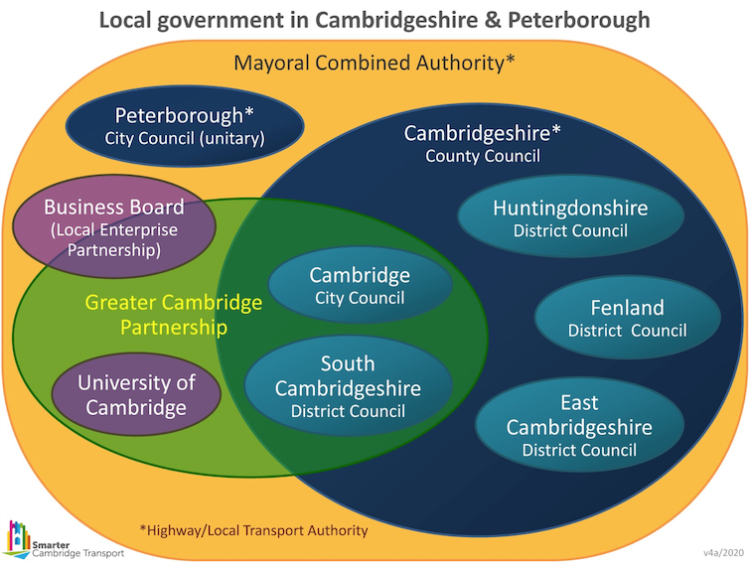
That in itself would not be enough, however, There would need to be significant constitutional and structural change across the country, the likes of which we’ve not seen (in England) for half a century. However, it would create a huge incentive to align the geographical boundaries of public service organisations so that they were consistent with each other. At the moment, local government, police, healthcare, and the courts all work to different geographical structures. The same goes for the regional quangos such as Highways England and the Environment Agency. Whether a future Labour government has the appetite to recreate consistent regional structures remains to be seen. As the Public Administration and Constitutional Affairs Select Committee concluded, the system of governance for England is a mess, and requires a major commission to overhaul it.
Which is why much as I’d be tempted to have every general election hustings in Cambridgeshire being an opportunity for the public to tear the Tories to bits and filmed in 3D surround sound, it wouldn’t actually achieve anything substantial. Conclude that the schemes brought in by messrs Lansley, Osborne, Grayling, May, Gove, Pickles, and others have failed by all means. But let’s have some meaningful discussions on overhauling what comes next – even if the present structures only allow for Cambridgeshire and Peterborough to be covered in the first instance. That will involve gathering the evidence and the in-depth reports, and creating easy-to-digest summaries for the electorate to read. In/around Cambridge, that’s where the universities and their research units could play a role. Because someone like me is far too biased. At least that way, more of the electorate will get a chance to assess politically impartial sources in this age of disinformation.
Food for thought?
If you are interested in the longer term future of Cambridge, and on what happens at the local democracy meetings where decisions are made, feel free to:
- Follow me on Twitter
- Like my Facebook page
- Consider a small donation to help fund my continued research and reporting on local democracy in and around Cambridge.
 The Cambridge Town Owl