
One of the reasons why I keep on referring to old things from times gone by is that the periods and people I select are times of significant economic and social change.
Some of the recent books from the olden days that I’ve digitised include:
- Community Centres (1946)
- You and the [welfare] state (1949)
- Civic Theatre Design (1949)
- Your town hall and how it helps you (1963)
- Pride of place (1974)
- Informal learning in the community (1999)
That’s not to say the contents of the above should be read uncritically and taken at face value. Rather the texts challenge us to account for what progress has been made since then, and to what extent generations that came after them met the aspirations of the wartime generations – certainly for the first three.
Most community centres need paid permanent staff – especially in communities with the greatest needs and the smallest voluntary capacity
In the case of the Community Centres book from 1946, much of the surveying work was done in the run up to the first edition that was printed in 1942. Back then, the state was much smaller – no NHS, and the local government, and voluntary sectors were much more prominent.
The Frecheville Community Centre is an interesting case study – not least because it is still in existence today (See their FB Page here)
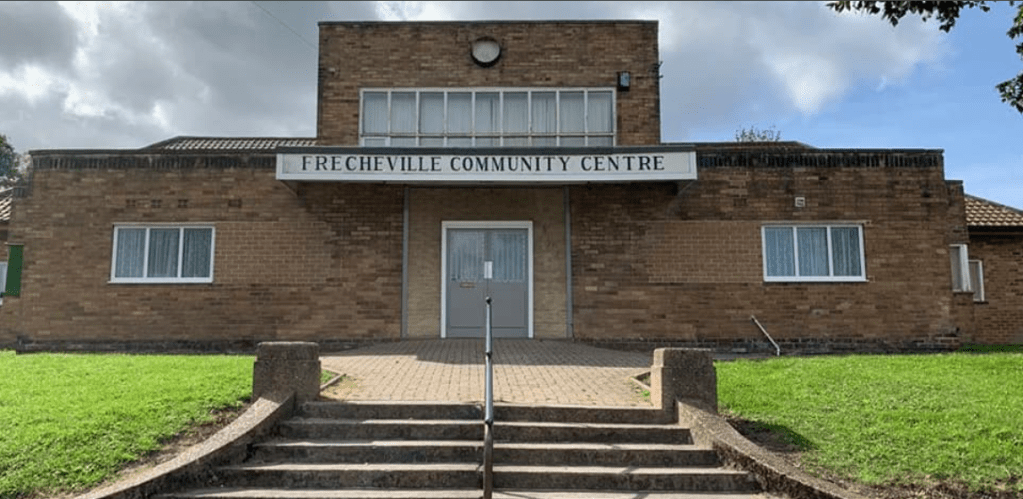
Above – Frecheville Community Centre, Sheffield

Above – the main hall in Frecheville, Sheffield
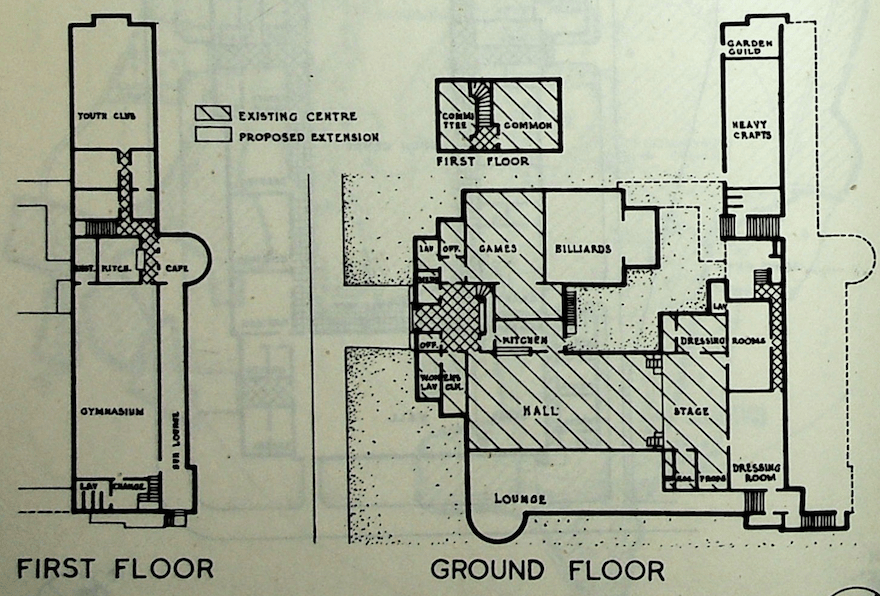
Above – from Community Centres (1946) p77 of the PDF version.
We can compare the proposed extensions as per the diagram above with what the building looks like today on G-Maps here. I can’t say I’m surprised that the extension that was supposed to house the youth club was the bit that doesn’t seem to have gotten built!
The history of the centre and how/why it was established also makes for striking reading – especially on how it was funded, and how all of the residents in effect had to contribute via their rents to help pay off the loan that funded the construction. As with so many other estates past and present, little consideration was made for community facilities. Which makes me wonder whether the state needs to intervene to compel industry professionals to undertake far more post-occupancy surveys and evaluations, and demonstrate one way or another how they will apply that learning to future projects.
The importance of the paid staff
The book notes:
“The present Secretary of the [Frecheville] Association is a full time, paid worker. He was formerly a member of the Association and an enthusiastic organiser of activities. The other permanent staff include a typist, stewardess, buffet attendant, cleaner, and groundsman.”
Communities (1946) p15/21pdf
Political parties in Westminster underestimate the value of paid full-time workers who run community centres. All too often people with the job titles of ‘community development officer’ are seen as disposable when cuts are forced upon local councils. The problem with that mindset is this only increases other costs further down the line. Only recently has Westminster’s public policy bubble been talking about ‘preventative public services’ (See the second half of my last blogpost here) where councils can afford to provide the youth clubs – and choose to do so, not only providing ‘a distraction’ for the kids’ but more importantly showing that they are an integral part of a broader community and wider society – one with rights and responsibilities.
My generation of teenagers in Cambridge didn’t have that level of altruistic community investment. It’s interesting to compare how many new half term activities there are today in Cambridge compared with the 1990s when the only reason we could get to play football on the playing fields around Cambridge was because the schools could not afford to repair the broken fences. I sometimes wonder how accessible the organised sessions are – even the ones put on for free, given the level of pre-registration inevitably (and understandably) required by law, vs an era where everyone had to improvise because the state and private sector refused to provide the resources or facilities.
Another comparison between the different ages is noting how ‘uniformed’ so many of the groups were in the mid-latter 20th Century.
The Filwood centre in Bristol reflects this with their youth provision”Ab

Above – Community Centres (1946) p10/17pdf
The number of churches-based groups of various denominations is hard to avoid noticing. At the same time, the number of adult organisations are predominantly for women. I am assuming this is in part due to the demands of war (several units raised in Bristol served overseas in the Gloucestershire Regiment) and the existence of workingmens clubs.

How do these compare with today’s clubs and societies?
Impington Village College – combining schools and community centres in an era of austerity
This is the one several of you will be familiar with.
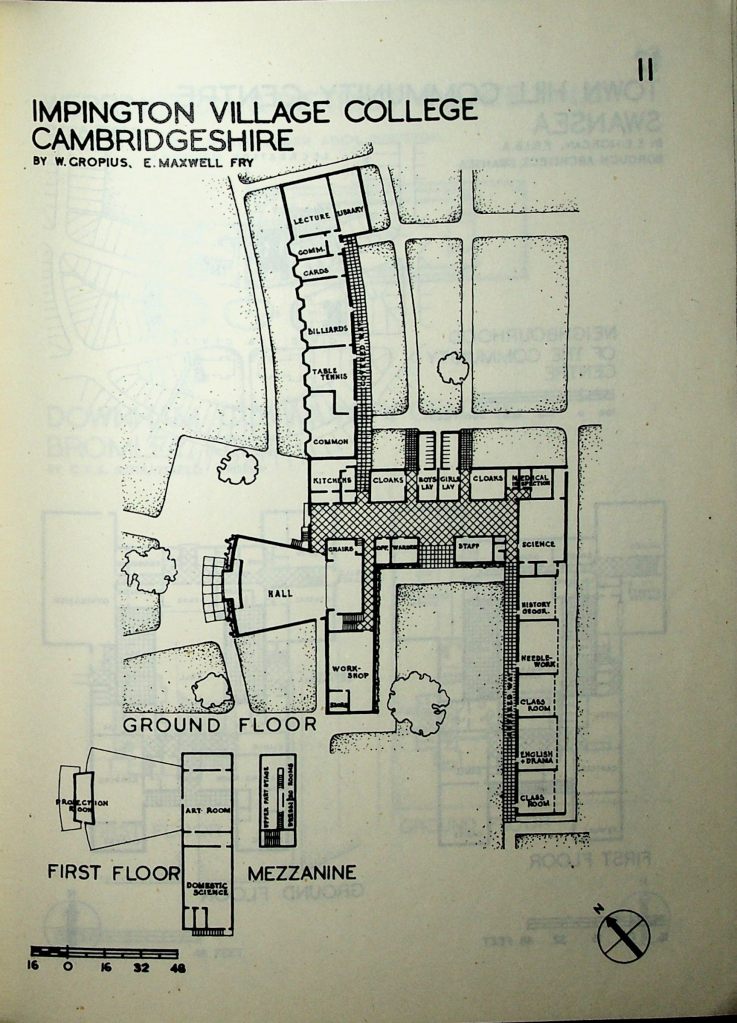
Above – plan of Impington Village College – Community Centres (1946).
The buildings have been extended significantly since the initial buildings – designed by Walter Gropius – the hall being Grade 2 listed, were built. (See G-Maps here). The concept of village colleges were pioneered by Henry Morris, and supported politically by Clara Rackham, who later became chair of the Education Committee on Cambridgeshire County Council. (I’m still waiting for the paperback version of Prof Mary Joannou’s excellent biography of Clara Rackham to be published!)
Cambridge City Council opens a new pavilion for Queen Edith’s ward in Cambridge. But they cannot afford to staff it – and ministers want councils to make even more cuts
When we look at some of the newer community centres, we see some of the problems:
It’s only open for full days on two days a week. It’s closed on Sundays, and only open in the mornings (9.30am-1pm) on Monday, Friday, and Saturday.
Mill Road Centre on the old Iron Works
The contract to run that is with the Romsey Mill, yet they can only afford to staff the Mill Road Centre for four mornings per week. I have issues of principle about council community centres being run by third party organisations – whether profit-making, religious, and/or not for profit. I think they should be secular, owned by (or at least on a very long term lease on preferential rates), and run by local councils. That said, I haven’t had any cause for complaint with Romsey Mill – they’ve been fine when I’ve hired their facilities before. As I said, it’s a point of principle. And in the face of such huge inequalities there’s only so far one can go in the current system. The centre and the council housing only got built because city councillors were able to extract the money from Chancellor George Osborne who desperately wanted Cambridge to be in this new-fangled combined authority of his. This was at a time when ministers effectively prevented councils building new council houses, while maintaining the right-to-buy programme.
The link above gives details of the prices for hire and the online methods of booking. The problem is that the online system so far doesn’t tell people what is happening and when – for example whether the private bookings are by community groups that are open to the public. At least the Clay Farm Centre publishes a list of events every week in advance.
One of the original proposals from messrs Holford and Wright in 1950 was to include a community centre for what was a rapidly-expanding housing estate that had a very young Olivia Newtown-John living on it when they published their report.
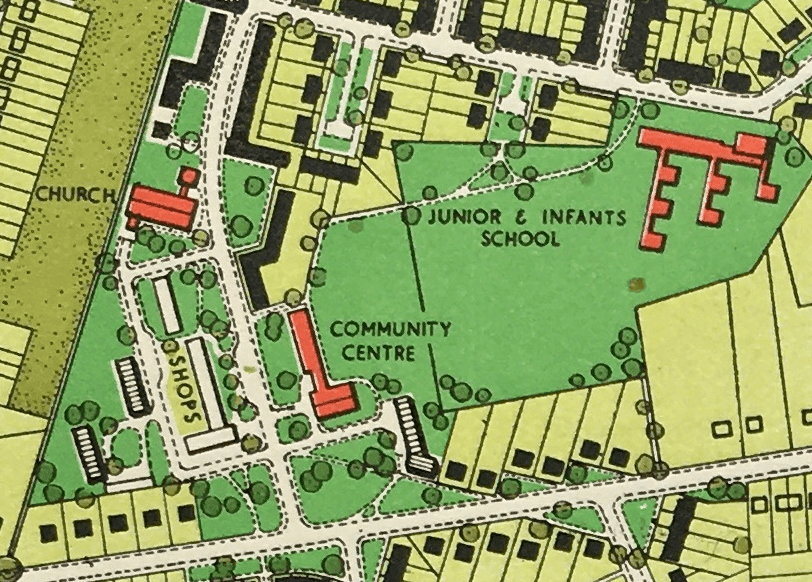
Above – a detail from Holford & Wright Vol 2 – Maps (1950)
Queen Edith’s Way runs along the bottom left to right, with Wulfstan Way heading between the community centre (that didn’t get built) and the shops (that did, but are long overdue comprehensive redevelopment). A pub and a non-conformist chapel opened in its place, the former being demolished in the late 1990s and fairly recently being rebuilt in the early 2010s, where as far as I’m aware it’s doing well. Certainly better than its predecessor in the 1990s.
Why can’t we have a system that’s like Events On The Wight?
I’ve been moaning about Cambridge’s inability to create something like https://events.onthewight.com/ for over a decade. Look at the landing page below. Everything clearly colour-coordinated, by days, by venues…

…and in the left side bar below the calendar it has themes that stand out for specific groups most likely to be at a disadvantage, such as people on low incomes, and under-18s

…and at the end they have reminders of big festivals and large events looming too!

Above-left, up-coming festivals plus community events all colour-coded all on the same landing page.
Design-wise it’s excellent. How is it then, that in a city supposedly full of wealthy, smart, dynamic people we cannot put together anything like as good as this?
Because our governance structures are not fit for purpose – being designed for a market town, not a city dominated by a university with a globally-recognised name. Furthermore, this is reflected by:
- …ministers not being entirely frank with Parliament over the state of local government finances and who demanded what,
- …ministers trying to pretend that they are increasing funding by talking ‘in cash terms’ when the increase they provided is lower than the rate of inflation – so it is a real terms cut, forcing councils to increase council tax bills which are more regressive (hit the poorest the hardest as a percentage of their income) vs income taxes or wealth taxes
- …The University of Cambridge spokespeople trying to imply that the local planning authority has not granted planning permission for the swimming pool the former committed in writing to build as a condition of planning for Eddington, without mentioning that the University is yet to submit a planning application for that very same pool!
- …The University of Cambridge being exempt from paying business rates – meaning that (as far as I am aware) all of that tourism revenue that the University and colleges receive from tourist charges don’t cover the costs of maintaining essential city infrastructure that needs maintaining – noting the University and Colleges are specifically exempt by name from business/non-domestic rates in Government Guidance here. (And yet they get seats on both the Greater Cambridge Partnership Board and the Combined Authority).
You can see why some town-gown issues still rumble on!
At least Scotland made an attempt to shake things up back in 2017. (Local taxation is a devolved matter in Scotland – Westminster cannot touch it).
“Leisure centres, some golf clubs, private schools and universities should be brought fully under the [Scottish] business rates system, according to a review.”
BBC Scotland, 22 Aug 2017
The analysis by the Institute for Chartered Accountants of Scotland noted that although the Barclay Review of 2017 recommended universities should be brought into the business rates system, Scottish ministers decided to maintain the exemptions (indicating a very successful lobbying operation!)
The point is that the principle of exemptions for universities for at least some of their functions has been tested and found wanting – but the political will to make the changes is still lacking.
The role of the University of Cambridge in looking out for residential communities
The only thing that local government can do in/around Cambridge is to ask the colleges very nicely if they’ve got any spare change from the £2billion+ they received in donations between 2015-2022. Only you’d have thought that between them they might have put aside some money for the swimming pool that they signed an agreement to build in order to get planning permission from Eddington. Wouldn’t it be nice if some of the colleges could contribute financially towards new shared facilities for shared activities? Especially in those parts of town that are the most economically deprived and/or lacking in facilities? I hope the wider town-gown-surrounding-villages relationships and governance structures come up regularly at the general election debates. Because the huge inequalities in and around our city are unsustainable.
Food for thought?
If you are interested in the longer term future of Cambridge, and on what happens at the local democracy meetings where decisions are made, feel free to:
- Follow me on Twitter
- Like my Facebook page
- Consider a small donation to help fund my continued research and reporting on local democracy in and around Cambridge.

 The Cambridge Town Owl