
Our city goes to the ballot box for the city council elections, and we are joined by the county and the City of Peterborough for the Police and Crime Commissioner Elections on 02 May 2024 – less than three months away
“Elections are due to take place in Cambridge on Thursday 2 May 2024. The Cambridgeshire Police and Crime Commissioner (PCC) will be elected, as well as 14 of the 42 seats on Cambridge City Council.”
Cambridge City Council – Elections 2024
If you want to stand for election this year, for some political parties it’s too late, while for others you need to be quick to put your name forward!
“If you would like information about standing for election as a Cambridge City Councillor, email us at elections [@] cambridge [.] gov [.]uk.”
Alternatively you can do what I did last year and stand as an independent candidate in order to get publicity for a specific *local* issue. In my case it was encouraging people to talk about overhauling how our city and county are governed – in the hope that it would start a conversation between other people and become a self-building positive conversation. Which it has – see https://www.cambsunitaries.org.uk/
“But I’m not good at public speaking!”
You don’t need to be – but you do need to have the basics of publicity so people know what your views are. For those of you wanting to become better public speakers, there is a non-political group that meets regularly to enable people to practice – the Cambridge branch of the toastmasters.
Either way, the Cambridge City Council election page says you’ve not got long to decide.
- Tuesday 26 March: Notice of election published (official start of the election period)
- Tuesday 26 March: Poll cards issued
- Friday 5 April, 4pm: Deadline to submit a nomination to stand for election
Above: six weeks and counting (from the time of typing)
Organising public events – does it have to be adversarial BBC Question Time-style events?
If you want to organise an event, see the guide that Chris Rand wrote in 2016 here. Also, see the Electoral Commission guidance.
If you are looking for affordable community centres to hire, see the map by Cambridge City Council here. Note that map didn’t appear by magic – it took lobbying and a cuddly toy standing for election ten years ago to persuade councillors that an online map of community centres might be a useful thing to have.

Above – local hoodlum Puffles gatecrashing a Labour stall back in 2014 outside the old Budgen’s store on Adkins’ Corner (named after Mr Adkins who ran the shop before it)

Above – Vote dragon, get dragon – Cambridge City Council installed a dragon slide at Coleridge Rec a year after Puffles’ election campaign. Photo: Cambridge Playlaws Project
You don’t have to have a ‘BBC Question Time’ style event – there are alternatives
About a decade ago during the 2015 general election campaigns, I recall one group organising an event that involved multiple shared conversations that was a bit like speed-dating, but with people forming groups and rotating the individual candidates.
If I recall correctly, the public that turned up separated into small groups that equated to the number of candidates on the ballot paper that were present. Each group had 15-20 minutes with each candidate before the candidates rotated. That significantly increased the number of conversations that took place, and increased the chances of everyone in the room having the chance to put questions to at least one of the candidates. For most people those exchanges can be enough on forming a judgement on a candidate – to the extent it influences how they vote. (Party manifesto, party leader, and any political allegiances/dispositions amongst other factors inevitably can have an impact too).
Cambridge City Council’s community centres
You can browse their list here
My hope is that by putting this up, there might be a few people living in different neighbourhoods in our city who could step forward to organise an election event for their community to meet and question the candidates on their ballot papers.
A dress rehearsal for the General Election contests?
One of the shortcomings of past general election contests in Cambridge is that the vast majority of debates seemed to take place in the city centre. The influential institutions and socially-connected societies inevitably selecting familiar venues meant that several neighbourhoods never really got the chance to meet the candidates in a group setting. This is something I’d like to see change this time around.
For example I think it’s essential that the larger residential areas – especially those with a large proportion of council housing, should have at least one large event. (Some didn’t have any at all in previous elections). Furthermore, there’s an historical precedent of candidates publishing in advance a list of places where they hold their own individual events
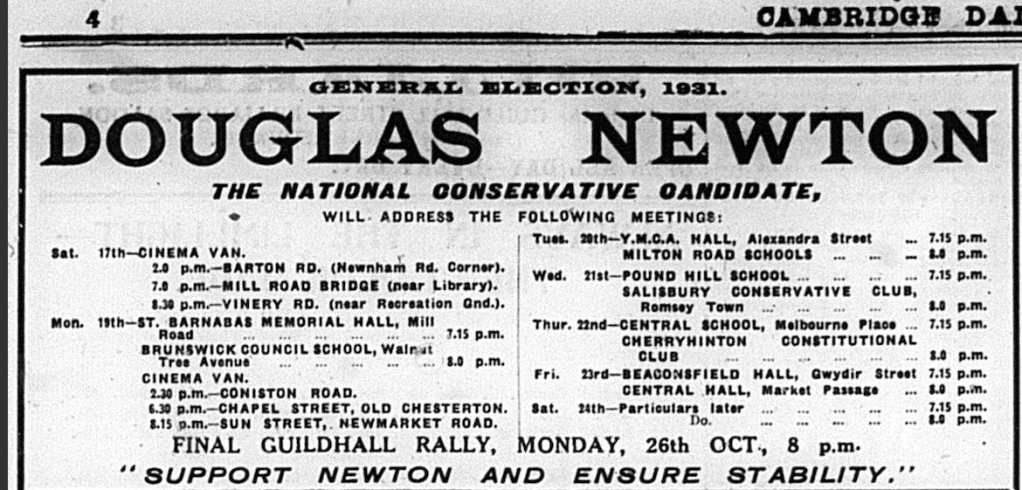
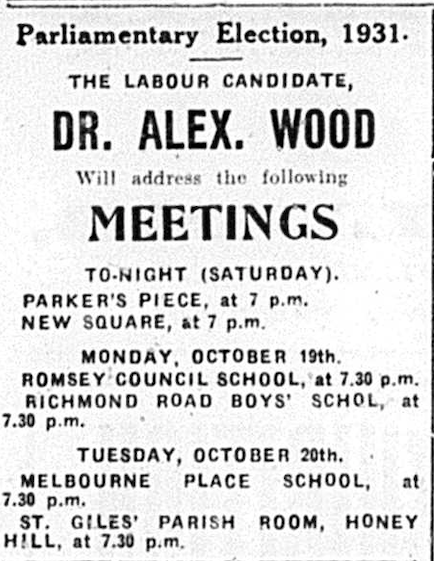
Above and left: From the Cambridge Daily News 17 October 1931 via the Cambridgeshire Collection:
Newspaper adverts from Cambridge Borough candidates Douglas Newton (Conservative), and Dr Alex Wood (Labour) – note the use of both school halls, and also the recently-invented ‘cinema vans’. Anyone planning on using tablets and portable speakers for centrally-produced campaign videos?
Above – how these notices contrast with the habit of today’s top-down controlled political parties who in recent times withhold details of such events, especially visits from senior politicians. I’ll leave you to speculate as to why this is, and to what extent this increases the divide between people and politicians.
Furthermore, rather than having a BBCQT free-for-all where the loudest voices can end up dominating, organisers could do what Chris Rand (who has sadly moved away from Cambridge) did with the Queen Edith’s hustings as the video below shows:
Above – from the Queen Edith’s hustings for the Cambridge City Council elections 2018 (pictured, Dr Joel Chalfen, who was the Cambridge Green Party Candidate in Queen Edith’s ward for 2018)
It’s almost becoming a piece of local history now – this being pre-Lockdown and also in that strange period of political history between the 2017 and 2019 general elections when the UK was governed by an unstable minority Conservative-led Government with a left wing Labour opposition led by Jeremy Corbyn. It’s all too easy to forget the importance of the national political context of that era. with that in mind you can watch:
- Queen Edith’s hustings 2018 Part 1 here
- Queen Edith’s hustings 2018 Part 2 here – where the number of questions people submitted ended up being far more than anticipated.
Also note that the first video received over 200 views, and the second video over 100 views prior to polling day, which (for me at least) demonstrated how important it was to video the debates for local residents unable to make the event. Furthermore, the local news reporters at the time told me how useful it was to have access to those videos for the purposes of writing summary news reports – not least because it enabled them to quote the candidates directly. Then, as now, was a time of local news organisations being run on a shoe string, with few firms willing/able to commit the staff to report directly from such events – especially when all-too-often there is a timetable clash somewhere.
“Won’t group conversations mean you can’t film them?”
These days I don’t have the capacity to do what I was doing a decade ago. Furthermore, for most people not attending the event, they only need/want to see some short clips of the candidates before making their minds up. The difference in viewing numbers between the first and second videos above (and with other events I have filmed over the years) reflect this. Furthermore, I’m also aware of how off-putting the camcorder can be, and that there’s a stronger public interest in members of the public feeling able to have conversations with candidates and elected representatives especially if they want to raise sensitive issues.
“I don’t know any community groups where I live who could organise an event”
You can get in touch with the Cambridge Council for Voluntary Services to ask if any of their members are willing/able to help organise an event near where you live, and have suggestions for who might be a suitable, impartial chair – reminding people that the Electoral Commission guidance applies.
If you are interested in the longer term future of Cambridge, and on what happens at the local democracy meetings where decisions are made, feel free to:
- Follow me on Twitter
- Like my Facebook page
- Consider a small donation to help fund my continued research and reporting on local democracy in and around Cambridge.
 The Cambridge Town Owl