Three gatherings in two days with a trio of very different groups of people gave me a snapshot of where our city is at – along with its structural weaknesses and our civic potential.
One gathering was running a workshop on the relationship between central and local government for the Cambridge University Climate Society, another was a gathering of the Coleridge Community Forum at their final Thursday food hub, and that was followed straight after by the Queen Edith’s Community Forum.
Queen Edith’s Community Forum – the end of an era
It’s not easy when the twin pillars of a local community depart for pastures new. In our case, former ward councillor Sam Davies MBE (2020 – For Services to the Community in Queen Edith’s, Cambridge) heads out to the West Country, while newsletter and magazine editor Chris Rand heads out east towards Ipswich. So the new committee elected on 22 Feb 2024 is:
- Chair – Claire Adler
- Treasurer – Fiona Goodwille
- Communications – Ed Griffiths
- Secretary – Gill Thomas
- Events – Pat Harrington
…with a handful of us (me included) as non-portfolio committee people who help out as and when needed. Such as filming meetings/debates and researching/writing articles on local things in newsletters and magazines. I’ve uploaded the videos to my YouTube Channel here
Above – Speech by Claire Adler, the newly-elected Chair of Queen Edith’s Community Forum
The turnout this evening wasn’t particularly high, but given that the Met Office had issued a weather warning over wind and rain (part of Cherry Hinton Brook burst its banks on the northern edge of Coleridge ward!) the prospect of heading out in the cold, windy rain in February inevitably put people off. Hence the importance of filming such events – not least the public speakers who raised a series of important issues not just for our neighbourhood but the city and county too.
Matt Burman – The Junction, Cambridge
As CEO and Artistic Director of The Junction, Mr Burman summarised the ever-tightening financial constraints not just on his own organisation but for the arts scene across the country. Hence the importance of community support through schemes such as The Junction’s Membership – of which I’m one. Prior to his speech I asked him about The Junction hosting some small community gatherings in their upstairs function rooms – for example for the Coleridge Community Forum if only to let more local residents know that the building exists and that it is for them as well.
The statistics on the freezes to cash-terms funding from the Arts Council (Frozen since 2010 – so a real terms/accounting-for-inflation cut of almost 50% since then) and from Cambridge City Council – themselves clobbered by austerity since 2010 – has inevitably had a significant impact on what a community arts institution can do. Hence wanting to explore better ways of tapping into some of the wealth in the more affluent parts of South Cambridge (we do have pockets of hidden poverty despite the gleaming science boxes of the Biomedical Campus) to support the arts for the many.
One of the inevitable tensions that The Junction has to deal with in trying to provide entertainment for teenagers and young adults is managing narcotics ‘n’ booze. Just like it was in the mid-1990s when me and my lot went clubbing there in the olden days before the Leisure Park was built and you had to walk past a derelict cattle market along a very poorly-lit Clifton Road.
And even then, I remember meeting teenagers of a similar age who crossed county boundaries to get to the Junction. (One of them at the time was my Godmother’s daughter – I remember being astonished that they wanted to make such a long journey, but they told me that in 1990s Mid-Herts there was nothing for older teenagers to do.)
Fast forward to today and the tale above would not sound out-of-place, because Mr Burman told us that nearly a third of The Junction’s ticket sales are from post codes outside of Cambridgeshire. Only around a third are Cambridge-based post codes. That in itself tells a very big story about the shocking state of the performing arts in East Anglia. In the face of the financial catastrophe in local government, movements such as the Campaign for the Arts have sprung up (that one being a response to CV19).
How do arts institutions provide for teenagers and young adults while trying to balance the risk of losing their licences if they are seen to tolerate the consumption of such substances? (Knowing that neighbours who are disturbed will inevitably complain – understandably so). I don’t know what the answer is. I just feel sad for today’s generation of teenagers who don’t have the calendar of different club nights that my generation had every Friday and every Saturday night. (See The Junction’s current club nights here).
Trying to survive in a fragmented city – how do people and institutions communicate in a broken-up city?
This came up in an exchange between Alex Elbro, who you may know from Cambridge 105 Radio, and Gill Wilson of the Cambridge Biomedical Campus over how to publicise the various things that were happening on the place I will always know as ‘Addenbrooke’s’ because I grew up with it. Similar to the Cambridge Leisure Park site being ‘the cattle market’ because in my early childhood it was still a functioning livestock market. Anyway, it was about the Addenbrooke’s Choir – something that perhaps should have been featured on Cambridge 105 but hasn’t been. This was after some questions that involved the mentions of various different newsletters. Gill Wilson made the point that everyone is talking but no one is listening because everyone is so busy. The multiple organisations sending out newsletters reminded me of the fragmented governance structures and the institutions all having their own consultation websites and event calendars.
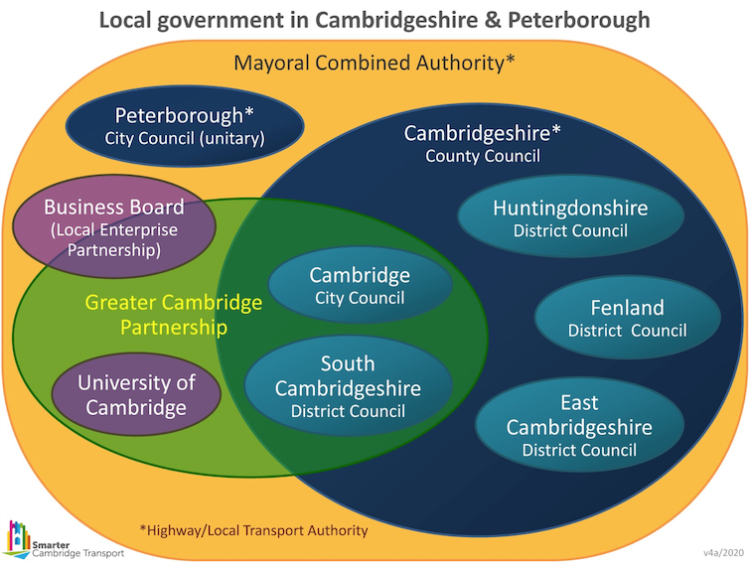
Above – by Smarter Cambridge Transport
It’s hard enough keeping up with the calendars of the above institutions so trying to keep up with the announcements in the newsletters of every sci-tech organisation or property firm wanting to make a splash is trying to do so in an empty swimming pool. Why an empty pool?
- Reach PLC has turned their stable of local newspapers into royal family clickbait – with their print circulation less than 4,000 for the once mighty Cambridge Evening News
- BBC Local Radio has been all but destroyed in a botched cutting process not helped by a real-terms licence fee freeze imposed by ministers (there are more imaginative ways of raising additional revenue through online subscriptions for overseas viewers, and licensing of their huge archive online, but they’ve had little encouragement from ministers to do this)
- Commercial radio has gone a similar way to the above – being taken over by larger media groups that play the same output just with a slightly different local ‘brand’ stamped on them
- The University of Cambridge’s structures are such that very few people really know where its centre of power is, let alone influence it – making it all but impossible to co-ordinate anything *as a city*
- The governance structure of local government in and around Cambridge is ever so fragmented that no one really knows who is in control of things generally
- Attempts at starting sustainable community/local TV stations all failed.
I pointed out that in the mid-1990s the old Cambridge Evening News would shift tens of thousands (around the year 2000 it was over 40,000 although the long term decline had already started). At least back then all the listings were in one place. What was missing from those days – certainly for us teenagers was the encouragement from adults to really engage with and get involved with arts, drama, and music *unless* you knew someone who was already passionate about public participation.
And in an era where people really were judged by their exam results – to the extent they were encouraged to drop the ‘fun’ stuff, going back through the newspaper archives and looking back at ‘missed events’ actually makes me even more angry about that era than I already am. Which is not good. Especially as after coming out of the other end of the education system as apparently one of the ‘successful ones’, I view much of that time as utterly wasted. Why do I feel that way? Sir Ken Robinson explained in a TED Talk that was animated by the RSA back in 2010. Have a watch.
Above – Sir Ken Robinson / RSA Animate 14 Oct 2010 – Changing Education Paradigms
Sadly the Education Secretary at the time, Michael Gove (who is behind Cambridge 2040) had different ideas – as the former Deputy Prime Minister Nick Clegg alleged in 2015. (You can take some of the things with a pinch of salt as it was from the run-up to the 2015 general election that saw the Liberal Democrats lose over three quarters of their MPs in the Commons – including Cambridge MP Dr Julian Huppert.)
“Hasn’t anyone invented an online equivalent for the events listings in the old newspapers?”
I’m still waiting to see who wants to create https://events.onthewight.com/ for Cambridge.
And the problem that Cambridge faces is that so much is targeted at everyone *other than the residents*, that the people who make up our city are all too easily forgotten. Why in the world would anyone brand an arts and entertainment website supposedly trying to serve the whole city as “Visit Cambridge”?

Above – Visit Cambridge: What’s On
One of the points made at the meeting was that the above is what the Cambridge BID (established under the auspices of the Coalition Government) is trying to use to bring together organisations that put on events. But the phrase ‘Visit Cambridge’ automatically implies that it is aimed at visitors – tourists, rather than residents. And for residents – especially those of us who grew up here, this is home – warts and all.
Furthermore, the fact that BIDs (Business Improvement Districts) exist is a symptom of a broken system of local government financing – which as we know is out of control. In return for paying an additional levy on top of non-domestic business rates, firms in the designated area get to have a huge influence on projects to improve their area. The problem with this is that Cambridge’s BID doesn’t cover the whole city. It only covers the historical centre plus the area around Cambridge Railway Station.
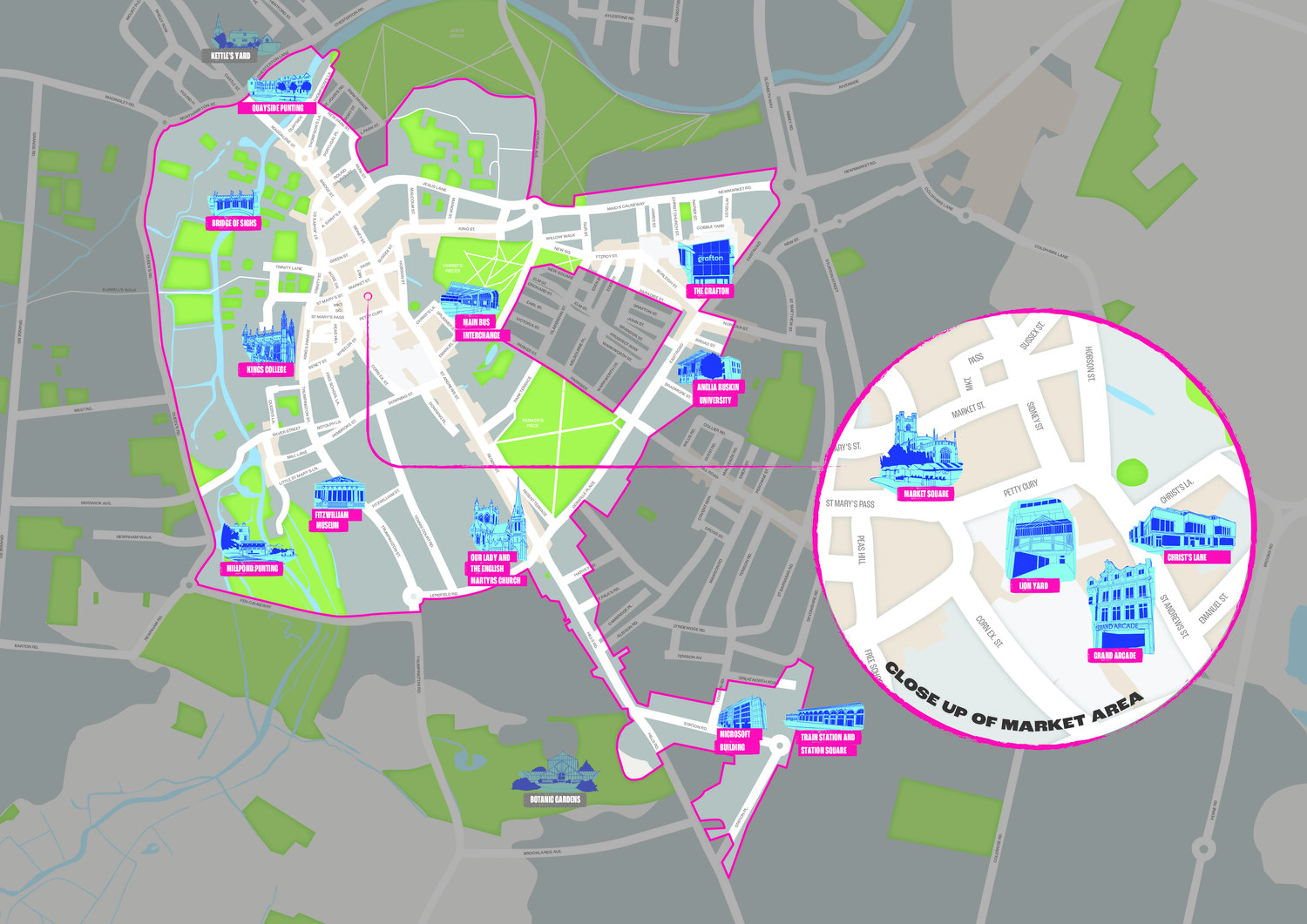
Above – the Cambridge BID Area
Such is the cash crisis and the fragmented system of local government that Cambridge City Council has become almost non-existent in comparison to the BID and the University of Cambridge.
Ministers only have themselves to blame when they complain about lack of civic pride
This contrasts with the thanks given to Sam and Chris earlier, who as Claire Adler said, through their work in empowering the rest of us, have given the people of Queen Edith’s an identity that we did not have ten years ago. There is an historical context to this because the part of town where the forum meeting too place was at various times known as:
- The Rock Estate (after the building company that built many of the homes in the late 1800s/early 1900s)
- New Cherry Hinton (as opposed to old Cherry Hinton Village at the other end of Cherry Hinton Road)
- St John’s – the church parish named after the Anglican church built in the 1890s – and at a time when the institution still dominated, and some council wards were named after church parishes.)
It wasn’t a one-off event that put Queen Edith’s on the map. It wasn’t a corporate branding exercise that did it either. It was the result of nearly a decade’s worth of continuous activity – including throughout the biggest national crisis to affect our day-to-day lives since the War.
“Community action is hard work – with no guarantee of success either”
“You have to learn how to listen.
Michael Sheen, 2017
It’s not just a question of standing there with a clipboard and asking questions with the right look on your face.
You have to show up.
And stay around.
You have to let go of your assumptions and your biases and your agendas and your prejudices.
It’s really hard.
Speak to the people who are on the frontline of working in communities.
The ones doing the really tough work of giving support where it is desperately needed.
Where their resources are getting smaller all the time but the need for what they’re doing is getting greater every day.
Ask them about listening.
Because they’re really good at it.
But they’re also the ones who’ll say that they’re not being listened to.“
There was something deeply prophetic in Michael Sheen’s words when he gave the Raymond Williams Lecture back in 2017 – Sam Davies spent years trying to make the case for improving our city and how it is structured and governed. Sadly to no avail – hence in part her resignation from Cambridge City Council late last year.
Cambridge cannot afford to lose councillors of the calibre of Sam Davies
The fact that she’s not the only high calibre [in my opinion as someone who watches council meetings online and in the chamber!] councillor to resign should:
- ring alarm bells in local government across our county
- be a major discussion point for all of the constituencies in Cambridgeshire in the run p to the general elections – with party candidates put under detailed scrutiny on what their political parties are proposing to change about local government in England. Because it cannot continue like this.
Cambridge also cannot afford to ignore the concerns of its less affluent residents just as the University of Cambridge and its member colleges/institutes should not be bypassing the involvement of its students, staff, and researchers when deciding what its corporate views are regarding the future of our city.
I took along a copy of the Holford-Wright Map of 1950 to the Coleridge Community Forum / food hub and it was wonderful to see how many conversations people struck up just by looking at the now 74-year-old map.
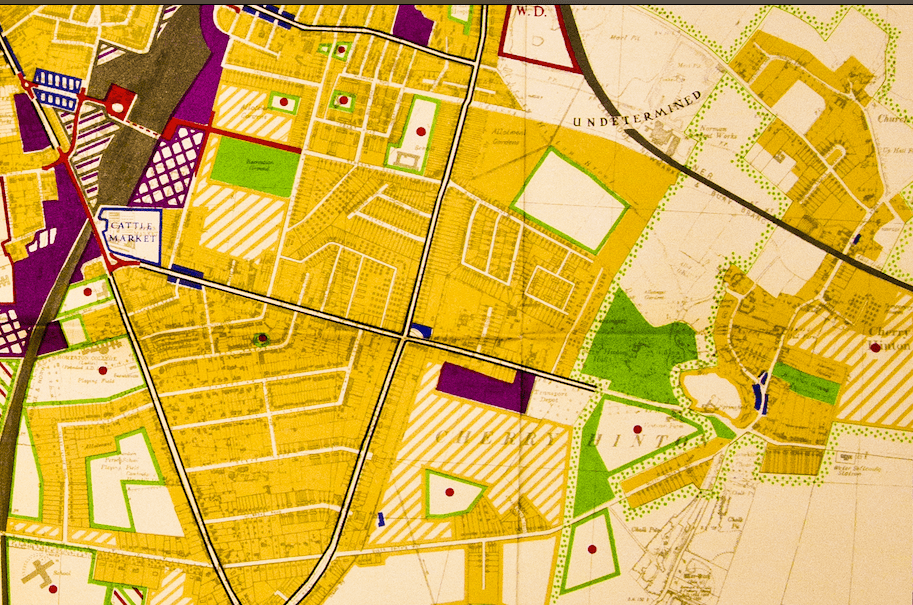
Above – Coleridge and Queen Edith’s wards from a detail in Holford/Wright (1950)
Hence why I’m going to be putting on some joint events under the oversight of both forums and see where it leads people to.
Similar issues on governance were raised by the students and researchers at the workshop I ran for the Cambridge University Climate Society

Above – an advert for my earlier workshop at Emmanuel College, Cambridge
One of the areas they found the most interesting was the Cambridge Green Belt, of which I showed them the ***huge maps*** from the Cambridge Green Belt 1992.

Above – that’s just two of the four full-size maps put together.
It enabled the participants to compare the Cambridge around the time I started secondary school with the city of today – and question me on what the green shaded area really meant, and the processes by which developers through ministers can overcome the protections of the Green Belt. Hence concern about the future growth of the city in the face of the climate emergency, the water crisis, and the ecological crises. They told me that it’s essential that future generations of undergraduates get a ‘crash course’ in local government in Cambridge as well as on Westminster politics in their first year – ideally within the first term, so that their campaigns (especially on local issues that are important to them as well as the wider city) can have a far greater impact by identifying the decision-makers (and how to influence them) much earlier on in their time in our city.
The question for us residents is how best to support the students in holding their powerful institution to account for the decisions that it effectively makes in their names.
Food for thought?
If you are interested in the longer term future of Cambridge, and on what happens at the local democracy meetings where decisions are made, feel free to:
- Follow me on Twitter
- Like my Facebook page
- Consider a small donation to help fund my continued research and reporting on local democracy in and around Cambridge.
 The Cambridge Town Owl