The Levelling Up Committee of the House of Commons took evidence earlier today – and came out with some damning quotations about the construction industry’s failures to accommodate children and young people.
Image: Remember the Cambridge Playlaws project?
You can read through the written submissions here. (I originally thought there were only three – which seemed an abnormally small number!) You can also see links to the select committee hearings in the events tab.
Public policy failures – ones for ministers of the future to consider
“National policy has long overlooked the participation of children and young people in the built environment, and there is currently very limited national policy or guidance about participation and good design for children and young people.”
Earls Court Development Company, and ZCD Architect (CBE0106) – evidence to Commons Levelling Up Committee, 01 Feb 2024
“For decades, public policy in England has failed to create places that support children’s healthy development and wellbeing.”
Architecture for Kids
The latter reeled off some key statistics in its written evidence:
- 1/5 of UK population are under 18
- Children spend far less time outside than they used to
- Children play on their street far less than they used to (80% in 1970s – 22% in 2022)
- Children walk/cycle to school far less than they used to (86% in 1970 – 25% in 2010)
- 1,665 child pedestrians/cyclists (0-15) were killed or seriously injured in 2021
- 30% of UK children live in areas with unsafe levels of fine particulates
- Only 21% of children in England (5 -15) meet official targets on physical activity (1hr/day)
- The UK has the second lowest life satisfaction of 15year olds across all OECD countries.
Their recommendations for ministers in terms of medium term policy changes are:
- Revising National Planning Policy Framework to include requirements for planning applications to meet children’s need for safe, accessible outdoor space on their doorstep for active play and social connection
- High quality guidance on child-friendly planning to sit alongside NPPF
- Requiring children are considered a statutory equalities group in the planning process.
- Requiring children are meaningfully involved in significant local planning decisions
- Child Impact Assessment as standard part of planning process
- A coordinated approach to restoring children’s access to outdoor space, play & mobility
- A ‘Child-lens’ approach to transport policy ensuring safe streets in residential areas and around schools
- Public health and physical activity strategies prioritising children’s free outdoor play
I’ve picked out a few that stand out for me – in particular the ‘child-lens’ approach: how does the street look from the perspective of someone only three feet tall?
The evidence sessions at Commons Levelling Up Committee
You can watch the evidence sessions from today here
I’m yet to sit through all of the footage but I caught a number of points including:
Some of you may know Mr Anstead from his work on the Hartree development in North East Cambridge (the Anglian Water site that, if the Honey Hill application is approved by ministers, will be redeveloped into a new quarter for the city). I declare an interest in having delivered a paid commission on the life of Eva Hartree in the context of her civic work in Cambridge.
The report Mr Anstead referred to was this one:
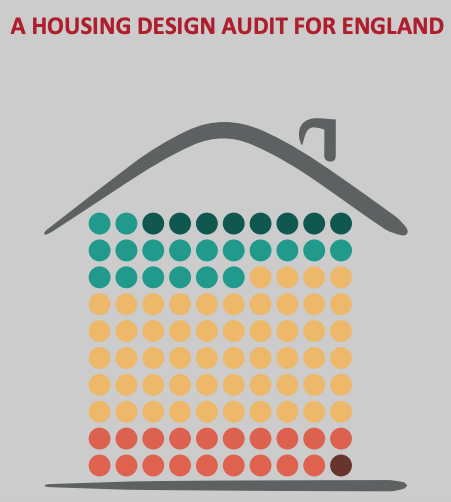
You can read the full report and the summary from https://placealliance.org.uk/research/national-housing-audit/
Inevitably its impact was lost in the winter lockdown of December 2020. Two of the conclusions that should be of interest to Cambridgeshire residents due to the volume of development past, present and future, include:
- “New housing design is overwhelmingly ‘mediocre’ or ‘poor’ – Because the improvement is from a low base, today the design of new housing developments are still overwhelmingly ‘mediocre’ or ‘poor’ (three quarters of the audited projects).
- “Many schemes should have been refused – One in five of the audited schemes should have been refused planning permission outright. The design of many others should have been improved before relevant permissions were granted.”
There are two structural failures underneath each one. The first is that ‘the market’ is failing to deliver good design. This could be for several reasons including the abuse of oligopoly powers by the volume builders, to good design not being rewarded by profit maximisation. ie a ‘race to the bottom’ to achieve the lowest cost. This is something that reminded me of Olly Wainwright’s criticism of the Cambridge Station Redevelopment.
“With outline permission achieved, Rogers’ practice was ditched in favour of a team of uninspiring commercial firms, including Chetwoods, TP Bennett and Perkins & Will, to bring forward detailed applications for the individual plots.”
Olly Wainwright in The Guardian, 13 June 2017
The second is the failure of local government planning committees – an understandable one given the political and financial contexts. Why didn’t planning committees refuse more below-par applications? For a start Ministers chose to bring in a policy that enabled developers to appeal against refusals by local planning authorities, with the latter picking up the bill in the case of a planning inspector overturning the refusals. In the face of top-down imposed austerity, the entire sector found that not only could they not compete in the jobs market for town planners, but they could not afford the financial hit of having to meet the legal costs of developers that won on appeal. Especially with large developments.
As a result, councillors understandably became over-cautious and ended up approving developments that might otherwise have been refused. That swathe of poor quality buildings is the legacy of Messrs Shapps and Pickles who were the ministers that brought in the policy – the final ministers who I served under before taking voluntary redundancy from the civil service in the face of austerity back in 2011. (Yes, I still have a chip on my shoulder!)
Councils should incorporate evaluations as a planning condition – and include evaluations of neighbourhoods within it
Or at least try to if they do not have the formal legal powers to do so.
This relates to the point architect Dinah Bornat of ZCD Architects made to the committee about evaluations only covering the individual buildings, and not the wider neighbourhood.
“It’s really interesting – the questions that are asked of residents in new developments… it doesn’t stretch to anything really about the neighbourhood…it’s a bit like buying a fridge or washing machine.”
“It’s bizarre – when you look at new developments for sale, the image you always see is a happy person – you see children playing outside – really often. It turns out we’re not really that bothered about a south-facing garden as whether it’s a neighbourhood that children can play out in. That’s a really important even though we don’t ask those questions”
Dinah Bornat to Commons Levelling Up. 26 Feb 2024
This reflects the conclusion from the Place Alliance Report:
“Resident satisfaction contrasts with community dissatisfaction – Whilst new residents are generally happy with the environments around their new homes, this contrasts strongly with the views of local communities (as represented by their local councillors) who regret what they see as too much overdevelopment and a loss of local character. Both residents and communities see a negative impact from unduly car and roads dominated environments.“
Place Alliance – National Housing Audit 2020
The House of Lords Inquiry into High Streets in towns and small cities
This one is still accepting submissions so if you have any views, get in touch with the committee and send it in – noting the questions put to the public by the committee. which include:
“Who is involved in ensuring a thriving local high street and does the current structure of Government support facilitate those groups in working together?”
House of Lords Built Environment Committee
One for the residents of Cambourne, St Neots, Huntingdon, Wisbech, Chatteris, and St Ives to name but a few of our towns in Cambridgeshire?
Competition and Markets Report into the house building industry

Above. You can read:
- The Press Release
- The full report and summary report
- BBC News on allegations of price sharing in the house building sector
It will be interesting to see what the CMA investigation concludes – and which of the recent developments in Cambridge are covered by it. The most important thing however will be the policy recommendations and the number of those that transfer over into political party manifestos – in particular Labour’s manifesto given the odds of them forming the next government.
Talking of neighbourhoods, Cambridgeshire County Council has released its draft Active Travel Toolkit
Councillors will be considering this next week – see item 6 and appendices in the papers here

Above – from the County Council’s Highways and Transport Committee 06 March 2024
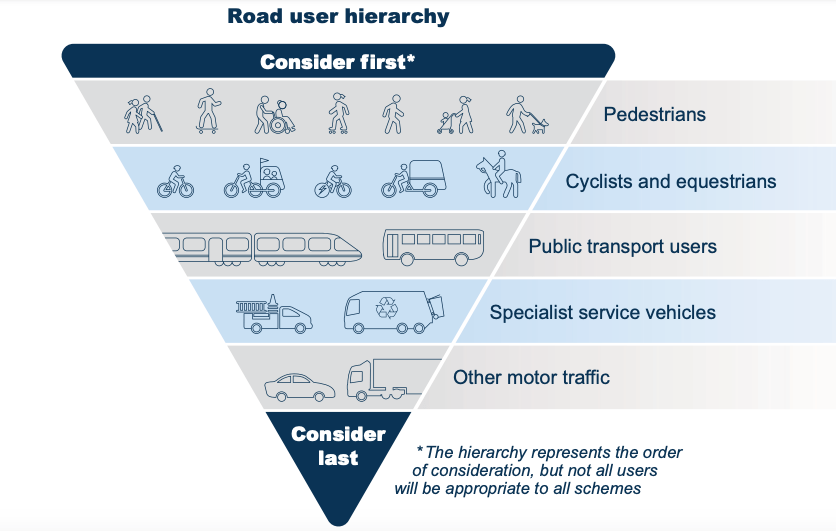
In one sense there’s little that’s new – you’ll be familiar with the concepts such as the road user hierarchy
What’s even more telling are the list of references and guidance documents that influenced this local one.
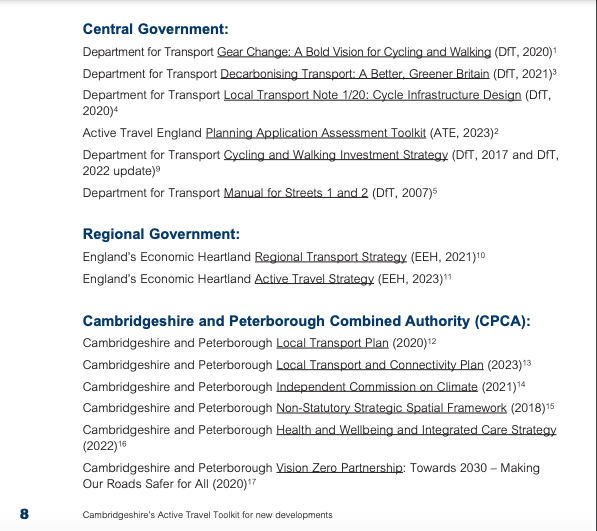
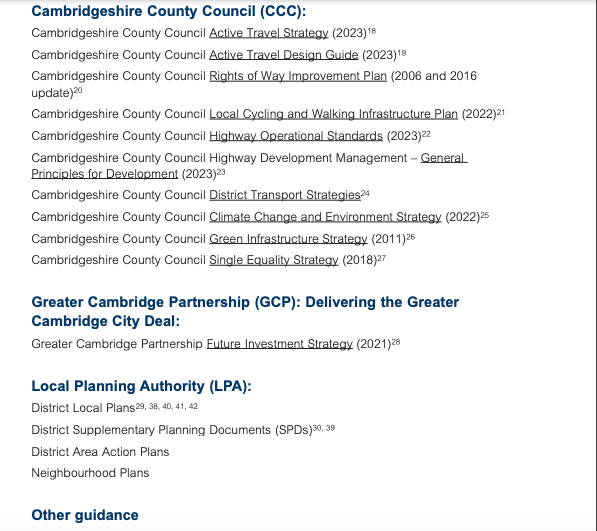
Above – from pages 8-9 Item 6 App A
At what point does so much guidance become micro-managing? At what point does it become impossible for anyone to have that broad overview of what is and is not permissible?
Again, this was one of the things that came up in the CMA report about the planning system and how its current structure, systems, and processes inevitably lead to a reduction in house building. At the same time, the system is just as much one around the finance industry as it is the construction industry, the CMA noting that much of the house building is done using a speculative model. That is that the builder is not ‘building to order’ but building on the assumption they will be able to make a profit from selling on their product – hence the volatility of the market.
Not surprisingly, this has led to calls for more sites – especially public sector surplus land – to be sold off to housing associations or acquired by councils to build much-needed social and council housing. It will be interesting to see which party manifestos come up with a policy to bring in such a change in the industry – one that benefits both the smaller building firms (who then get a more stable market to work in) and local communities who get the affordable, social, and council housing they so desperately need.
Food for thought?
If you are interested in the longer term future of Cambridge, and on what happens at the local democracy meetings where decisions are made, feel free to:
- Follow me on Twitter
- Like my Facebook page
- Consider a small donation to help fund my continued research and reporting on local democracy in and around Cambridge.
Below – remember the Cambridge Playlaws? Some of the learning applies here too

 The Cambridge Town Owl