
The ex-Labour Cabinet Minister, now multi-tasking as an academic and a TV breakfast show worked with a team of researchers at Harvard, MIT, and UCL, to examine the massive regional inequalities in the UK which was published in Feb 2024.
Pictured: East of England Regional Plan 2010
They are part of a series of papers here – interestingly the paper published just before the regional government paper was on Decarbonisation – by former Universities Minister Chris Skidmore, and Grace Girling. Mr Skidmore resigned as an MP following Rishi Sunak’s decision to continue with pro-fossil-fuel policies including introducing a new petroleum licensing bill.
The recommendations on regional inequalities:
- Have a strategy for growth & productivity
- …that focuses on the specific drivers for each region
- Invest in social infrastructure so the gains are not just financial
- All parts of the UK should have a tier of government that sits between local and national government
- All parts of England should be invited to take part in shaping that future governance structure – with no one left out or opting out
- The Prime Minister should chair a Cabinet Committee responsible for regional and national growth
- People holding the public offices of sub-regional leaders (eg CA Mayors) and national leaders of devolved institutions should have seats in the Lords
- …and have consistent ‘single pot devolved budgets for the English regions as to the devolved administrations
- Offer unitary local councils long term funding agreements over five years, rather than annual ones at present
- Reallocate capital (ie on buildings and machinery – assets) to compensate for historic underspends in some regions.
“What is social infrastructure?”
“Social infrastructure covers a range of services and facilities that meet local and strategic needs and contribute towards a good quality of life. It includes health provision, education, community, play, youth, recreation, sports, faith, and emergency facilities. Green infrastructure in all its forms is also a key component of social infrastructure,”
Definition from Ch5 of the Draft London Plan 2017
“‘Social’ infrastructure represents the crucial organisations, places and spaces that enable communities to create social connections – to form and sustain relationships that help them to thrive.”
Lilian Barratt for the British Academy, Jan 2023
The paper does not support overhauling the tax system
This bit in particular

Above – Balls et al (2024) p11
This brings in the problem of how to deal with somewhere like Cambridge – and also Oxford – both of which are globally-prominent cities that are run like market towns. i.e. the plaything of ministers with too much on their plates already. Furthermore, as Cambridge’s contemporary history has shown, successive ministers have not been able to resist the temptation of creating institutions and boundaries influenced largely by party political considerations. In the case of Cambridgeshire, our boundaries and institutions were established under Conservative (Health, Cameron) or Conservative-led (Coalition) governments.
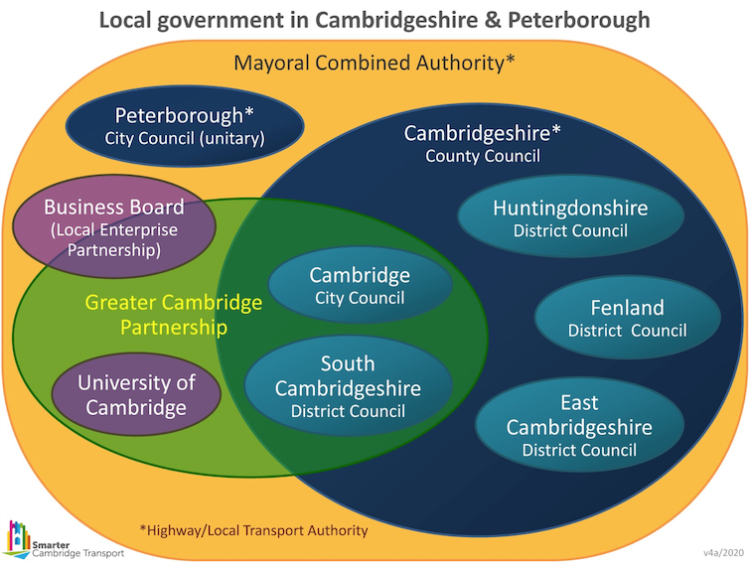
Above – the familiar (to locals) looking diagram of Cambridgeshire’s governance mess that was signed off by Chancellor George Osborne in his final Budget.


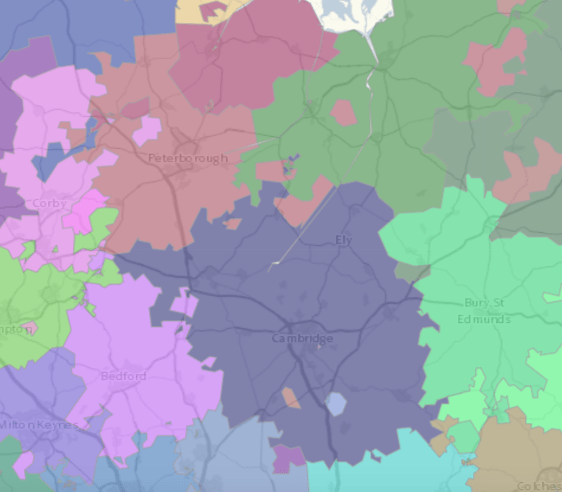

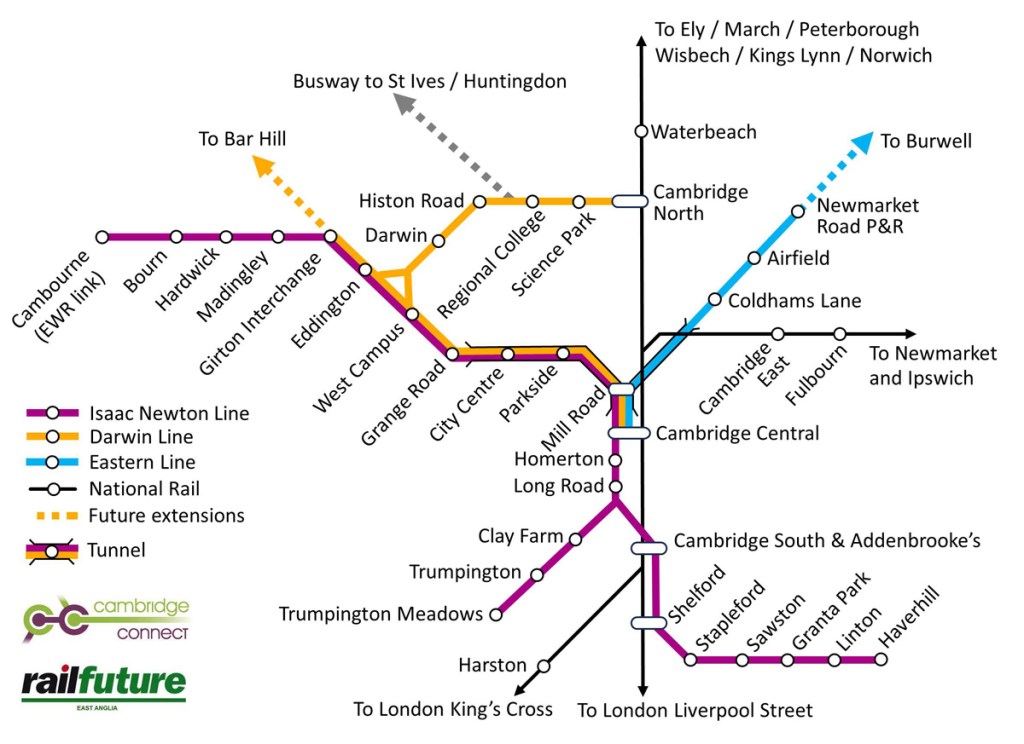
Above:
- The principle of the hub-and-spokes-and-wheel model by Thomas Sharp (1931), noting he was writing in the age of the rapid expansion of the motor car.
- Redcliffe-Maud’s proposals from the maps for Greater Cambridge and Greater Peterborough Unitary Councils (abandoned after the 1970 general election) as part of his Royal Commission on Local Government in England – you can read the summary here.
- The Cambridge economic sub-region from the March 2010 East of England Plan (abandoned in…2010 after the general election a few months later!)
- Nathaniel Lichfield’s illustration of the Cambridge economic sub-region (1965)
- The tube-style map of the Cambridge Connect Light Rail map that could be built in phases, and then extended to link up the surrounding towns and villages as per the principles of Thomas Sharp in 1931.
“Does that mean we cannot have a ‘stomp duty’ on property speculators involved in/around Cambridge or some other levy that makes rich firms and the University stump up for the existing infrastructure gap that Dr Andy Williams, formerly of Astra Zeneca spoke about in 2023?“
It’s this talk if you were wondering.
Actually the concept of land value capture is mentioned twice.
“Other options include reform of the business rates system, experimentation in land value taxation and a further systematisation of the rules from HM Treasury to help value-captured based financing.”
Balls et al, (2024) p34
The infrastructure gap came up *again* this morning (26 Feb 2024) at 07:13am on BBC Radio Cambridgeshire
BBC Radio Cambridgeshire’s Dotty McLeod and team followed up my inquiries about the University of Cambridge’s long-delayed swimming pool. The first media inquiries into this were from the students in The Varsity Newspaper here – important to recognise the importance of the students on picking up public interest stories and also getting the views from students on how they are being impacted by the failure of their institution to deliver what they signed up to. Because without them, my blogposts on the subject (such as this one linking to the documents and agreements concerned) would have stayed within the local political bubble.
Being cross-examined by Dotty McLeod
Although I’m familiar with Ms McLeod, as an interviewer you have to prepare properly for interviews with her and her BBC Local Radio colleagues – as many a national politician has found out the hard way. And this is exactly how it should be. Just because I’m seen to be on the side of the underdog in this case does not mean I should be given an easy time. Which was why I got up far earlier than normal and had all of the articles and references on my laptop to hand to respond to any question she might have.
Have a listen to her questions from 1h13m here (available until 24 March 2024)
“We also asked the University [of Cambridge] if they had applied for planning permission [to build a swimming pool] or contracted somebody to design a swimming pool, and unfortunately we got no response to that”
Dotty McLeod, BBC Radio Cambridgeshire, 26 February 2024 [1h15mins]
The University of Cambridge were offered the right of reply on the BBC Cambridgeshire Breakfast Show but declined to send a spokesperson.
Cllr Katie Thornburrow (Labour – Petersfield) who is responsible for town planning policy at Cambridge City Council, also appeared on the show and she was cross-examined by Ms McLeod – have a listen from 1h42m. Later on in the show we also heard from the St Neots Splash Park (See the concept here) that also remains long-delayed.
The complaint as former councillor Sam Davies MBE posted this morning:
…i.e. the social infrastructure needed to help new developments become thriving communities always seem to be scaled back, and all too often we are left with dormitory towns full of homes to make profits for big developers, but little for the people that end up living there.
It’s the failure of the building industry and allegations of collusion between the big volume builders that has now resulted in an investigation by the Competition and Markets Authority

Above. You can read:
- The Press Release
- The full report and summary report
- BBC News on allegations of price sharing in the house building sector
There will be *a lot more* to this – especially given the numbers of new build homes in/around Cambridge.
“How does all of this relate to regional government?”
The first is co-ordinating housing and transport policy. One of the things the CMA report makes clear is that volume house builders are building to a speculative model, which is volatile in the extreme. Furthermore, the current model squeezes out the small building companies, hence the ‘Barratt Boxes’ criticism of newly built housing designs. Furthermore, Janice Morphet, author of a number of books on local government, queried the Political decision to hand over house building to the private sector, saying that a new method of allocating housing sites needed to be created that ensured housing associations and local councils could build houses to meet social need irrespective of economic conditions.
Above – such a model (especially with the disposal of surplus public land) could and should be used to enable housing associations and local councils to build much-needed social and council housing. Regional planning comes into this to ensure that those housing developments are co-ordinated with transport and social infrastructure investments. For example if Cambridge Connect were built, a regional plan could ensure that new housing could be built on sites within walking distance to the light rail stops in rural areas – dealing both with a rural housing shortage (especially for local people) and creating a larger enough population to ensure the financial sustainability of essential local amenities like a convenience store. That in itself could reduce demand on car use – and wear and tear on roads.
All of this matters because as we found out, the last Labour Government was split on what should happen to Cambridge.
“I remember during this period having a fearful row with John Prescott [Then the Deputy Prime Minister with responsibility for Housing, Planning, and Transport] over Cambridge. I wanted to build Cambridge up as a major economic focus for the whole of eastern England…“
“I thought if you could make Cambridge a really big economic motor, it would spread activity and wealth out across the eastern England. John Prescott wouldn’t even give permission to Cambridge University and the City Council to expand the science park in Cambridge.”
“John subsequently found a way of changing his mind, I am glad to say, and the science park was expanded.“
Lord Peter Mandelson, 21 Feb 2022
Which brings us back to the point of regional planning. Should central government be micro-managing things that can be done at a regional level, or is there a better model for both local and regional accountability? My issue with the Combined Authorities is that there is no directly-elected assembly to hold Mayors accountable.
Whatever system the think tanks and politicians come up with, I hope it is something that involves a big seat for citizenship education and civics. That way we can go beyond the platitudes of ‘allowing people to have their say’ and ensuring people can gain an informed view of the decisions facing where they live.
Then they can choose what to get involved in. Back this up with Universal Basic Income, Universal Basic Infrastructure, and properly thought-through and designed citizens’ assemblies that don’t simply become a) talking shops for the obsessives like me, or a means for the connected and the obsessive (like me!) to bypass democratic safeguards and democratic decision-making processes, and we might get somewhere.
Food for thought?
If you are interested in the longer term future of Cambridge, and on what happens at the local democracy meetings where decisions are made, feel free to:
- Follow me on Twitter
- Like my Facebook page
- Consider a small subscription to help fund my continued research and reporting on local democracy in and around Cambridge.
Below: FInd out what the issues are in newly-built communities
See the timetable via South Cambridgeshire District Council here

 The Cambridge Town Owl