
Today’s Cambridge Arts Network conference at The Guildhall saw delegates grappling with increasingly frustrating issues as the powerlessness of the people and small institutions became more than apparent
In our globally-recognised city that is run like a market town, our city’s arts networks (including the Cambridge Arts Network, and CamCreatives) tried to unpick a number of very challenging problems that our city faces – many of which have their roots embedded in our broken structures, and the inequalities that result from them.
Designing child-friendly cities
There was a significant amount of cross-over from the previous day’s select committee hearings at the House of Commons LUHC Committee that was discussing children and the built environment. In particular, there are a host of recommendations coming from those giving evidence (written and oral) about how the interests of children must be at the heart of our planning system. Whether this is possible under the present extractive system we live in is for another debate.
There is a growing tension between what Cambridge University’s researchers are discovering, versus what the senior decision-makers of their institutions (including the wealthy colleges) are making that affect our city.
For example, Owen Garling of the Bennett Institute talked about civic pride – referring to this report on Pride in Place
The Institute’s research is gaining an increasing profile – as is the work of Prof Flora Samuel at the Department of Architecture.
“The urban room is a place where the community, university, local authority, industry and practice come together to debate the future of their cities. Flora is in the process of setting up an urban room for Cambridge.”
Prof Flora Samuel – Dept of Architecture, University of Cambridge
It’s still in its early days, but the Cambridge Room has now been launched https://www.cambridgeroom.org/about – or rather the website has.
Mr Garling quite rightly raised the theme of sport as being a contributor towards civic pride. Just ask Cambridge United fans. (10 year old me was one of them at Wembley back in 1990 for the first ever play-off final). Just ask the city when The Boat Race is on. In more recent times, both town and gown have been taking more notice of each other’s sporting achievements than I recall in the last millennium. But that’s the response of the people (both at grassroots, and in individuals in influential positions) rather than the institutions.
The challenge is when a big institution such as the University of Cambridge has to prioritise things. The University’s actions over the covenants it willingly signed with Cambridge City Council and South Cambridgeshire District Council speak volumes.
For me, there are two issues:
- Why did the University of Cambridge [as an institution] fail to prioritise the construction of the West Cambridge Swimming Pool given the time it had to fundraise, plan, and build the facility?
- Why did the University of Cambridge then refuse to get back to our local BBC Radio Station, BBC Radio Cambridgeshire when they quite rightly – and as is their job – hold the University accountable over the University’s conduct regarding the preparation of a planning application for the swimming pool itself?
“We also asked the University [of Cambridge] if they had applied for planning permission [to build a swimming pool] or contracted somebody to design a swimming pool, and unfortunately we got no response to that”
Dotty McLeod, BBC Radio Cambridgeshire, 26 February 2024 [1h15mins]
It’s not just town that loses out – it’s the students as well.
Ellie Mason, the Cambridge University Swimming and Water Polo Club (CUSWPC) Junior President, told Varsity that a “university swimming pool would be invaluable to CUSWPC” as “the lack of a university pool limits our financial accessibility along with our training hours”.
“The absolute necessity of a University sports centre has not diminished over the years. Instead, it continues to grow. It grows each year with the rising cost of pool hire, now so great that the Swimming and Water Polo Club cannot afford a coach,” campaigners said.
Varsity 25 Jan 2024
This is, however, one for students and academics to lead on. As a town person, what I say and do carries no weight within that 800+ year old institution. I can support them – especially as it was a previous generation of students that campaigned to get the University to agree to a new swimming pool in the first place. I hope this generation of students can make their institution deliver on that promise.
Luton and Milton Keynes doing great stuff
…the former helped by the agreement the borough council has with Luton Airport. Which seems fair enough given the air and noise pollution that the airport causes. I was particularly impressed by the Milton Keynes Cathedral of Trees
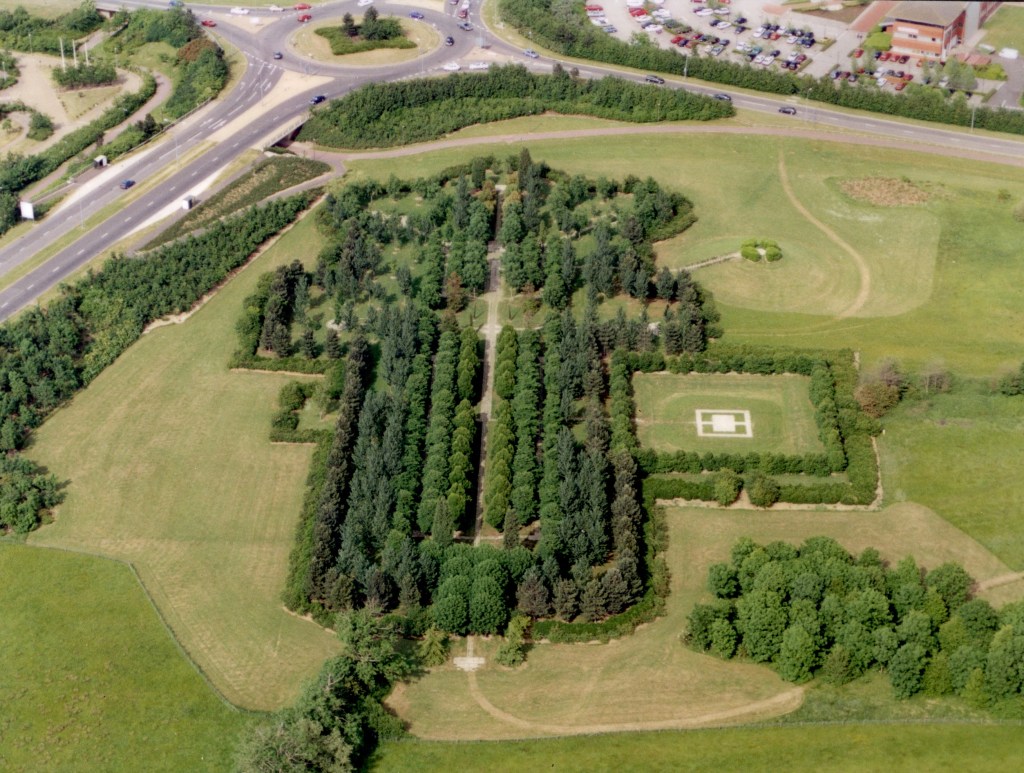
Above – Milton Keynes Tree Cathedral – from The Parks Trust. Hence wondering if an expanded Wandlebury could also plant one. (Assuming we get Cambridge Great Park!)
Marie Kirbyshaw of the Culture Trust in Luton took us through what the two large towns have, and it was at this point that Paul Smith of CamCreatives pointed out that while Luton were fortunate enough to be able to buy a a freehold of an old industrial building with support from a Lottery grant, housing and land prices in Cambridge are so prohibitive that this is a non-starter in Cambridge.
One thing I’ve never quite understood is why there isn’t a rail link between Luton to Cambridge via Hitchin.
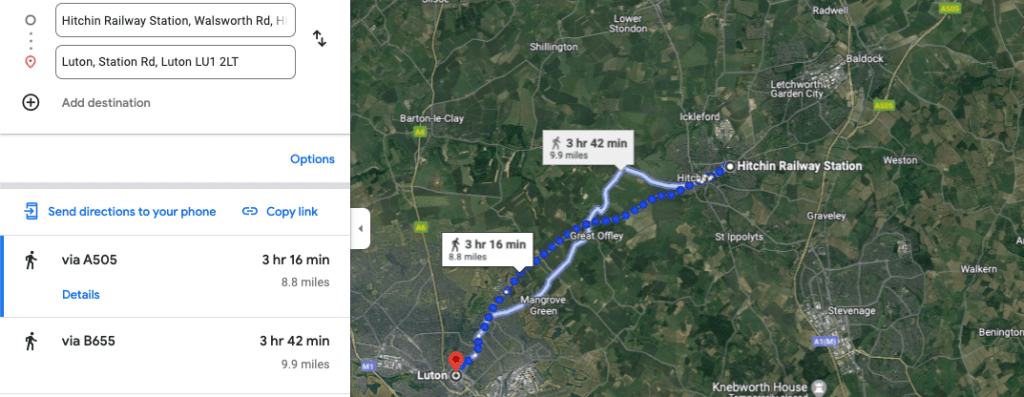
Above – Luton to Hitchin is less than 10 miles on foot.
I’ve played around in previous blogposts trying to work out what the most suitable route – others have suggested Luton via Stevenage given the existing buildings in the way north of Stevenage.
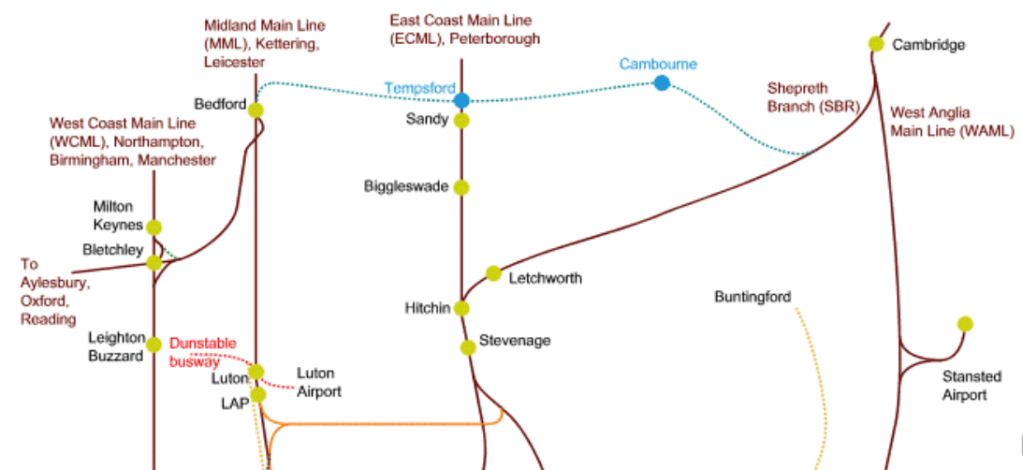
“What’s Luton-Cambridge rail got to do with any of this?”
Everything is over-concentrated in Cambridge and we see the impact of it from science park speculators buying up old municipal tips through to property speculators buying up houses designed for families and converting them into barely suitable HMOs. The latest one being an artificially sub-divided and extended property in Coleridge ward (item 10 here).
Some are of the view that the government should ‘let rip’ in/around Cambridge and build until the industry is exhausted. Others are of the view that our environment is already burdened beyond capacity and that all building should halt now. And then there are those in between.
Whatever level of building you think Cambridge and South Cambridgeshire should have, my take is that a national industrial strategy sitting alongside a series of co-ordinated regional strategies underpinned by an overhauled governance system for England is the way to go.
In my case a regional strategy would have Cambridge linked up by rail to Bedford and Northampton in the west, with both designated as ‘landing sites’ [subject to local consent] for growing start-ups that become too big for Cambridge. Both county towns have suitable riverside sites for Michael Gove and co to build their beautiful alternatives to mirror Oxford and Cambridge’s ancient colleges if that’s what they all desire. Alternatively they could build bland ugly boxes like Cambridge is doing.
A Cambridge-Stevenage-Luton rail line would simply increase the choice of those that wanted to do a rail commute from elsewhere. Existing train times from Cambridge-Stevenage are around 40mins. An upgraded railway line extended to Luton could do that journey in a similar time. Trains need not terminate at either end – offering potential services via upgraded lines including:
- Cambridge-Norwich line,
- Cambridge-Ipswich line, or a
- Cambridge-Haverhill-Colchester line.
And at a more local level, we can adopt Thomas Sharp’s model of sub-centralisation from 1931 with Cambridge’s surrounding towns linked to each other by light rail – as Nathaniel Lichfield’s study of 1965 (below-right) indicates the principle of the spheres of influence of the smaller market towns sitting within a Greater Cambridge sub-region.


That then sits nicely within what Redcliffe-Maud recommended in 1969 with a new unitary council for the old Cambridgeshire (which was much smaller than today) and Isle of Ely unitary council (I think it should be called *Great Cambridge* on the grounds that this is what we want to become) served by a light rail built in phases as shown below-right in the first instance by Connect Cambridge.

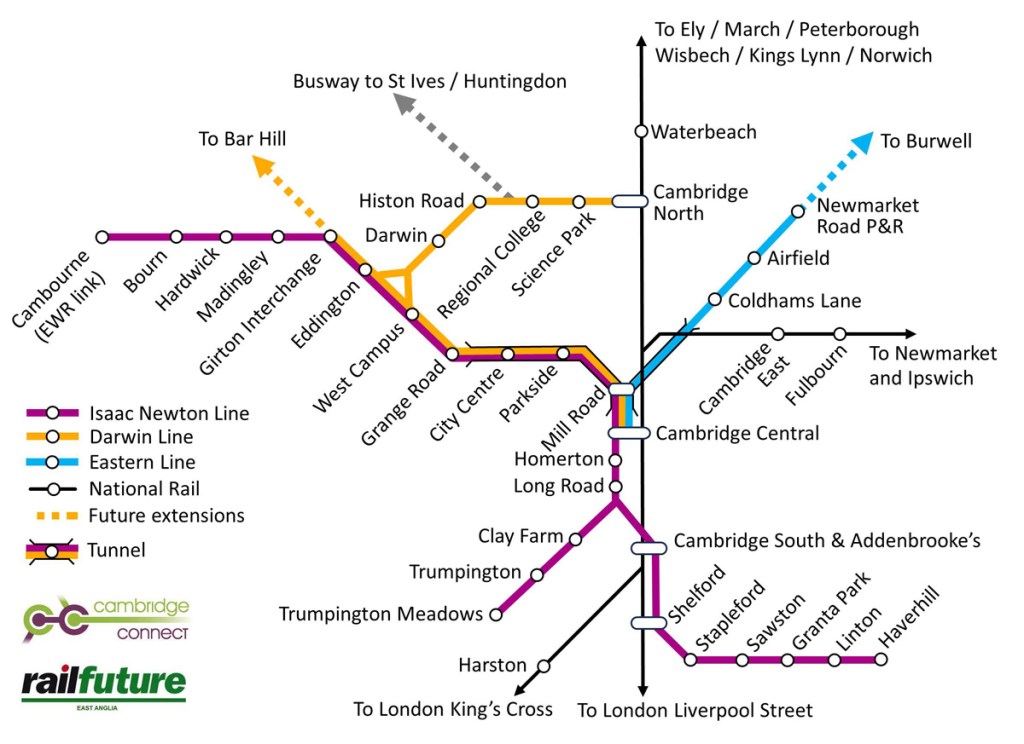
Above – I wrote in more detail about what this might look like, and how each surrounding market town could host at least one large amenity/facility that Cambridge currently does not have. Such as a roller rink,
“What’s all that got to do with Art?”
It brings me back to my final and central point: Cambridge’s art scene is really struggling in the face of budget cuts and huge running costs – in particular with renting of premises in the face of the sci-tech bubble. Any city that bases its economic success on too few industries or sectors builds in future risks. History tells us that. This is why Cambridge needs the mechanisms to share the wealth through a series of policies related to local/regional wealth taxation, market signals, infrastructure funding (linked to that local taxation), and so on. That doesn’t look like happening under the present government, so we will have to wait until the general election when all of these issues can be put to the party candidates to see what their party leaders have planned.
Food for thought?
If you are interested in the longer term future of Cambridge, and on what happens at the local democracy meetings where decisions are made, feel free to:
- Follow me on Twitter
- Like my Facebook page
- Consider a small donation to help fund my continued research and reporting on local democracy in and around Cambridge.
Below: From Rob Cowans’ Urban Design Handbook – what should Cambridge and surrounding towns build, and where?

 The Cambridge Town Owl