
…by failing to meet even the basic legal requirements on the minimum wage – let alone the Cambridge Living Wage, for those on the lowest incomes.
Pictured – the student-led Cambridge Land Justice Campaign – which is campaigning on inequalities issues associated with the University of Cambridge
During my various periods of house-bound boredom I find myself browsing through the Government’s announcement pages to see what has been published and not publicised. The same goes for Parliament’s page for Written Ministerial Statements to Parliament. The joke in Westminster goes that if you want to hide something scandalous, publish it…as a written ministerial statement. Because hardly anyone reads them but at the same time it still counts as making something available to the public. It helps to have an unaware public and a disinterested press pack more interested in personalities than policies.
‘Emmanuel College ‘named and shamed’ for not paying the minimum wage to 47 workers’

Above: “Emmanuel College, Cambridge , CB2, failed to pay £3,924.75 to 47 workers.” Government press release from Department for Business and Trade, 20 February 2024.
Which is unfortunate given the significant assets Emmanuel College has, along with the underspend in the most recent set of accounts submitted to the Charity Commission for 2021/22. You can browse through their accounts here

It looks even worse when you look at the growth in the value of the college’s assets over the last five years.
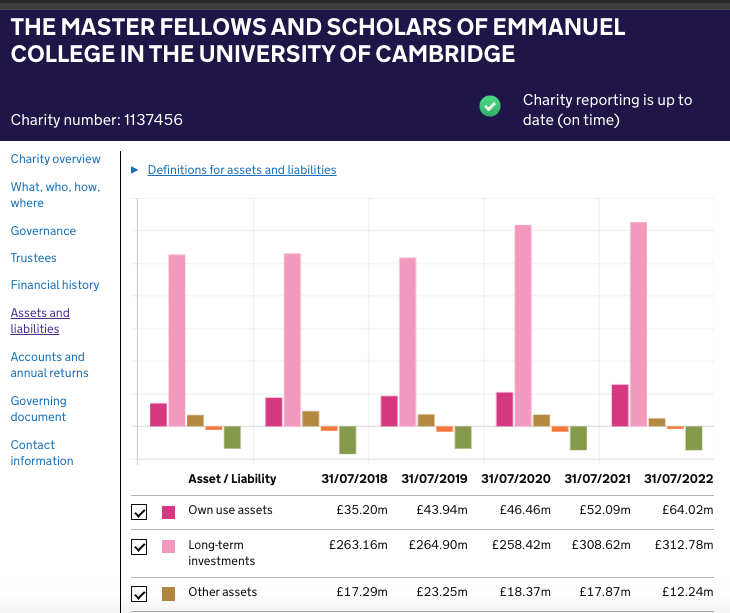
Above – from the Charity Commission – note the significant rise in the value of both in own use assets and Long-term investments
I’ll leave it to the College and the University authorities to debate the above with their own members, campaigners, and journalists.
[UPDATED TO ADD]
I’ve just had a note from the Cambridge and District Trades Council’s Press Secretary, Andrew ‘Ozzy’ Osborne, who states:
“This shocking revelation that a Cambridge University College would be employing workers at below the minimum wage is a wake up call to the entire city. We need to ensure all employers in the city are [Cambridge] living wage employers like King’s College.
“I would go further and urge all the colleges to recognise trades unions for their workers and negotiate with them for a proper rate of pay which would be a living wage for Cambridge acknowledging the high cost of living in the city. It’s not like the colleges in this city are short of a few coins”
Andrew Osborne, Press Secretary, Cambridge and District Trades Council, 29 Feb 2024
(Founded in 1912, the Cambridge and District Trades Council is the association of local trades union branches in and around Cambridge, with affiliating unions covering a wide range of trades, professions, sectors, and industries)
From a local history perspective, colleges paying their staff very low wages is not a new thing.
In the 1920s, Homerton College-educated local teacher Leah Manning led college domestic staff (‘bedders’) on an equal pay campaign, and was also involved in mobilising the domestic staff during the General Strike of 1926 – as Homerton College records here. Later a president of the National Union of Teachers, and afterwards a Member of Parliament, Homerton hosted a Blue Plaque ceremony in late 2019 to commemorate the legacy of Dame Leah on improving the lives of those on the lowest incomes in our city.
The present day challenge for the University of Cambridge as an institution is that it has become so large and complex that different parts of the same institution can and do end up doing things that are in direct conflict with each other. For example at the Cambridge Arts Network Conference on 27 Feb 2024 at the Cambridge Corn Exchange, Owen Garling of the Bennett Institute made some very important points about the role of sport in strengthening civic pride. Yet at the same time the University of Cambridge was coming under media scrutiny from BBC Radio Cambridgeshire over the long-delayed West Cambridge Swimming Pool that the University signed a covenant with Cambridge City Council to build as part of the planning permission for the large Eddington development.
Above – from my earlier blogpost – I didn’t lay the blame at Mr Garling’s feet, for he is not the decision-maker on the fate of the West Cambridge Swimming Pool that the University of Cambridge promised to pay for and build. Instead I put a more generic: “Where do we even start if we’re trying to build civic pride?” referring at the same time to the University’s publicised success of the philanthropic fundraising combined with the local government financial catastrophe that this evening (28 Feb 2024) is being featured on BBC Two’s Newsnight.
This case reflects the growing risk that Cambridge University academics and institution staff now face as they become more outward-facing: Audiences (especially in these politically and financially polarised times) are more willing and able to call out the actions of the institutions even if the speaker from said institution is not the decision-maker. At some point the situation becomes untenable. We see this on a regular basis – like today with another climate-emergency-based protest.
Above – Extinction Rebellion protesters outside another Cambridge University research institute
You can read the write-up of the above action in Varsity Newspaper
I only picked up on both of these things after I had come back from town – or rather ‘gown’ having run the second of two public policy workshops for students and researchers… who are members of Cambridge University’s Climate Society. The venue of those workshops? You guessed it…
The main learning points I took away from that pair of workshops is:
- There is a critical mass of students who are interested in what I call ‘applied politics’ – making the actions, functions, and decisions of local and national political institutions relevant to the lives and interests of the students;
- There is a role for local councils and other public service providers to run their own events for students that are tailored to their interests (which involves having a conversation first and then selecting and/or producing materials specifically for them – which then generates a significant level of conversation, debate, and the momentum for them to continue with their own independent actions/research).
Those above-two points link all the way back to the King’s Politics Society hustings for the Cambridge City Council elections in 2014 to which me and my social media avatar at the time, Puffles, were invited to. One of the questions from the students still resonates with me today. She asked all of us how the work of the council is relevant to the day-to-day lives of the students. ‘What does the council do for us?’ – noting that there are some residents who – quite understandably note that students are exempt from council tax and Cambridge University and its colleges are specifically exempt from non-domestic business rates. Hence discontent from residents who ask why councillors should give the University any attention at all.
But – and as we discussed in my policy workshops, the system of local taxation is not one that councils have any power over. Parliament is sovereign, and the political party that has the majority in the Commons gets to form the government and in effect decide what laws and policies are approved by Parliament. At the end of each workshop I asked the students what one thing they were now aware of that perhaps they did not know some 90 minutes earlier. The international students raised the significant level of centralisation of power in the UK – which was very interesting to hear. Especially in the face of what local solutions to the climate emergency might be available. (Some of the students came from countries with written constitutions, where funding and powers of regional and local tiers of government are protected by a national/state constitution in the way that the UK does not have).
That led us to the recommendations in the UK Climate Assembly’s report. We were going to try an exercise involving amending the Climate and Ecology Bill but when I took the students through it in the first workshop, it was clear that the Bill was not drafted as a piece of detailed legislation to have a big impact, but rather to spur ministers on to take much more urgent and radical action. Hence why we went through the UK Climate Assembly Report summary, picking out which bits the students thought could be turned into legislation, and which ones were more for individual ministers or institutions to act upon.

Above – Climate Assembly report summary, p10/12
Note information and education being the top priority. When it came to going through the various different sections of the report, we took the first recommendation on transport below.

Above – Climate Assembly (2020) p12/14
Can you legislate to:
- bring in a ban on the sale of fossil-fuelled cars on a specific date?
- bring about a vague reduction in the use of something on average over an extended period of time?
- make something better but not say how, when, or through what method?
This was the thing that the home-based students picked up on as a key learning point: you don’t need to pass a law to achieve your aims – but that if you do, you need to be *really specific* about what the law change is going to do, especially on driving a change in behaviour.
There’s a case that the students can make for the University of Cambridge to bring in an extra-curricular course or series of workshops to educate their students and researchers on the essentials of civics and politics both for national and local government
It doesn’t have to be particularly onerous – it just has to be enough to spark the curiosity in the students to enable them to apply the principles to whatever it is they want to research or campaign on. The same goes for students at Anglia Ruskin University – there’s no reason why the two institutions cannot run a joint programme, supported by local councils and public service providers making some of their staff and elected representatives available to take part in Q&A sessions or run their own workshops. The longer term impact can only be of benefit to both town and gown.
Food for thought?
If you are interested in the longer term future of Cambridge, and on what happens at the local democracy meetings where decisions are made, feel free to:
- Follow me on Twitter
- Like my Facebook page
- Consider a small donation to help fund my continued research and reporting on local democracy in and around Cambridge.
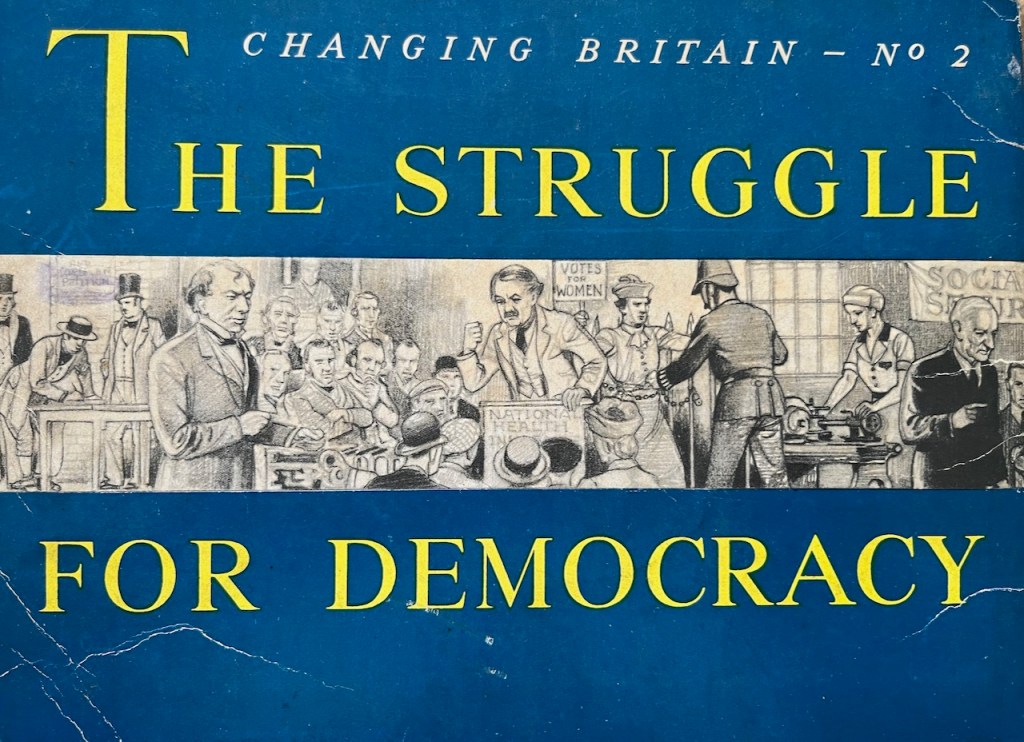
Below: Arrived earlier from WWII – the struggle for democracy.
Published in 1944, I’ve digitised my copy and you can browse through it here. A lovely illustrated guide on the progression of democracy from the Great Reform Act to the Beveridge Report.
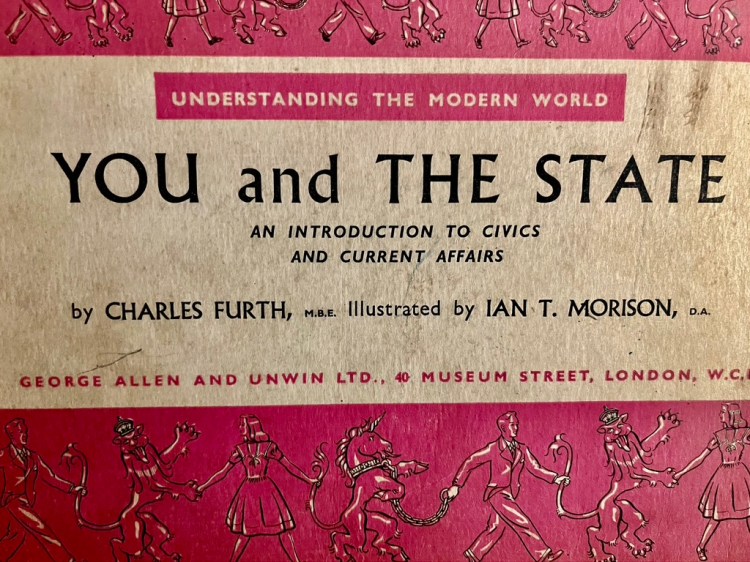
…and if you want to see what happened five years later… have a look at You and the State from 1949, digitised here.
 The Cambridge Town Owl