
And if not, can we generate enough of it to shape our city’s future in the run up to the general election?
Before I start, a quick reminder of the two events coming up this month on Cambridge’s past and its future, both being held at the Central Library in Lion Yard, Cambridge See https://cambridgetownowl.com/workshops/ for details.
One other thing to add, I’m differentiating ‘Civic Spirit’ from ‘Community Spirit’ because in a number of neighbourhoods you will find those strong neighbourhood identities – Mill Road being prominently mentioned, but also residential areas such as Arbury. (Other parts of our city would love to have an annual carnival the likes of which Arbury hosts annually).
‘Public squalor, private wealth’
Nearly six months ago, I wrote:
“Cambridge is a city where ministers have given various business sectors the upper hand over the institutions of local governance, the result of which has left us with a city of public squalor and private wealth.”
CTO 23 Sept 2023
Back in February 1914, The Globe Newspaper wrote about the work of Sir Laurence Gomme as Clerk to the London County Council upon his resignation after 13 years in the post.
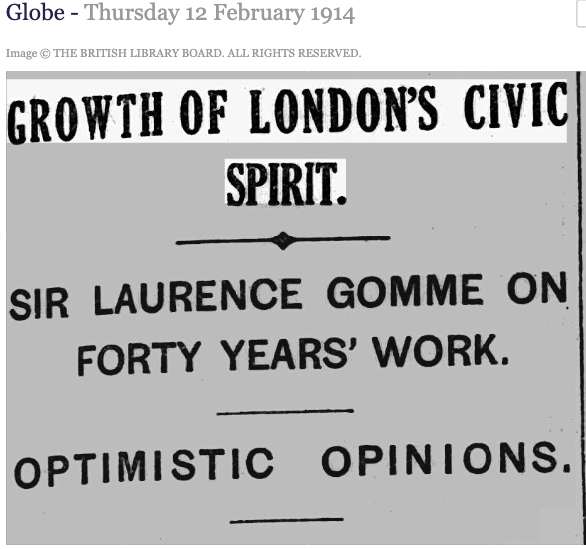
Above – Civic Spirit. Can we have some of that too? The Globe, 12 Feb 1914 in British Newspaper Archive
The article notes he spent over 40 years working for the metropolis of London at a time of huge inequalities and the growth of local government in response. And the picture in the 1870s was grim.
“Writing in the [1870s], at the time when Sir Laurence first took up his position as a public servant, Matthew Arnold spoke of “London with its external hideousness and its canker of publice egestas, privatim opulentia (public poverty and private wealth) unrivalled in the world”
“The poverty of the central control and of the civic spirit as contrasted with the opulence of private persons struck him as one of the most depressing of London characteristics”
The Globe (1914) in BNA
This is something I’ve raised repeatedly at multiple tiers of local government in and around Cambridge. Cambridge City councillors debated citizenship education at September 2023’s East Area Committee although it doesn’t look like much will happen prior to the general election in terms of policy changes at the Combined Authority which holds the purse strings for adult education. It falls within the remit of their Skills and Employment Committee – which in itself says everything about the institution’s priorities when it comes to lifelong learning. And the reason for that is because that’s what ministers measure the success or otherwise of the Combined Authority on. In an era of tight funding, if it’s not helping hit a target, it’s unlikely to get funding.
And yet, upon his retirement, Sir Laurence said something interesting when asked by The Globe about anything he had done to deal with the extremes of poverty and wealth.
“The growth of a healthy civic spirit is one of the developments that I have tried my best to foster. And I think that thew work of the London County Council in this respect has not been in vain. Londoners now take an interest in the corporate life of the city that forty years ago was entirely absent.”
“Some people seem to think that the task of inculcating a civic spirit into such an enormous areas as London is hopeless. But for myself I am include to be optimistic about it. With proper organisation and development I believe the time will come when Londoners will to a considerable extent forget their private interest in the interest of the community”
Sir Laurence Gomme to The Globe (1914) in BNA
It’s somewhat depressing that the inequalities in London over 110 years later have ended up demonstrating the opposite, but then could he have imagined globalisation on the scale that we currently have it – alongside the accumulation of enormous wealth to a tiny few, whether in the corporate sector, through the ill-gotten gains of political/military power, or both.
Civic spirit as a counter to militaristic jingoism
Three years after Sir Laurence’s remarks, Cambridge’s first woman councillor, Florence Ada Keynes was quoted in the Newcastle Journal (not entirely sure how as it doesn’t appear to have been syndicated) writing about The Woman and the Future.

Above – Florence Ada Keynes in the Newcastle Journal, 12 Feb 1917, in the British Newspaper Archive.
In it, Cllr Mrs Keynes (as she was back then) wrote:
“For the future of Europe, with its crowded populations pressing upon the artificial barriers that wars and dynasties have cast up between them, any intensification of the narrowly national spirit is fraught with danger. The growth of the civic spirit can bring nothing but good. It may become a rivalry, but a rivalry only in the arts of peace”
F.A. Keynes in NJ (1917)
Furthermore, she hints at a future European Union – which matches her ideals family’s friends and contacts across the continental Europe – she was in France with her husband Neville Keynes – Cambridge University’s Registrary, when war broke out.
“In these days of international strife, how refreshing – even if it be only a dream of Utopia – to imagine what Europe might become if the energy, the self-sacrifice, the genius, now devoted to the works of destruction, were turned by the citizens of every nation to the production of an ideal community”
F.A. Keynes in NJ (1917)
Mindful of the looming civil war in Ireland that preceded the outbreak of war in continental Europe, Florence also noted the industrial strife – something that didn’t entirely vanish during the war.
“At present we, in Britain, appear to be at a parting of the ways. On one hand, class warfare threatens national peace when the restraining influence of national peril is removed. On the other hand, a new feeling of common responsibility is tending to break down class distinctions, and to emphasise the fact, too often overlooked, that we are all interdependent, and that only on the success and happiness of the whole can individual happiness or success be firmly based”
F.A. Keynes in NJ (1917)
Now if that isn’t a blast from an historical figure from Cambridge’s past to the holders of real power in and of Cambridge today, I don’t know what is.
Reminded of Eglantyne Jebb’s study of Cambridge in 1906 which begins with an illustration of ghostly skeletal figures stating to those men responsible for our town:
“Give an account of your stewardship or ye may be stewards no longer!”
Florence goes on to state:
“One thing is clear: The state will need the help of the greatest number of responsible citizens. They are needed now. They will be needed after the war. It is generally admitted that for present purposes the number has been enormously increased. Women are now recognised as an important factor in national life, as an essential factor in the national struggle. Appeals are made to their patriotism, to their courage, to their self-sacrifice, and they are responding to these appeals.”
F.A. Keynes in NJ (1917)
It was the actions of so many women across the country that finally persuaded Parliament to remove the ban on women having the franchise – but even they could not be persuaded to do so on equal terms as the men – granted universal male suffrage having not had it when the First World War broke out in 1914 – the era of politics preceding the outbreak referred to as Politics Without Democracy by Michael Bentley in his study of the era.
Florence continues:
“Are [women] to be retained in this position and given the opportunity of devoting their special gifts to the solution of the problems of the future? Are they to be encouraged to educate their children, both boys and girls, to become intelligent citizens? Or, after having had the door opened and having responded to the call for help, are they to be shut in again, and told as formerly that they are unfitted to express an opinion upon national affairs?”
F.A. Keynes in NJ (1917)
Florence was writing in an era when the discussion of civics and citizenship education were about to become highly-contested issues.
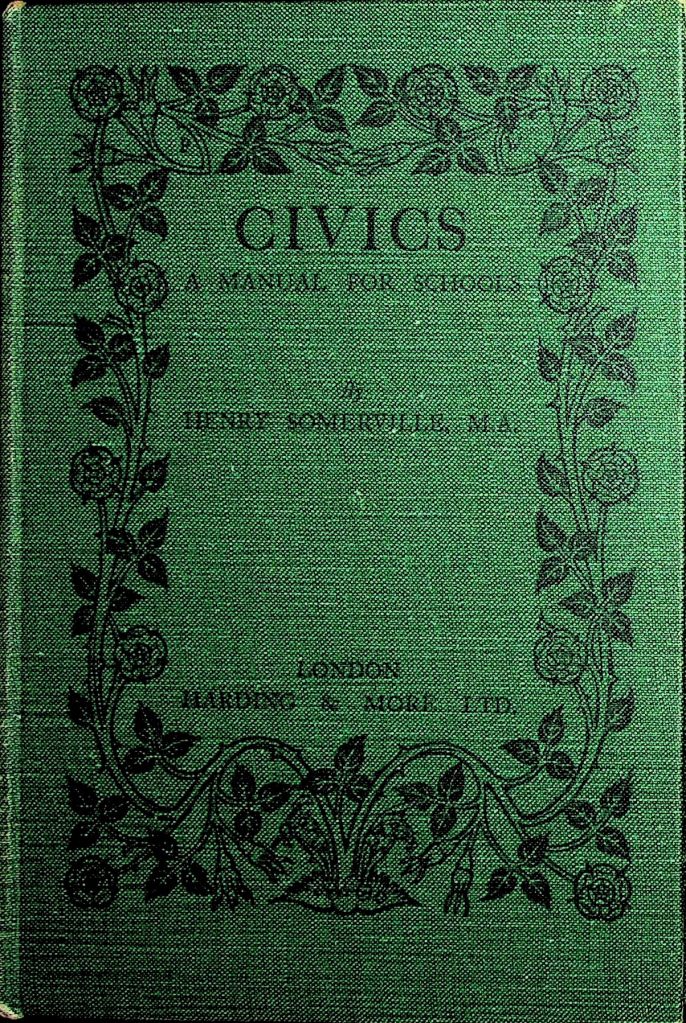

Above – two publications on citizenship from the olden days:
- Civics – a manual for schools (1936) by Henry Somerville
- The Education of the Citizen (1920) by Arthur Greenwood
The same issue of educating children and adults about civics, politics, and citizenship came up again in WWII as debates on what the future society should be like stepped up.

Above – The Struggle for Democracy (1944)
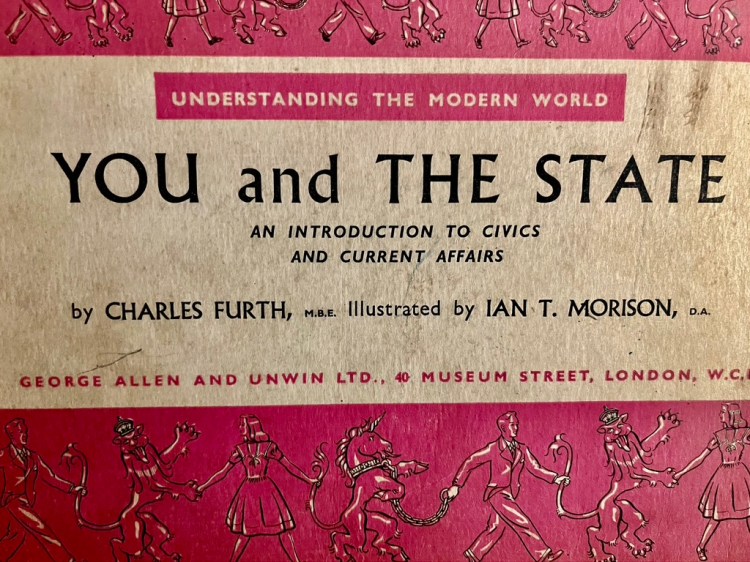
Above – You and the [Welfare] State (1949)

Above – Your Parliament (1955)
Sadly, by the time my generation got to school, the importance of civics and democratic education had withered away and the governments of Margaret Thatcher and John Major ensured that many in our generation were taught next to nothing about the society we were supposed to make our independent way into. Which is why I feel ever so strongly about it today. Because combined with Section 28, mine was a generation ‘educated to be ignorant.’ That ministers de-prioritised the progress made in the 2000s on citizenship education also makes the Prime Minister’s words about the importance of ‘defending democracy’ ring hollow. And that’s not from looking at what’s happening within his own party ranks, but looking at how few teenagers take GCSE Citizenship – only 145 in the whole of Cambridgeshire in 2022 (compared with the 9,000 or so that took GCSE Maths)
Florence finishes with the following:
“It is quite clear that the country needs its women to play the part of good citizens in time of war. The wonder is that having received so little encouragement in time of peace, they have not been found altogether wanting. What greater contribution they may make to national life in the future will depend upon the way in which they are fitted into the political framework of the state, and the extent to which their latent powers are encouraged and developed by responsibility.“
F.A. Keynes in NJ (1917)
And in that, collectively 21st Century UK national politics is failing. Not least the political framework of the state is showing its complete inability to prevent the tidalwave of hatred being hurled repeatedly at women in politics.
“Diane Abbott alone received almost half of all the abusive tweets sent to female MPs in the run-up to the general election, research by Amnesty International has revealed.”
The Guardian, 05 Sept 2017
Over six years have passed. Why have ministers failed to get a grip of this? Because it’s not just national politicians, but the whole of our body politic that suffers as people who might make for superb candidates for elected public office choose not to get involved at all. And who can blame them?
“So…what’s the plan?”
For me, there are two educational pillars to all of this:
- Local political and social history (including how national politics influenced it in the past)
- Local democracy (including how it fits in with national and international politics)
In the workshops I have run over the past six months, the lack of solid foundations on how our political and governance systems function and malfunction makes things much harder for the public to understand both *how* and *why* things go wrong. That makes it even harder for them to scrutinise what their politicians are doing.
Furthermore, the teaching of both to children and teenagers at school, and to adults in a lifelong learning programme, are as important as each other.
And we used to have programmes for adults that did that. Furthermore, the tutor for the programmes in the late 1940s and early 1950s for The WEA was none other than Cllr Clara Rackham.

Above – Clara Rackham inventing the Great Cambridge Crash Course 75 years before I came up with a similar concept! (Image from the WEA File in the Cambridgeshire Collection (C.36.6))
“But there’s no money in local history – and there’s even less for local government”
Therein rests the big problem to put to election candidates:
If they want civic pride to grow, then local councils have got to become more than the impoverished branch of the executive state in London fed on little but crumbs from the Chancellor’s purse. At present, ‘local government’ in its civic sense has all but ceased to exist- merely functioning as ‘local administration’ due to the constraints imposed by rubber-stamping Parliaments as services have been privatised, cut, and outsourced. Which is why local government no longer has an in-house production unit for schools that there once was half a century ago – the same unit that produced this board game for children on Cambridge’s traffic problems.
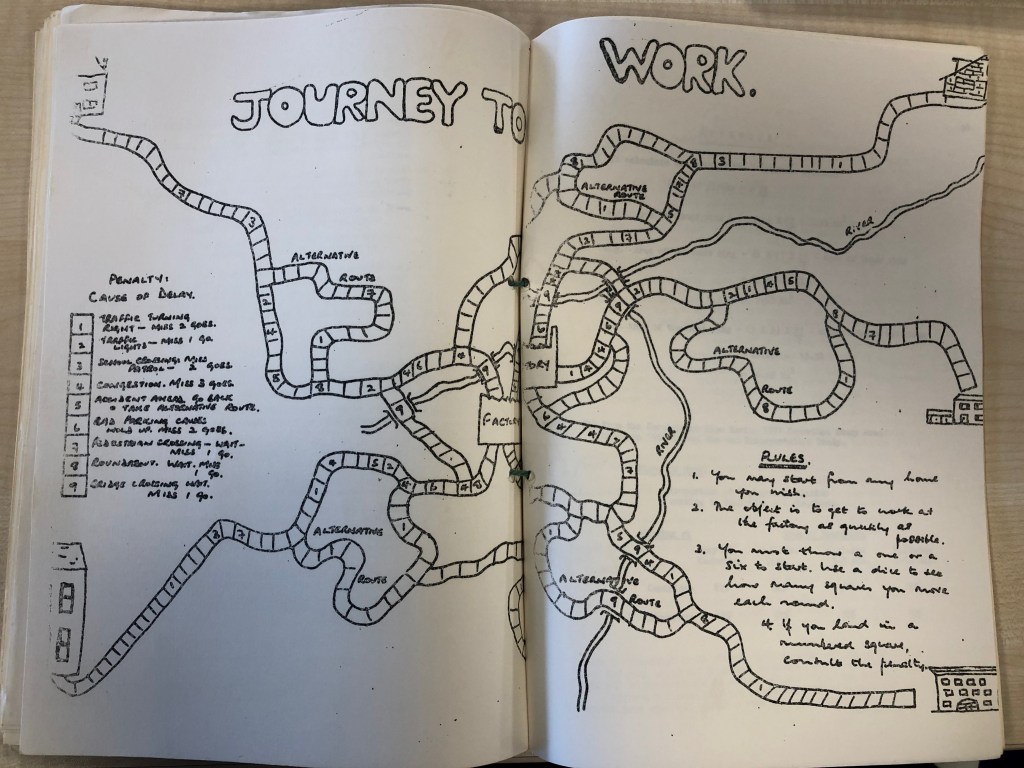
Above – from Aspects of Cambridge (1976) Cambridge Curriculum Development Centre in the Cambridgeshire Collection (C.36.1 PAM)
Which means there is also hardly anyone around to update the guides and catalogues of materials that are there – essential unsung jobs that enable researchers to find things.

Above – from Cambridgeshire Library’s online catalogue which you can search here
Building a new civic spirit has to start with learning about our local history and learning about how our democracy functions and malfunctions. At present, central government is a barrier. Will the next government keep those barriers in place, or remove them? And if it keeps them in place, then what?
Michael Sheen hinted at a solution back in 2017 – have a watch. (It’s worth watching the full lecture).
“We must affirm each other.
Michael Sheen 2017
That is where our future lies.
That is where we build from – each other.
Use what voice we have in the service of each other.
Whenever we can, join our voices together to help create a Wales that is our ‘own world’, as Williams described it.
A world that can argue, and challenge, and question, and explore.
A world that can encompass multiple histories, and diverse experience.
A world that does not avoid its past or ignore its divisions.
A world where our difference can become the source of our strength.
Confident enough to take control of our own energies and our own resources.
Connected to each other and taking responsibility for ourselves.
That is how we build our dragon.
Put real flesh on its bones.
And hope that, one day, it will fly.
Thank you“
As I wrote in the blogpost on Mr Sheen’s extended lecture, ‘Replace the word “Wales” with “Cambridge”, and “World” with “a city” and you could say the above could apply to a future Cambridge.’
To create it will involve the input of our entire city – and that means not just the people who live in it or study at ‘the University’. Reminding everyone that Anglia Ruskin and its predecessor institutions have their own proud history – Dorothy Enright, the principal achieving great things in the inter-war era, at a time the ancient institution with its colleges on the other side of Parker’s Piece still upholding the ban on women graduating.
I’d like to think that our collective civic spirit is there. Furthermore, I also think a general election year is the year to demonstrate how powerful and influential it could become
Food for thought?
If you are interested in the longer term future of Cambridge, and on what happens at the local democracy meetings where decisions are made, feel free to:
- Follow me on Twitter
- Like my Facebook page
- Consider a small donation to help fund my continued research and reporting on local democracy in and around Cambridge.
Below: Citizenship Studies: if you want a more up-to-date guide on what teenagers studying the GCSE in Citizenship Studies have been covering in terms of content, get yourself a cheap second hand copy of a GCSE Citizenship textbook or revision guide. (The pre-2016 ones cover the rights we used to have when the UK was in the EU).
 The Cambridge Town Owl