
And now Queen Edith’s Ward in Cambridge has its own case study.
Image: Queen Edith’s Community Forum – chances are some of you will want to raise this at a future forum meeting (or alternatively on the F-book Page here as well).
Local residents are *not* happy with this mast.
This was something local residents campaigned against, and it was refused planning permission by Cambridge City Council. But the mast installers appealed to the Planning Inspectorate and won.
If you want to see the planning appeal decision, see Ref 21/01386/PRI16A in the planning portal site at https://applications.greatercambridgeplanning.org/online-applications/
I’m not going to do a blogpost-hit-job on the planning inspector concerned. He has overturned a number of other planning refusals on phone masts including in Harlow, and in Leighton Buzzard – which are a matter of public record. You can find multiple examples of other planning inspectors overturning refusals online
“What does the law say?”

- The Town and Country Planning Act 1990 is here
- The Town and Country Planning (General Permitted Development) (England) Order 2015 is here
What’s striking is how long the secondary legislation – an Order in Council – happens to be. The original PDF document runs into 164 pages. Secondary legislation in principle is only supposed to be for things like technical details or administrative things. The policy issues, and other issues of substance are meant to be in the primary legislation (The Act of Parliament) so that MPs and Peers can scrutinise them in detail, rather than be presented with ‘take the whole lot or zap the whole lot’ documents of draft legislation. Which is why I have issues with it. And not only me – people who know more about it than me.
“Legislative scrutiny is one of Parliament’s core functions, but the delegated legislation system is no longer fit for purpose. It is now a growing source of political frustration across the political spectrum.”
Hansard Society, 06 February 2023
In a well-functioning democracy, the above should not be an issue. But it clearly is.

Above – the Order signed by the Conservative Housing Minister Brandon Lewis MP during the final months of the Coalition Government
How much Political blame you want to place on the Liberal Democrats as junior coalition partners is your call. When you look at the results of the General Election of 2015 the Liberal Democrats collapsed from 57 seats to nine. That number is still only at 15 – a rise from the 2019 General Election tally due to very effective by-election campaigning.
“Something must be going badly wrong if so many appeals are being made – and are successful”
The information to justify the above statement (or otherwise) is not easy to find – and ministers really should get a grip of this so the public can see to what extent the system is functioning/malfunctioning.
The Local Government Association published data on appeals allowed – which hover between 25% and 30% of appeals received against refusal
What’s much harder to find are the percentage of planning decisions – refusals – made by local council planning committees that are appealed. Ministers put out this statistical release but it’s not clear what percentage of decisions are refusals, and of those refusals what percentage are appealed.
Ministers were warned when they changed the planning system – getting rid of swathes of the previous government’s guidance.
Another Conservative Minister in the Coalition Government, Greg Clark MP, moved the motion in the Commons that effectively approved the Government’s proposals – but it was the junior Liberal Democrat Minister Andrew (now Lord) Stunnell that wound up the debate – and you can read his speech here.
If you do a key word search for “appeal” in the debate transcript, you will find that a number of MPs warned the Minister about the risk of the rising number of planning appeals to planning inspectors. Including:
- Hilary Benn MP
- Nick Raynsford MP (former Housing Minister under Labour)
- Clive Betts MP (Chair of the Select Committee covering housing and planning then as now!)
- Even Dominic Raab!
“In my view, the developer’s right of appeal over the heads of our democratically elected councils should be curtailed and the balance shifted in favour of local communities and their representatives.”
Dominic Raab MP 20 Oct 2011 in Hansard Col. 1160
Note that since then, further primary legislation has been enacted – i.e. new planning laws such as in the Housing and Planning Act 2016, and other laws such as the Levelling Up &c Act 2023.
***Which is why the planning system is so complicated!***
Having so many successful appeals against initial decisions is not a sign of a sound, functioning system. Quite the opposite. Just ask the Home Office. In the case of town planning, the problem here has the added complexity that those of us who don’t have our own properties to live in despite wanting/needing our own stable place to live, don’t have a voice in the planning system. And this is reflected by the lower voter turnout for people renting their properties.
“In the 1960s, the turnout gap between social groups was negligible. By the 2010s, it had grown to 18 per cent between the top and bottom third of earners; to 23 per cent between renters and homeowners; to 15 per cent between those who did and did not attend university; and to 28 per cent between those who are 61 or older and 18-24 year-olds.”
IPPR 11 Dec 2023
Above – the recently published IPPR study on voting inequalities.
I’m extrapolating here I concede. The analysis from the IPPR shows people in rented accommodation are less likely to vote. Therefore I am assuming that people renting – especially in short term unstable renting are less likely to engage civic functions/duties that involve far more effort and time, such as local consultations.
When you consider the knowledge needed to make sense of town planning applications – especially for large developments, how many renters will be able to find the time and the cerebral effort to study what could be hundreds of pages of documents in order to give an informed opinion? When I was renting I didn’t know the first thing about my basic housing rights, let alone local government and local town planning. My generation wasn’t taught anything about citizenship and civics. As I’ve written repeatedly before, my generation of 1990s teenagers were educated to be ignorant because successive education ministers did not include civics, politics, or citizenship in our curriculum. I still remember this though.
Above – Tom Allen on school in the late 20th Century
It’s almost like John Major’s Government wanted us to be ignorant of politics so that we wouldn’t engage in it armed with the knowledge of how it functions and malfunctions.
Which is why I repeatedly encourage people to buy themselves a cheapo second-hand book on GCSE Citizenship and browse through the things that they didn’t cover at school. (Noting the ones published before 2016 include coverage of the EU and the rights we used to have!)
“Coming back to the mast, is there anything anyone can do?”
Ask the mast company to see if they can move it to a different spot?
As far as I’m aware, there’s very little that can be done from a legal perspective. From a Political perspective, this will be an interesting case study for the candidates in South Cambridgeshire to look into and get some detailed guidance from their parties’ HQs – only it’s more than likely to come up on the doorstep in Queen Edith’s ward if not elsewhere in the constituency.
Furthermore, it’s a useful case study to use not just about helping people learn the essentials of the planning system, but of how we are governed and how we can hold power to account.
Food for thought?
If you are interested in the longer term future of Cambridge, and on what happens at the local democracy meetings where decisions are made, feel free to:
- Follow me on Twitter
- Like my Facebook page
- Consider a small donation to help fund my continued research and reporting on local democracy in and around Cambridge.
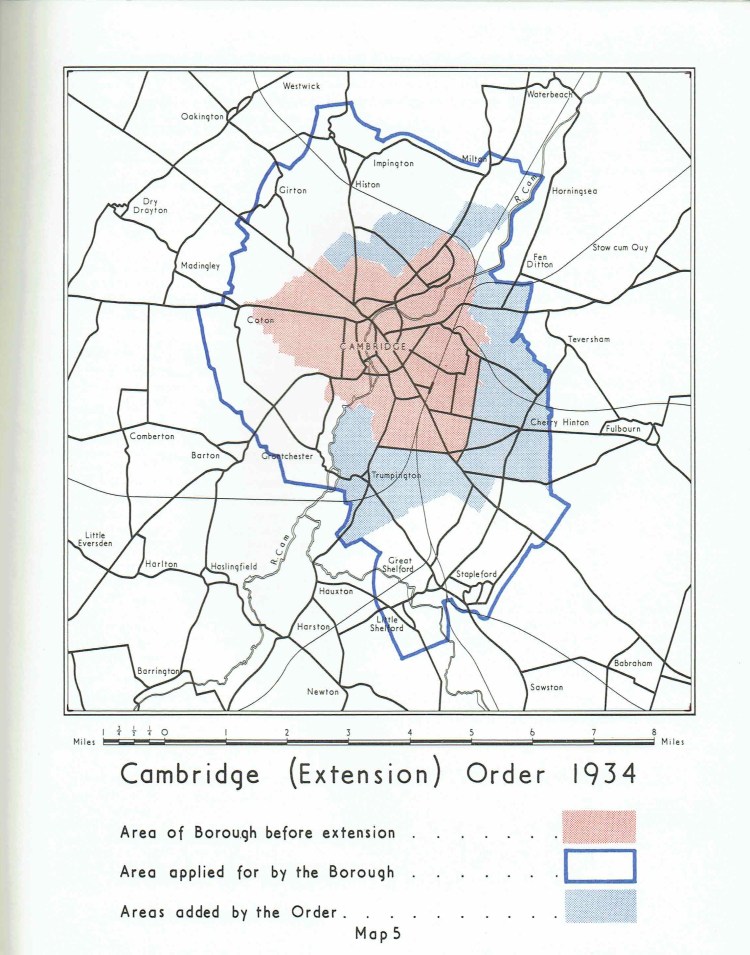
Below: A detail of previous attempts to change, expand, and improve Cambridge – we’ll be looking at these in more detail at Cambridge Central Library on Sat 09 March 2024 from 11:15am. See https://cambridgetownowl.com/workshops/ for more details
 The Cambridge Town Owl