
The lack of detail in Michael Gove’s Case for Cambridge, published with The Budget 2024, shows how complex building such a case is. But if the people of Cambridge and Cambridgeshire are to come up with alternatives, we need to know some civic essentials
As I mentioned in my previous blogpost:
Browse through The Treasury’s Budget Documents here
Scroll down and you will find three documents specifically relating to Cambridge and Cambridgeshire.

Then:
Print out a copy of The Case for Cambridge and browse through it
The next event I’m running under the ‘Great Cambridge Crash Course’ banner at the Cambridge Central Library on 23 March 2024 will be on Michael Gove’s proposals.
With thanks to the participants of my event on 09 March earlier, every new session brings an interesting combination of people coming from a range of different backgrounds and life experiences. Trying to design individual events and courses has to meet that challenge of being able to cover the essentials for those new to the city while providing enough detail for those that have been following/engaged in local campaigns for decades.
Former city council leader Lewis Herbert calls for a locally-designed vision.
I agree. The challenge is *how* to go about encouraging local people to get involved – and making the processes as accessible and as easy-to-comprehend as possible.
Sadly due to technical issues, the above-broadcast did not go out earlier today (I was hoping to write about it) but the podcast will be available early in the week.
First things first: Be clear about what you mean by ‘Cambridge’
Sadly, Michael Gove has not – we are still awaiting to find out his proposed geographical area for the Development Corporation that The Chancellor said would have a long-term funding commitment attached to it.
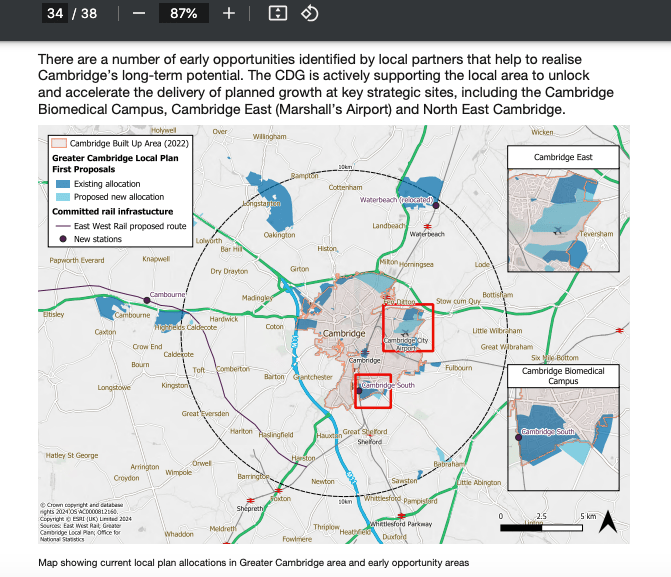
Above – The Case for Cambridge (2024) p34.
The above map has a circle around it without anything labelling it – something that only adds to the confusion. It looks like a six mile radius boundary or there abouts, but that doesn’t help residents know whether their area is going to be incorporated into the Development Corporation, let alone how it will be affected.
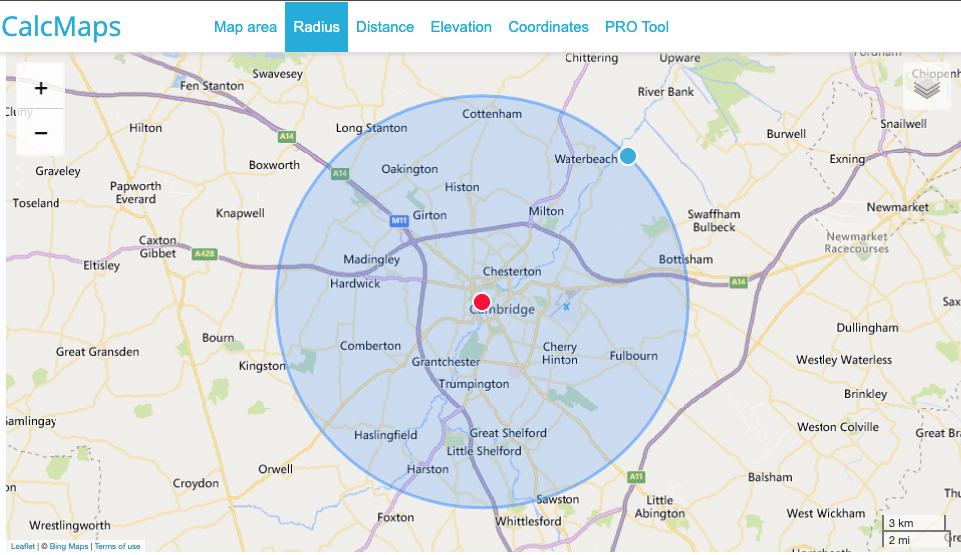
Above – from calcmaps
Cambridge’s municipal boundaries have hardly changed since 1935.
Furthermore, if we are to encourage ‘beyond the usual suspects’ of those who closely follow what’s happening in local decision-making (whether community groups to corporations), knowing *where* to have those conversations is useful For example below:
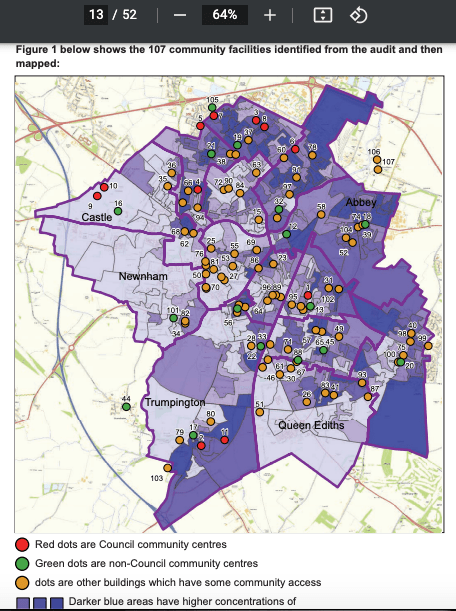
Above – Cambridge City Councils’ Community Centre’s Strategy, p13
It’s a little more straight forward for South Cambridgeshire because the district that rings Cambridge like a…ring (or a slightly deformed doughnut) is parished. That means each village belongs to a parish and thus has a parish council. You can see their list here by council ward here. Unlike the now-abolished area committees in Cambridge, each parish council is formally constituted (Local Government Act 1894 as amended). Therefore, unlike the City of Cambridge, the surrounding predominantly rural districts already have the community level governance infrastructure in place, irrespective of how efficient or effective it currently happens to be functioning. (Some parish-level councils are so small they are not much more than two chaps and their four-legged friend. Others are fairly large town councils with very long histories (eg Huntingdon Town Council next door to South Cambs) that they may as well be mini-borough councils).
Ensuring everyone knows the basics of what ministers can and cannot do
It’ll be useful for the general election debates too. The concept of Parliamentary Sovereignty vs a Written Constitution protected/upheld by a Constitutional Court is one that still confuses people – especially newspaper columnists and politicians who should know better.
“Parliamentary sovereignty is a principle of the UK constitution. It makes Parliament the supreme legal authority in the UK, which can create or end any law.”
https://www.parliament.uk/about/how/role/sovereignty/
This matters because the processes of changing what local government can and cannot do are different under each system of government. In our case, if the Government wants to change anything related to local government, all it needs to do is to table new proposed legislation in Parliament, or make use of existing powers under previously enacted legislation. Under a written constitution, the powers, rights, and duties of the local government sector have greater constitutional protections – and the process of changing them is much harder.
Given the diversity of countries now represented in Cambridge, one of the most important things our city should be doing is educating our adult population on the essentials of how our system functions and malfunctions. Why? Because for those people who grew up in countries with a written constitution, what Michael Gove is proposing might be considered ‘unconstitutional’ from their perspective.
In the case of Cambridge, our modern city council has its roots in a piece of primary legislation that most people have not heard of: The Municipal Corporations Act 1835 – something I wrote about and which the Father of Modern Cambridge, Charles Henry Cooper covered in his works, here. Amongst the powers granted by Parliament to the new Cambridge Borough Council were the powers to establish and fund/pay for a town police force in 1836.

Above – from Annals of Cambridge Vol. 4 (1842) by Charles Henry Cooper, p600
A later Act of Parliament took those powers away and transferred them – ultimately to central government control.
All of the above may feel like very heavy reading for people who don’t follow politics closely, or whose talents don’t reside in ploughing through text-heavy documents all day. Which is why condensing, consolidating, and simplifying the proposals into easy-to-understand, easy-to-access materials and activities is essential.
Furthermore, for those that will want to go into some of the detail, one-off events won’t be enough, not least because there are so many different parts of our lives that will be affected should Gove’s ambition of 150,000 homes in/around the city be realised.
One civic hero has already demonstrated how to do this.
Councillor Clara Rackham, who served on both town and county councils, created a civics class under the auspices of the Workers’ Educational Association after the Second World War. I covered it in Lost Cambridge here following a discovery in the Cambridgeshire Collection.

Above – 12 meetings at the old Romsey Labour Club, covering the essentials of civics and politics with Cllr Clara Rackham. From the WEA File in the Cambridgeshire Collection (C.36.6)
If you think how much more complex the role of the Government has become – not least because of regulating technological changes, then it may feel like 12 sessions might not be enough!
Should local councils and civic society organisations want to go ahead with coming up with local alternatives to Michael Gove’s case, running some ‘train the trainer’ sessions might not be a bad idea.
Food for thought?
If you are interested in the longer term future of Cambridge, and on what happens at the local democracy meetings where decisions are made, feel free to:
- Follow me on Twitter
- Like my Facebook page
- Consider a small donation to help fund my continued research and reporting on local democracy in and around Cambridge.
Below: The Struggle for Democracy (1944) – digitised here. A reminder of how we are government has changed over time, and who the people were that campaigned for better changes.

 The Cambridge Town Owl