It’ll take more than redrawing a few boundaries or tweaking local government finance to deal with our present political malaise. Yet history tells us we’ve been here before. The big gap in the report? Adult education/lifelong learning provision – teaching people about civics does not get a mention.
You can read the summary of the report by the Productivity Institute in Jack Newman’s thread here.
Alternatively, you can read the online summary which has a link to the full report on the right hand side.
The research was funded by the Economic and Social Research Council – one of the publicly-funded research funding bodies.
In a nutshell, the report is calling for:
- Re-design the scrutiny function in Combined Authorities,
- Publish an explicit menu of governance options for Combined Authorities and set out a democratic process for choosing and changing models of leadership.
- Change the mayoral voting system back to the supplementary vote model, and place the Electoral Commission in charge of overseeing any future changes.
- Revitalise local media as an anchor for public accountability and democratic life
“Can’t we overhaul local government in England as Parliament recommended in October 2022?”
In case you forgot, the Public Administration & Constitutional Affairs Committee recommended such an overhaul following their inquiry into the governance of England.
Given what the report’s recommendations for the scrutiny of combined authorities state, I can’t see that much difference between having a directly-elected scrutiny committee versus a directly elected assembly to oversee the functions of a combined authority mayor – which in effect is what the London Assembly has: a directly-elected assembly that forms its own committees that cover the much-wider functions of the Mayor of London compared with other combined authorities.
Parliamentary Sovereignty
“That old chestnut again…?”
It matters – and it’s a concept I’ve had to state and re-state in my workshops because this is the concept that is at the root of so many of the local issues in and around Cambridge.
“The predominance of top-down accountability mechanisms within the UK’s political system is both a reflection and driver of its centralised governing model. The constitutional conventions of ‘parliamentary sovereignty’ and ‘ministerial accountability’ are the anchors of a web of vertical accountability chains.”
Newman et al. (2024) p15/17
This is one of the reasons why local public services are so fragmented on the ground: Whitehall reporting silos. The Government Offices Network for the Regions (in which I started my civil service career in the Cambridge office that covered the East of England) was an attempt by Michael Heseltine to break those silos when he created the network in 1994. The reality however, proved to be different, and senior civil servants struggled to break out of their parent departments even when put in a room together to thrash things out. The restructure and rebrand, along with the move from London of a number of senior civil servants out to the regions in the mid-2000s wasn’t enough to persuade the incoming Coalition Government to keep the network on. This was something Lord Heseltine picked up on in his report in 2012.
“At the earliest opportunity civil servants based across the country should be brigaded into Local Growth Teams, structured around clusters of LEPs, primarily tasked with joining up government and local partners in the areas of their responsibilities to facilitate, identify and realise economic opportunities.”
Heseltine (2012) No stone unturned – in pursuit of growth, Recommendation 8, p49/52
Lord Heseltine was also cross-examined by Parliament on his report, and you can browse through the transcripts here. He also had something to say about rapid ministerial turnover in 2017.
“Broad and long-term experience in government brings with it big benefits for policies. There can be good reasons for reshuffles but overly short periods in office often cause problems for the delivery of policies, weaken leadership of departments, and can damage government effectiveness overall.”
Tess K Bishop, Institute for Government (2017)
When we look at the present parliament and the ministerial reshuffles – to say nothing of the three prime ministers of 2022 – speaks volumes about the instability in Downing Street. Hence the Institute for Government’s recommendations on how to overhaul the street that is also an institution.
“It’s still all top-down stuff though”
That’s the structure that goes back far into the mists of time. Without giving a lecture in constitutional history, we have:
- Members of Parliament accountable to their constituents – primarily through the ballot box at general elections and by-elections
- Ministers accountable to MPs in Parliament – primarily through voting on legislation and tabling questions to ministers, and bound by the Ministerial Code (assuming there is a Prime Minister willing to enforce it)
- Civil servants accountable to ministers for the delivery of ministers’ policies – subject to the Civil Service Code
- Delivery organisations overseen by civil servants on behalf of ministers – which includes local government as required by law. (For example the Local Government Act 1999 Sections 1 & 3 on ‘Best Value’ – which for some poor performing local councils has resulted in civil servants recommending to the Secretary of State to use the powers in Section 15 of said Act to intervene)
One of those notices in 2023 was to the Cambridgeshire & Peterborough Combined Authority – but the quantity of other authorities listed shows that the problems go beyond one or two problem areas.
“Short of getting rid of the principles of Parliamentary Sovereignty and Ministerial Accountability to Parliament (incl of how efficiently and effectively taxpayers’ money is spent), what alternatives are there?
The report highlights the different types of accountability. The UK currently has the very highly centralised system for England of top-down accountability. The creation of the Scottish Parliament and Scottish Government, along with the devolved institutions for Wales, and for while it functioned, Northern Ireland, hinted that arrangements for more bottom-up structures are possible. This is because UK ministers have on the whole been disciplined enough to stay out of intervening in devolved matters – e.g. policy areas that Parliament transferred to the Scottish Parliament in the Scotland Act 1998.
Bottom-up accountability – how can local councillors hold ministers to account?
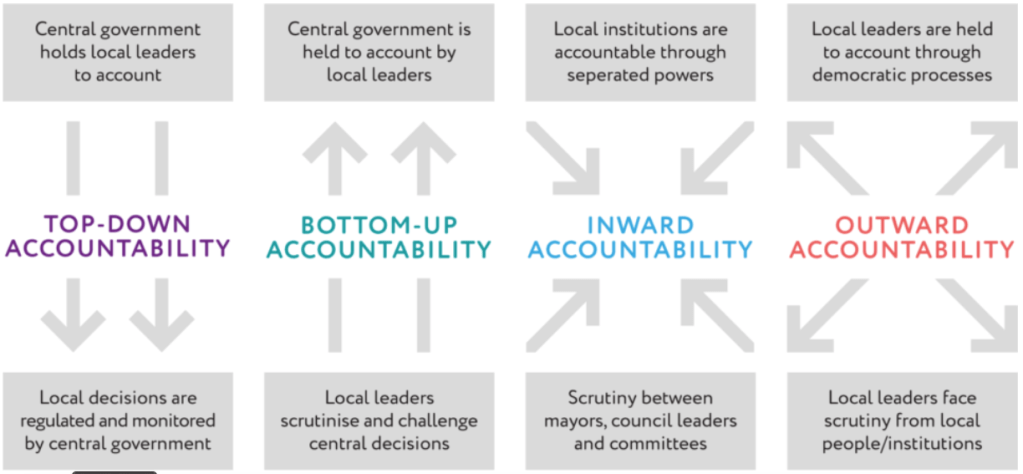
Above – from the Rebuilding Local Democracy landing page
One of the arguments for ‘Metro Mayors’ is that they are meant to be influential enough to influence government policy. Under the present dysfunctional administration, that has been hard to see in practice. Especially where ministers seek to undermine individual mayors for party political reasons – whether for artificially-conflated culture wars, or looming elections. Or both. The inevitable challenge for whoever is in public office locally or nationally, is having to work with other tiers under different party political control. And even then, being in the same political party does not guarantee easy working relationships.
Current lack of bottom-up accountability
It’s not just the proposals for a new Cambridge Development Corporation in The Case for Cambridge, but also Michael Gove’s compulsory asset transfer of council assets in Middlesbrough to the Middlesbrough Development Corporation. (Will the council get the assets back when the corporation is eventually wound up? Will it be compensated in any way?)
Could the UK follow Germany’s example?
This could make for an interesting alternative to the current House of Lords – and some have proposed that the Mayors of the Combined Authorities have seats in the UK’s upper house – taking their seats upon election to their mayoralties.
“In Germany, the sixteen states or Länder are listed in the preamble of the constitution where ‘the people’ are appealed to as residents of the Länder. This is reflected in Germany’s legislature, with the upper house, the Bundesrat, containing delegates from the states rather than directly elected members.”
Newman et al. (2024) Box 4 – p18/20
This contrasts with what Margaret Thatcher did in the 1980s through the Local Government Act 1985. The Greater London Council was a Political thorn in her side throughout the 1980s. So she abolished it.
“The Local Government Act of 1985 abolished city-wide governance in London and the metropolitan counties. The abolition of these tiers was justified in relation to governing efficiency, but there was a significant party political advantage in removing political offices and policy platforms held by the Labour Party.”
Newman and Kenny – Devolving English Government (2023) p19
Newman and Kenny describe the present set up in damning terms:
Did the conflicts between Labour-run councils and Conservative-run central government in the 1980s lead to the present broken system? The Political context matters because such was the polarisation of politics at that time – along with the adversarial nature of Westminster politics, that it’s hard to see both then and now how a more consensual model of politics and policy-making could function in a ‘winner takes all’ First Past the Post voting system. What does effective scrutiny even mean if a political party with a manifesto full of catastrophic policies wins an election?
Carrying out a scrutiny function vs carrying out an executive function have subtly different skills sets
It’s one thing having a former minister on a back bench scrutinising their predecessor – one thing the former PM Theresa May was good at with her successor Boris Johnson. Trying to carry out a scrutiny and executive function *at the same time* I’m not so sure about. Given the proposed and abandoned plans for regional provinces under Redcliffe Maud’s plans from 1969, representatives

Above – Redcliffe Maud (1969) p10
Interestingly, Redcliffe-Maud proposed provincial councils/assemblies to be made up of existing councillors and co-opted members.
“Provincial councils should be elected by the authorities for the unitary and metropolitan areas (including, in the south-east, the Greater London authorities), but should also include co-opted members.”
Redcliffe Maud (1969) p8
That in part reflected the very specific duties Harold Wilson’s Government proposed for the provinces – in what later would become the Government Office Regions boundaries that Heseltine established. See also:
- East Anglia: A study (1968)
- Strategic Choice for East Anglia (1974)
- East of England Regional Development Strategy (2008)
- East of England Plan (draft revision) (2010)
Inward accountability as a bottleneck rather than a filter to sift out bad policies
The multitude of committees and forums has resulted in inefficiencies (multiple committees reviewing and approving the same information) and bottlenecks (party-political disagreements / dysfunctional working arrangements holding up progress). Hence the Cambs Unitaries Campaign.
“Decision making could become significantly more efficient, as currently some decisions in areas such as transport that currently need to be considered by multiple committees across authorities, could in future be considered by a single committee within a new unitary authority.”
https://www.cambsunitaries.org.uk/how-will-it-work/
The failures of outward accountability are longstanding
The turnout graph of comparator democracies is striking.

At the same time, the decline of local media has been long documented.
“…the media’s ability to hold to account those who wield power in local communities may be starting to decay. And this, just at the point when greater localism and more devolution is being demanded by the public and enabled by central government.”
Rona Fairhead of the BBC Trust (2015) in Ramsay & Moore (2016) p8/10
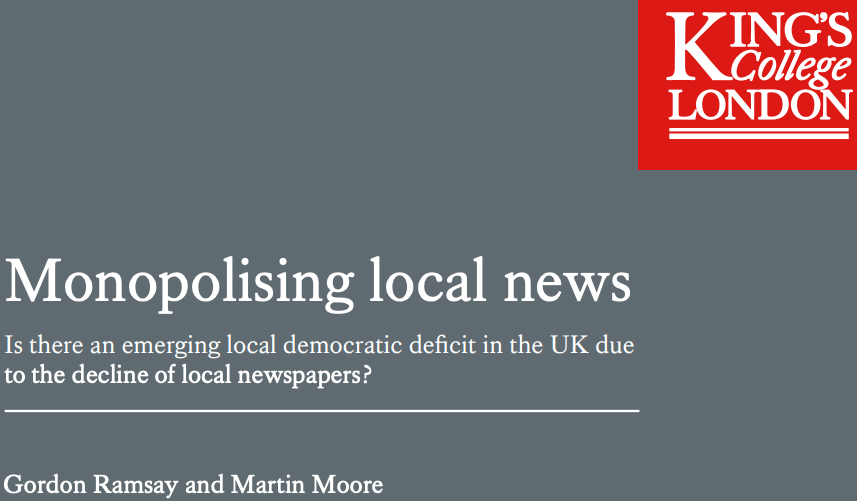
Above – the paper by Ramsay and Moore (2016) is worth a read
Educating for democracy
This was a question that Kathleen Gibberd asked her readers in 1938. What did previous generations cover? I’ve digitised some old guides from the past century or so:
- A Primer for London Citizenship – 1915
- The People’s Government – 1931 (by Kathleen Gibberd)
- The Good Citizen – 1932
- Training for Citizenship – 1935
- Civic Affairs – 1939 (guide to local democracy in Leicester)
- Brighter Citizens – 1947
- Citizenship – 1948
- You and the state – 1949
- On Citizenship – 1966 (note the focus on functioning in a consumer society)
- Local and Central Government – 1983
Having run a number of crash courses and workshops on the essentials of democracy in a variety of contexts (local, national, policy-specific), the lack of knowledge on essential and basic concepts is striking. The concept of Parliamentary Sovereignty is the most prominent one. Furthermore, bringing participants back to that root concept enables them to see where the faults in the system are – in particular when it comes to scrutiny.
Furthermore, it’s not like previous generations did not make a good go of trying to educate children and adults on the essentials of democracy. With the present focus on skills for jobs in the face of very tight funding settlements, inevitably civics, citizenship, democracy and political education gets deprioritised. Furthermore, the civic society institutions that might have provided such learning opportunities such as the Workers’ Educational Association and the old mechanics institutes, working mens colleges, and townswomen guilds no longer have the presence in our towns and cities as they once did.
And that’s my worry
We do not have the civic society or public sector infrastructure to create the social and civic spaces need to learn about how politics – how our political systems function and malfunction, and what we can do to improve them. At the same time, the way our economy and society functions means that at present, few people have the time, resources, awareness, or the motivation to participate – again, not their fault. Putting on a term of evening classes and having it listed in an online course catalogue or on fliers will never be enough.
Which is why lifelong learning and adult education need to be debated during the general election campaign.
Food for thought?
If you are interested in the longer term future of Cambridge, and on what happens at the local democracy meetings where decisions are made, feel free to:
- Follow me on Twitter
- Like my Facebook page
- Consider a small donation to help fund my continued research and reporting on local democracy in and around Cambridge.
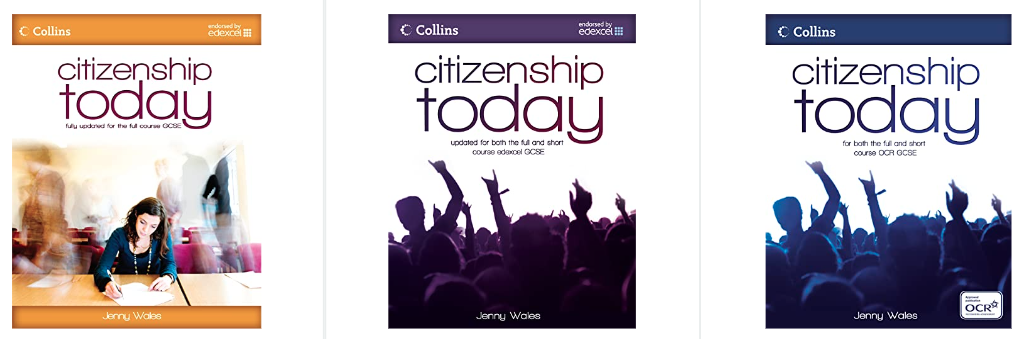
Below: If anyone’s looking for a cheap-but-modern guide on civics and citizenship studies, get hold of one of the earlier editions of Citizenship Today which conveniently covers the rights we used to have prior to Brexit.
 The Cambridge Town Owl