
I’m in the ‘Renationalise the buses and be done with it’ camp. But in the meantime…
[Image – from Unite Glasgow – can’t we all have this?]
Some of you may have seen Alex Spencer’s report in the Cambridge Independent about the fun and games the residents of East Cambridgeshire District are having with buses.
“Emma Fletcher, from the A to B1102 group, said of the survey, which attracted around 900 responses: “We were absolutely delighted with the response, bearing in mind there’s been a lot of surveys and consultations for the general public to take on board.
“The survey reconfirmed that there were some very clear destinations where – definitely, for our teenage children – services were lacking.“”
Cambridge Independent, 18 March 2024
That’s the same Emma Fletcher who some of you will be familiar with from previous civic-related things in/around Cambridge.
“Shouldn’t Stagecoach just give up now rather than wait for Emma to make the campaign even bigger?”
Probably. Stagecoach has also got ACORN Cambridge – the Community Union also breathing down their necks following this meeting at The Guildhall with Cllr Anna Smith, Deputy Mayor of the Combined Authority. (I was supposed to be there but I’m burning out far too much of late).
“The A to B1102 Group? That sounds like someone has made A-to-B more complicated!”
You can read their webpage here
Also compare the road on G-Maps below…
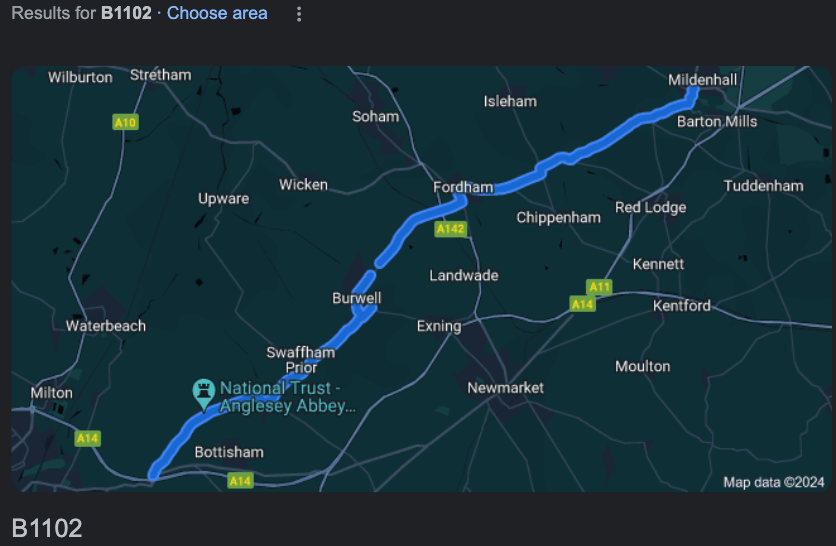
…with the old railway map of the Cambridge-Mildenhall branch line
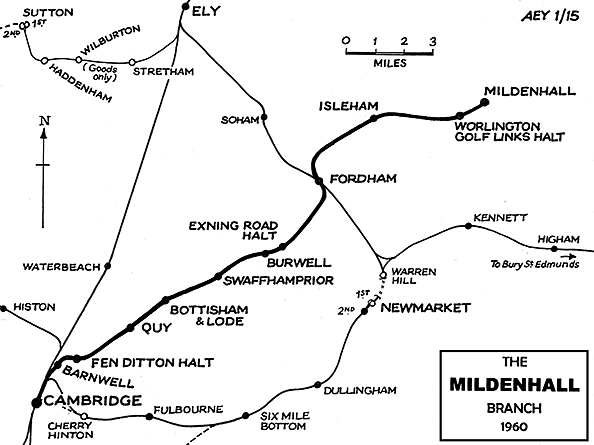
Above – from Disused Stations (Mildenhall Branch)
You can watch the video footage of a train journey on the old branch line here
“Think how much road traffic might be taken off if that line were re-opened (at least from Cambridge to Fordham) if it were included on a light rail loop or a suburban rail line linking Haverhill-Cambridge-Ely-Wisbech”
That’s for another blogpost.
The point about long commutes for teenagers is one that needs seriously addressing – both the unreliability of services, and the very poor design and planning/location of further education college sites.
“Why can’t we plan ahead?”
For reasons Dr David Cleevely gave to Lewis Herbert on Cambridge 105 earlier. Have a listen from 30m45s here.
“What is it that we wish we had been doing in 2024 that enabled us to get to where we are?”
Dr Cleevely’s spot on with the long term policy question. Having decided on what the future vision is going to be, what are the policies and actions that we need to take *now* in order to achieve that vision? This is one of the places where the UK is going badly wrong with its own Net Zero targets. Repeating ‘Net Zero by 20XX’ doesn’t cut le moutard. It simply enables ministers to get away with either doing nothing, or doing worse than that assuming someone else will sort out the mess.
Furthermore, the fragmentation of the public sector and of local government – in the absence of regional planning structures & systems, alongside the over-dependence on professional private consultancies means that there’s no single competent institution to bring it all together.
Government [ie state-funded public services] in all its forms, national and local, is starved of resources and just living hand to mouth day to day instead of thinking about that longer term future… ….Let’s lift our eyes of just what is in front of us.” Dr David Cleevely.
That is ultimately a Party Political decision by ministers.
“We need an arrangement with HM Treasury who are too jealous of the reins of economic power. We need to get better at articulating an idea that is greater than the sum of its parts, and work out how we get to that.” Thom Holbrook.
That is both a Political issue and also a departmental cultural issue – especially for The Treasury.
“We need to move away from being a client. Let’s have proper devolution. It’s peer-to-peer. We are an engine of economic growth, and should have the capabilities on the ground. When you get someone coming up from London, they have no idea of how Cambridge works in all its detail.” Dr David Cleevely
“In order to understand an infrastructure gap exists in different pockets in different parts of the region. “ Dr David Cleevely – similar to what Dr Andy Williams of Astra Zeneca said.
“One of the things Dr Williams mentioned was the failure of previous governments to build the necessary infrastructure needed for previous expansions.”
Dr Andy Williams to Queen Edith’s Community Forum, 31 March 2023
One of those pockets happens to be north east of Cambridge. Go further north into Fenland and the number of bus trips per hour has collapsed since the banking crisis.
“Fenland has emerged as a bus travel black spot with one of the largest reductions in bus services of all areas of the country between 2008-2023. New research shows a staggering drop in bus services of 84 per cent making it the second worst part of the country.”
John Elworthy for Cambs Times, 05 Dec 2023
I had to double-check those figures. Turns out it’s almost as bad for Peterborough. In fact, one could say that the economic woes of Peterborough are in part due to the collapse of bus services by 75% over that same time period. No wonder the Cathedral City is struggling.

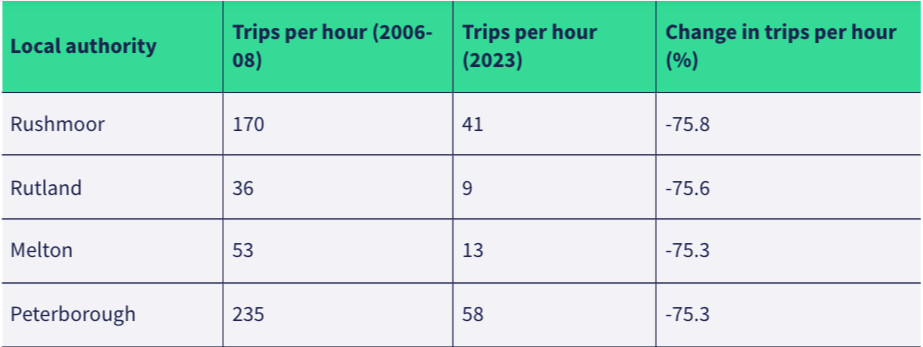
Above – note the reduction in bus trips per hour by over 75% for Peterborough between 2006-08 and 2023. By Friends of the Earth Nov 2023 here.
No city could resist such a collapse in passenger numbers and services and not take a hit – whether it be in the reduction in essential staff being able to get to work (leading to chronic shortages) and/or the cutting off of access to customers – something that anecdotally I think helped lead to the demise of The Grafton Centre in Cambridge when regular bus routes from South Cambridge to the bespoke bus station were pulled by Stagecoach.
Mr Holbrook picked up on the Development Corporation – one we still don’t know the boundaries of at the time of blogging
He noted that one of the potential gains from such an institution is the ability to cross county boundaries for planning purposes, enabling strategic planning. Note in the case of Cambridge, a radius of just over 15 miles crosses the county boundaries of:
- Bedfordshire (Sandy & Biggleswade)
- Hertfordshire (Royston)
- Essex (Saffron Walden)
- Suffolk (Haverhill)

Above – from CALCMAPS here
And as we know, Lord Redcliffe Maud made the case for all but the first pair of towns to become incorporated into a new ‘Greater Cambridge’ unitary – one that was based in part on commuting distances in the evidence set.
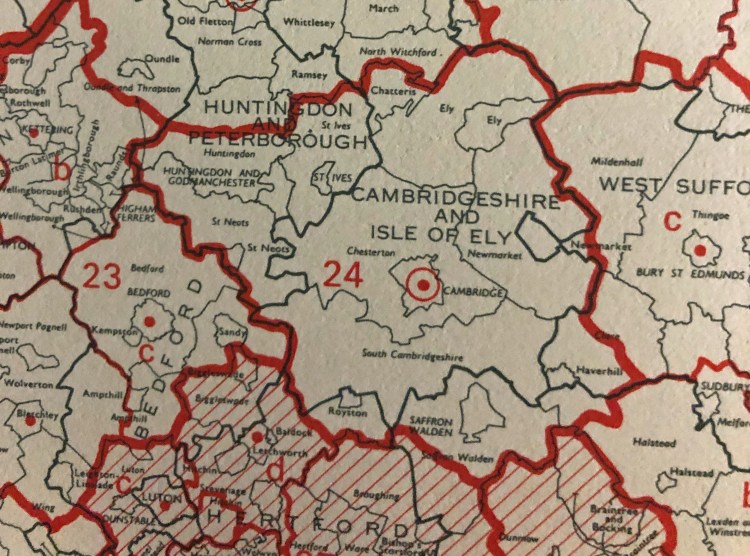
Above – Redcliffe-Maud’s proposal for a new Greater Cambridge unitary council (1969)
“None of that is going to deal with the buses in the time left that the further education students have left at college”
Which makes the shambolic time-wasting of the present holders of ministerial office ever so frustrating. But then I’m also aware that there was similar sentiment in the run up to the 2010 general election with Gordon Brown’s Government – one that had some of the traits of the present one in terms of high ministerial turnover, political splits, and a sense that it had ‘run out of ideas and steam’.
If a general election is to be held on 2nd May to match the local elections, the Prime Minister has to seek a dissolution of Parliament by 26 March at the latest. Because of the ‘wash up’ period that happens in the days prior to that – i.e. clearing what’s left of the legislative timetable (think the Ping-Pong with the controversial Rwanda Bill happening now!), we’ll find out in the next few days if there will be one now, or later.
We live in interesting times…
If you are interested in the longer term future of Cambridge, and on what happens at the local democracy meetings where decisions are made, feel free to:
- Follow me on Twitter
- Like my Facebook page
- Consider a small donation to help fund my continued research and reporting on local democracy in and around Cambridge.
Below – Together Culture which recently opened on Fitzroy Street en route to The Grafton. I joined them as they are working on the social and creative future of Cambridge – and I need to work outside of the house more regularly too

 The Cambridge Town Owl