
This draft code deserves more publicity – not just for the amount of work that has gone into it but because what the participants have produced looks more than interesting for the rest of our city
You can find the draft code here – scroll down to “Next Steps” and click on the link.
King’s Hedges, Arbury, and a bit of West Chesterton

Above – The area map on p6
“Why is Orchard Park excluded?”
Because it’s on the other side of the city boundary, so falls within South Cambridgeshire District. This is why Orchard Park has a constituted community council (effectively an urban parish council). And if you are a constituted institution then you can apply for a whole host of things (including funding) from external organisations that the old Cambridge City Council area committees could not. This is one of the many things that an overhaul of local government should sort out.
Local History
The detail below shows the growth of what is now the North Cambridge Academy. Note the social change on the Ordnance Survey map where ‘Ch’ on the 1973 map was relabelled ‘PW’ in the 1992 version. i.e. from “Church” to “Place of Worship” – even though it’s still the same institution and building.
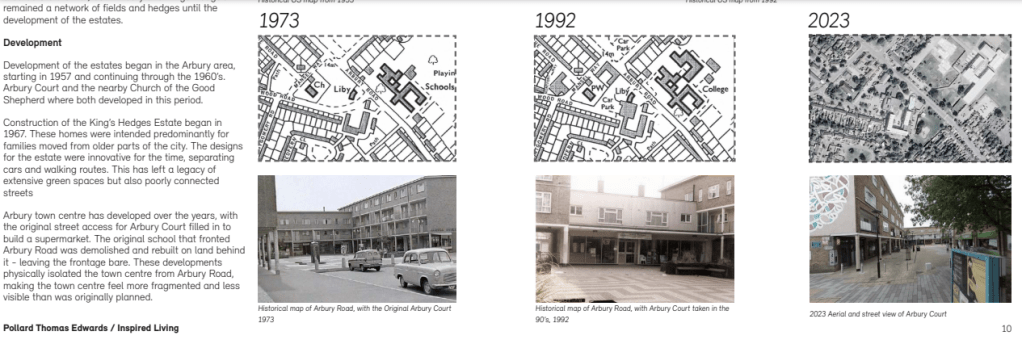
Above – NCDC 2024 p10
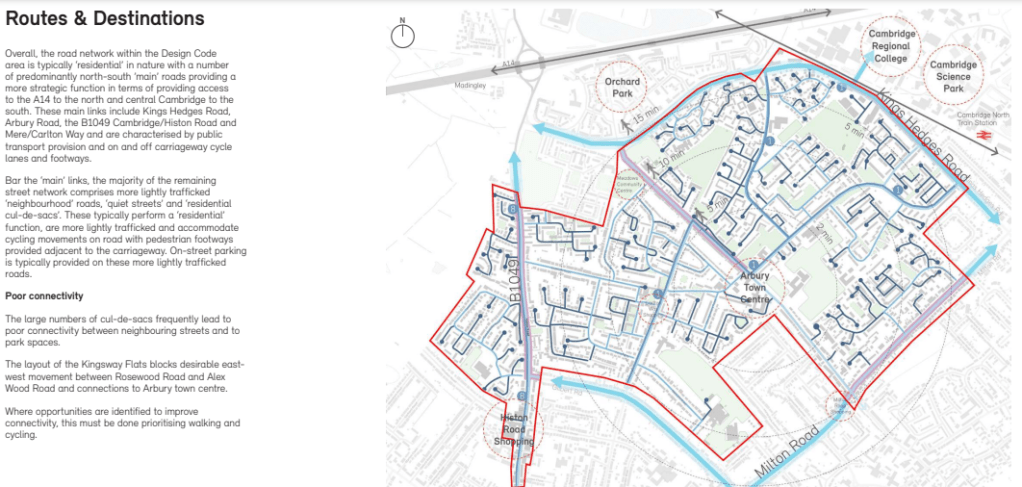
“Who decided the streets should be cul-de-sacs?”
That’s where local history and the familiarity of social and town planning history is important. It’s easy to forget that the slums of times gone by contained tiny homes without windows and ventilation. It was a public health nightmare. Hence the pioneering town planners made it their business to reduce overcrowding and provide for new homes that could have well-ventilated rooms. Hence the lower densities. Furthermore, front and back gardens and a car parking space responded to the massive rise in the use of the motor car – ones that transport planners had not prepared for.
What the town and transport planners of old may not have known, or were prepared to overlook, were the social impacts of the mass dispersion of previously tight-knit communities that had grown up with each other. In March 1965, Arbury was labelled a ‘Desert Estate’ with no community facilities on it.

Above – Cambridge Evening News transcribed in Lost Cambridge here
Knowing that local history is essential in beginning the process to design out the problems that were built in by previous generations. But that involves hard work that not enough developers are willing to put in – not least because of the financial incentives put in place to commission consultants to ‘deal with’ potential objectors to a cost-minimising/profit maximising minimalist proposal. So long as the political, financial, and town planning system incentivises such activities, that’s what we’ll get more often than not.
“Arbury town centre?!?”
I can’t say I’ve ever heard it called that before. On the other hand, if you are going to have a very long term plan (measured in decades) that shows both local ambition and a desire to overcome the social problems of previous decades, I can understand it. Hence the public spaces opportunities also matter.
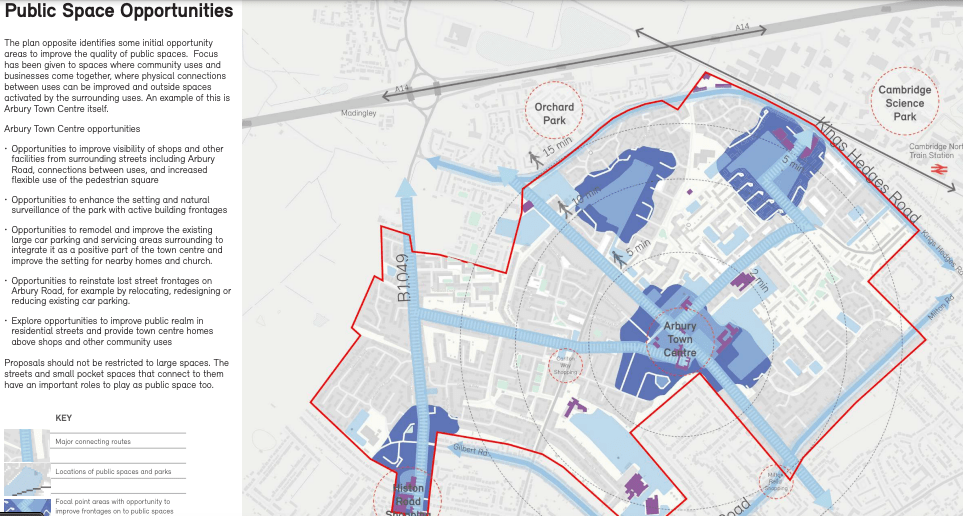
Above – NCDC 2024 p33
When you look at the present neighbourhood centre from GMaps below and compare it with the opportunities diagram above, you can see the longer term potential.

Above – GMaps focused on Arbury Court Library
You can see how within the next half century, the lifespan of the post-war council homes will be coming to an end unless retrofitted/renovated. As and when that time comes, a time when most of the householders are likely to have moved on (either to a different address, or have passed away) the redesign of a much wider area than Arbury Court then becomes possible. The challenge is how to frame it as ‘What sort of legacy would you like to leave for future generations after you?’ rather than ‘Councillors want to forcibly evict old people!’ And as we all know, predicting the future is a very difficult thing to do! At the same time, so is getting into a mindset of wanting to leave something better behind for a future generation that you’ll never meet. Or starting something new, the benefits of which you will never receive or experience. The planting of the proverbial row of trees.
“Will other parts of Cambridge go through a similar process?”
That’s the plan. Note that one sign of a sound process applied to different areas is that the majority of the participants – representative of the area – are content if not happy with the final result and how they got there. At the same time, the final result is not an identikit version stamped on every single neighbourhood.
What is it that will make Arbury unique? In Coleridge ward, we’ve got a dragon slide at Coleridge Rec. Arbury?
“How about a ***big crocodile slide*** as suggested by Valentine who won the thriving spaces competition?”

Above – Ideas from local school children – NCDC 2024 p9
I agree with the crocodile slide idea!
“Next Steps?”
Build it into citizenship and civic education in secondary and further education.
At the moment the system of local public services is too fragmented and underfunded to make this happen at a city-wide level. But at a neighbourhood level, the possibility of bringing teachers, parents, councillors, council officers, specialists and potential philanthropists (the Cambridge Science Park being on the edge of the neighbourhood) should be enough to fund a programme that builds on what the children are learning about their local area. That includes new learning materials that can be applied to a range of subjects – whether drama scripts for plays based on local history, through to geography worksheets, through to maths workbooks using content drawn from official plans, through to some of the ideas used in the London School of Architecture’s Saturday Club Programme for teenagers.
There are people in North Cambridge with the ability, willingness, and the resources between them to lead the way.
Go for it.
If you are interested in the longer term future of Cambridge, and on what happens at the local democracy meetings where decisions are made, feel free to:
- Follow me on Twitter
- Like my Facebook page
- Consider a small donation to help fund my continued research and reporting on local democracy in and around Cambridge.
If you want some ideas on how to go about this, pop into Together Culture on Fitzroy Street down the road from The Grafton Centre.
 The Cambridge Town Owl