
The campaign for an overhaul of local government in Cambridgeshire & Peterborough had its first workshop today at Cambridge’s Central Library.
It’s one thing agreeing that the present governance diagram is a mess, but it’s quite another thing to try and figure out what to so about it – as everyone at the Cambs Unitaries event found out.
“Our objective is to secure better local government arrangements for Cambridgeshire and Peterborough through a grassroots campaign to replace all the current main tiers of local government (the district Councils, the County Council, the Cambridgeshire and Peterborough Combined Authority and the Greater Cambridge Partnership) with at least two new Unitary Authorities to provide local services for the communities in the north and south of the County more effectively and democratically.”
https://www.cambsunitaries.org.uk/our-objective/
If you agree with the objective, feel free to sign up (for free) as a supporter here.
There were around 25 of us including the six of us (me included) on the founding committee of the campaign. (Note part of my call this time last year at the local elections in Queen Edith’s ward was to abolish the GCP and Combined Authority, and to create a unitary council structure for Cambridgeshire & Peterborough).
My part in the programme was to try and condense what would normally take 90 minutes of a workshop into a tenth of that time. Which was a challenge! The main points I tried to get across were:
- The concept of Parliamentary Sovereignty – in that it can legislate for whatever it likes within the UK, and cannot be bound by decisions of previous parliaments nor can it bind the decisions of future parliaments;
- We are considering the case of the administrative and governance boundaries for local government, not the historical ceremonial county boundaries – and the former have had proposed changes (some of which were accepted, the rest rejected) ever since the creation of modern local government under the Municipal Corporations Act 1835.
- Talk you your candidates (https://whocanivotefor.co.uk/) and councillors (https://www.writetothem.com/) about what their views (and their parties’ policies) are on reforming local government.
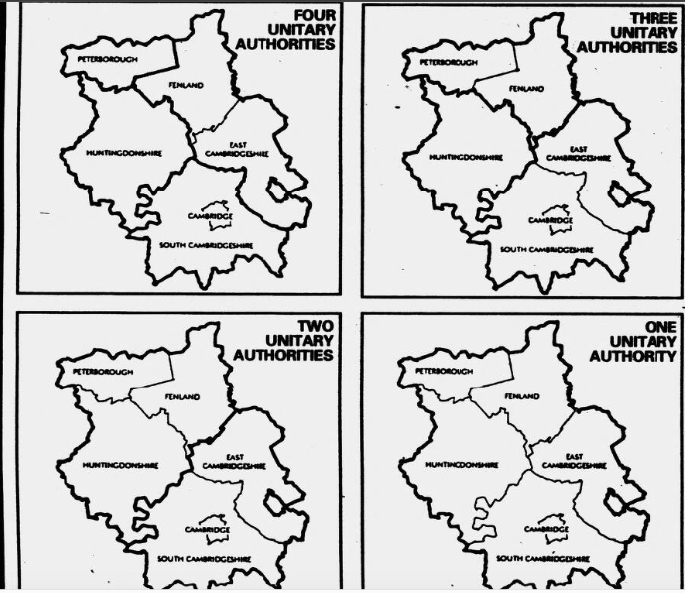
Above – some of the options considered (and rejected) in the review of the mid-1990s (Cambridge Evening News 23 Sept 1993 from the British Newspaper Archive – See my commentary in Lost Cambridge here)
One of the things a number of participants mentioned to me about my previous workshops on ‘How Cambridge got to here’ was taking people through the local history – in particular the contemporary local history of decisions ministers took after 2010 that created the Greater Cambridge Partnership in 2014, and the Combined Authority a few years later – the latter requiring legislation (not an Act of Parliament but an Order in Council) to create the CPCA – The Cambridgeshire and Peterborough Combined Authority Order 2017.
In order to demonstrate how Parliament and central government had changed how Cambridgeshire was and is governed, I printed out a couple of maps from this History of Local Government for Cambridgeshire from 1958.
I also showed maps from the Royal Commission on Local Government 1966-69 including the detail of proposals from the maps from volume 1 (below-right).


Above-left – from the Royal Commission’s summary pamphlet 1969 here. Above-right, detail from the proposed restructure for Cambridgeshire and Peterborough.
The picture today nationally.
Phil Rodgers (who blogs on local electoral politics amongst other things) with a display of the parts of England already under unitary councils, before taking us through the process that Northamptonshire went through following a local government financial crisis.
The case study of Northamptonshire commenced with an invitation from the Government to local councils in Northants on how it should be restructured. The negotiations for the conversion from a two-tier council (similar to Cambridgeshire) to the present unitary structure of two separate unitary councils was completed by the signing of the Northamptonshire (Structural Changes) Order 2020, with the commencement of the present structure having commenced on 01 April 2021 as explained in the Order’s notes.
What Mr Rodgers said was that if the people of Cambridgeshire and Peterborough wanted to have a unitary structure, a process involving government ministers would be required – coming back to my point about Parliamentary Sovereignty – as a couple of questions indicated significant pessimism over whether ministers would be persuaded to carry out those changes.
Group Discussions – what did people think?
I’m not going to go into huge detail as the note-takers will be providing more detailed write-ups in due course. What I took away were:
- The need to hold events across the county – this cannot be a ‘Cambridge’ thing. The saying ‘Charity begins and home, but does not end there’ can be seen in this context: The campaign started here, but doesn’t mean it stays within the boundaries of Cambridge or Greater Cambridge.
- The need to account for hugely-differing levels of expertise across a range of different academic disciplines, vocational backgrounds, and life experiences. All bring something different to the discussions – whether it’s people who are familiar with the various Acts of Parliament and the provisions within them, to those quite understandably asking whether this will simply mean more growth without the provision of doctors’ surgeries and NHS dental places.
Where Parliament is – the official view of the House of Commons Select Committee on Public Administration
Some of you may be familiar with the damning conclusion from the Public Administration and Constitutional Affairs Select Committee’s report on the Governance of England.
“The governance arrangements for England are not fit for purpose and in urgent need of comprehensive reform…”
“The report describes the current governance system, which includes local government and metro mayors, as a “patchwork” and “opaque”, leaving citizens wondering about which democratic representative or institution is accountable for decisions that affect their lives and livelihoods.
“The system has created “geographical inequality” and led to a feeling amongst people in England that they can’t influence political or social change, which represents a “warning sign for health of democracy”.”
House of Commons Press Release 31 Oct 2022
Their call for a new commission to examine *how* to overhaul the system was rejected by ministers – Michael Gove conceding that it would be for the next government of whichever colour to deal with the problem.
This for me means that we, the people of the county and combined authority area need to start the grassroots debates now. If we can do this, then when it comes to the general election hustings, both the public and candidates will have had advanced notice of some of the topics that are going to come up – with the latter able to compose more substantive and informed answers to questions put to them at hustings. At present, MP-candidates (i.e. Prospective Parliamentary Candidates selected by political parties) are holding back on substantive answers until their national parties publish their election manifestos. Understandable given how niche yet complex the issue is – one that will need more detailed examination by the policy advisers in their respective parties.
That said, the more that people talk about it and raise the issues with their local elected representatives, the greater the upwards pressure on national parties to come up with a more substantive policy response rather than a one-liner throw-away.
There will be more events later in the year – let’s get the local elections out of the way first!
If you are interested in the longer term future of Cambridge, and on what happens at the local democracy meetings where decisions are made, feel free to:
- Follow me on Twitter
- Like my Facebook page
- Consider a small donation to help fund my continued research and reporting on local democracy in and around Cambridge.
 The Cambridge Town Owl