A reminder just as much as a useful summary for anyone interested in the Cambs Unitaries Campaign.
The late James Brokenshire, former Housing Secretary in Theresa May’s minority government made a written statement to Parliament on unitary councils, dated 22 July 2019, here.
“What is a written statement? Or rather, what do they mean in politics?”
Remember that thing about Parliament being Sovereign? And Ministers being accountable to MPs in Parliament? Whenever there is a change of Government policy, or whenever the Government wants to clarify a policy issue (i.e. on actions being undertaken by the Government of the day), the Minister responsible for the policy area is expected to make the statement to Parliament in the first instance. That gives MPs the first opportunity to question the minister about the changes being made.
In this case, the Secretary of State for Housing, Communities and Local Government (now Levelling up etc…) was making clear who would need to do what in order for him to consider any proposals to change local government structures, systems, and boundaries.
“For councils wishing to restructure to form unitary local government, the first step of the statutory process as set out under the 2007 Act is for me to issue an invitation to councils to submit proposals. There are two circumstances in which I will consider issuing such an invitation.”
Those conditions are:
- There is a local request for an invitation.
- That I consider that the request demonstrates local opinion is coalescing around a single option which is reasonably likely to meet the existing publicly announced criteria for unitarisation.
Which explains why the Cambs Unitaries Campaign was established in the first place.
The first condition requires a critical mass of councillors to ask for an invitation from Central Government;
The second condition requires those making the request and their supporters to demonstrate that local opinion [however defined] has a preferred alternative in mind that can then be assessed against the criteria set out by the Secretary of State further down.
“Following such an invitation, it would be for the councils concerned to decide whether to develop and submit proposals for unitarisation, either individually or jointly by two or more councils.”
That means the Cambs Unitaries Campaign would not be able to respond to the request directly – rather it would be for supportive local councils to draw up the proposals themselves, or stick a covering letter onto proposals drawn up by someone else and adopting them as the policy of the councils. Either way, due process is essential – not least something that involves demonstrating the support of local public opinion. That could include a manifesto commitment at local elections or even a general election if a candidate makes it very clear that one of their headline policies is overhauling local government for their area.
“These criteria state that subject to Parliamentary approval a proposal can be implemented, with or without modification, if I conclude that across the area as a whole the proposal is likely to:
- improve the area’s local government;
- command a good deal of local support across the area; and
- cover an area that provides a credible geography for the proposed new structures, including that any new unitary council’s population would be expected to be in excess of 300,000.“
Ultimately the Minister responsible would have to table a motion in Parliament asking for its approval (most likely to be granted) in order for any proposals approved by the Minister to be implemented. Again, the Minister being accountable to Parliament, irrespective of how effective or otherwise this specific process is. In the grand scheme of things by this stage this is a formality. i.e. given the long process involved, MPs would need to have a *very good reason* to block it at the final hurdle.
For district council mergers, no requests or invitations is required – mainly because it does not involve the granting of new powers to a new organisation. Rather, instead of two separate institutions exercising the same set of powers, it would reduce to one. This is particularly the case where existing district level councils have ‘shared services’ – such as Cambridge City Council and South Cambridgeshire District Council’s Greater Cambridge Shared Planning Service.
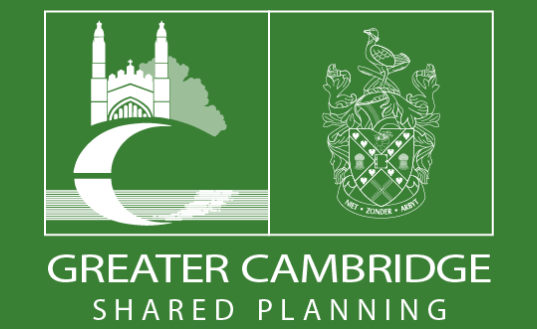
Above – note that South Cambridgeshire District Council has stuck with the formal coat of arms for their council while many decades ago Cambridge City Council went for the corporate logo for their corporate publications.
The criteria the Secretary of State listed for district-level mergers are that in his opinion (which he would need to have evidence to justify – lest he be hit with a judicial review) the proposed merger would:
- improve the area’s local government;
- command local support, in particular that the merger is proposed by all councils which are to be merged and there is evidence of a good deal of local support; and
- demonstrate the area is a credible geography, consisting of two or more existing local government areas that are adjacent, and which, if established, would not pose an obstacle to locally-led proposals for authorities to combine to serve their communities better and would facilitate joint working between local authorities.
Finally, the Secretary of State concludes:
Got any thoughts?
- Let your election candidates know via https://whocanivotefor.co.uk/
- Let your existing councillors know via https://www.writetothem.com/
Voters in the new-look reoriented South Cambridgeshire Constituency can hear what their MP-candidates had to say about possible unitary councils for Cambridgeshire in response to this public question at the recent Coton Village Hall hustings on 17 April 2024.
It has been 30 years since unitary councils were last considered – see Lost Cambridge here. Time for a review?
If you are interested in the longer term future of Cambridge, and on what happens at the local democracy meetings where decisions are made, feel free to:
- Follow me on Twitter
- Like my Facebook page
- Consider a small donation to help fund my continued research and reporting on local democracy in and around Cambridge.
Interested in campaigning for a unitary council? See https://www.cambsunitaries.org.uk/

 The Cambridge Town Owl