
That’s the easy bit – the hard bit is deciding where the boundaries should be and what powers such an authority should have
Some of you may have seen the leaflet:
As I’ve mentioned on numerous occasions, history provides some pointers on what things to consider.


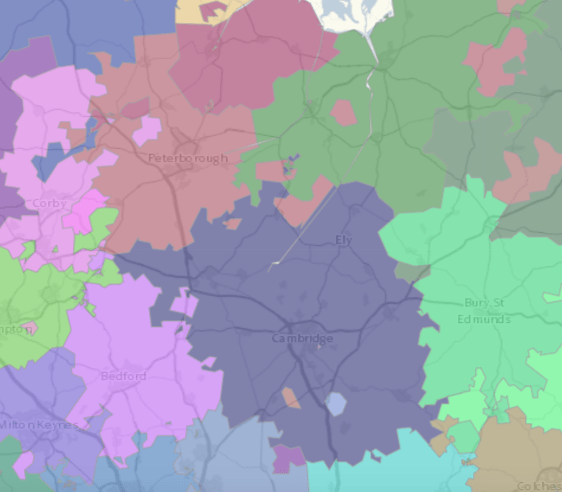
Above left to right: Abandoned proposals from the Redcliffe-Maud report 1969, Nathaniel Lichfield on the economic spheres of influence of Cambridge and surrounding market towns, and more recently Cambridge’s ‘travel to work area’.
In the book “Citizens All” from 1947 digitised here, the contents page gives some idea of who had responsibility for what prior to the decades of regionalisation and centralisation, followed by the decades of privatisation and austerity.

Above – Citizens All (1947)
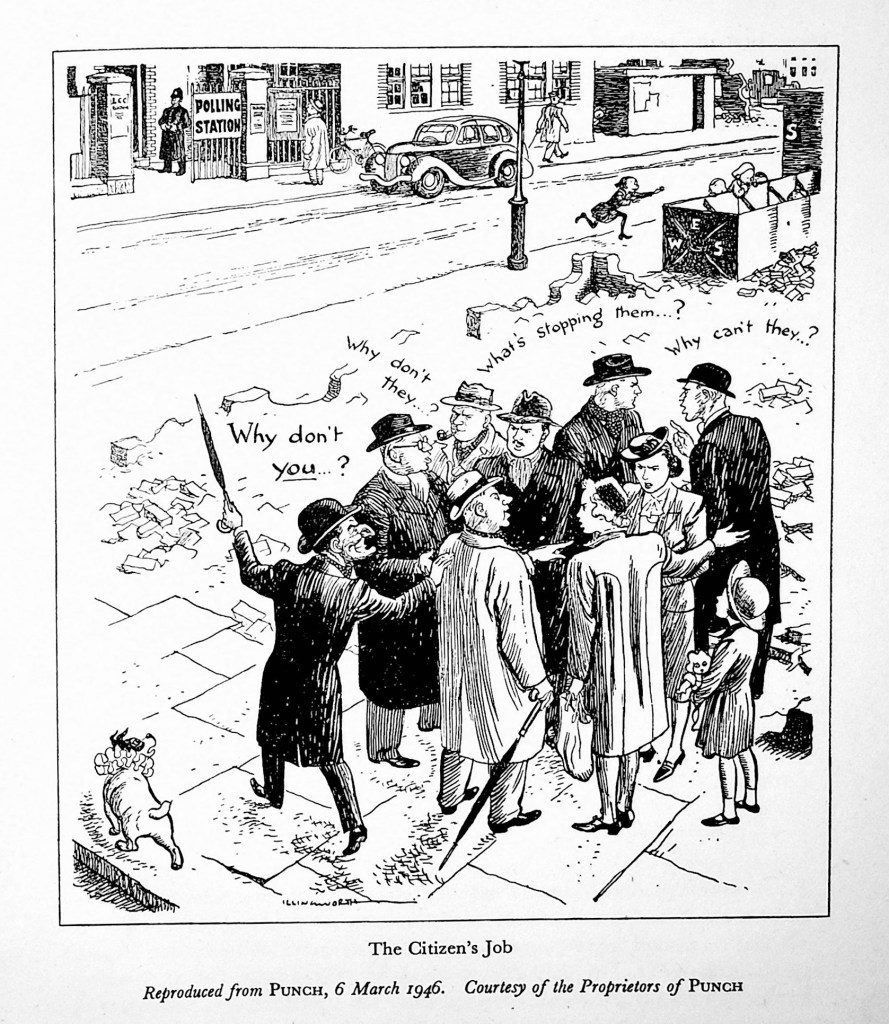
Above – from the same publication reproduced from Punch magazine
Which reminds me, I’m tempted to use the headline: “Why doesn’t someone do something about…?” as a title for a future event on the Great Cambridge Crash Course
…which touches on a blogpost on The Kindness of Leaders
“In the past, leaders were expected to be directive, ‘do what I say’, status-asserting people who got results. Compared with this, kindness was seen as weakness, a failure to make tough decisions or ignoring the bottom line.
Above – Ian Frost 20 Apr 2024
In politics and the media, I dare say that culture still exists – the two perpetuating each other’s cultures because taking ‘tough decisions’ [that all too often seem to hurt the weakest, not the most powerful] seems to be a trait that apparently demonstrates that a politician is ready for ministerial office. One of the highest profile examples of this was Nick Clegg’s U-turn on tuition fees – who as it turned out (and as more than a few people suspected at the time, got stitched up by the previous Labour Government *and* his soon-to-be coalition partners, the Conservatives. The same trick was pulled with the Ron Dearing Report that brought in tuition fees in the first place.
“We will ensure consistently high standards and will consult on the development of higher education when we receive the results of the Dearing Review. We have world class research in British universities which we will continue to support.”
Above – from the Conservative Manifesto of 1997.
Labour’s 1997 manifesto also mentions Dearing, but didn’t explicitly imply they’d bring in up-front fees that he recommended. Higher Education funding has continued to trouble policy makers for over a generation. Yet as history shows, in previous years some larger local councils used to have seats on the governing bodies of higher education institutions with the exceptions fo the very old universities. Both of them. (In England). Take Leicester and its old University College.
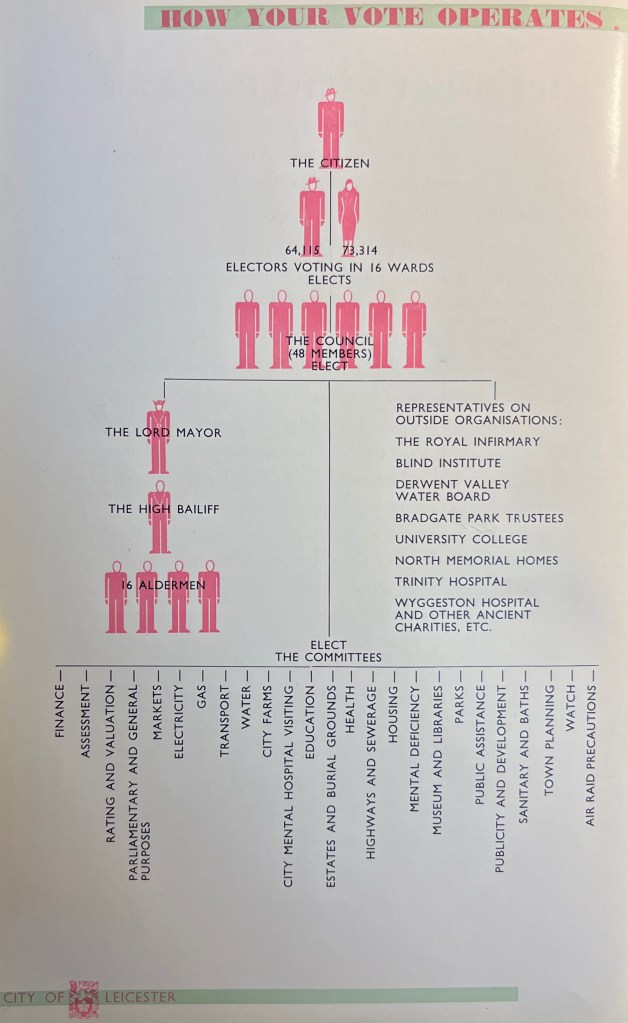
Above – City of Leicester 1939/40
What would it be like if local councils had seats on the governing bodies of universities?
“Where should the money come from?”
Here’s Jack Shaw.
He also mentioned this book on the history of the old Audit Commission
As I’ve asked politicians and academics, what would make for suitable additional revenue-raising bases for local councils to enable them to be independent of The Treasury?
Professor Colin Talbot pointed to an example from Australia.
The CGC in Australia has a very good explainer here
Above – on devolution and how it works in Australia
The other old book I got hold of that provides a useful framework to look at contemporary problems is Myles Wright’s planning notebook.
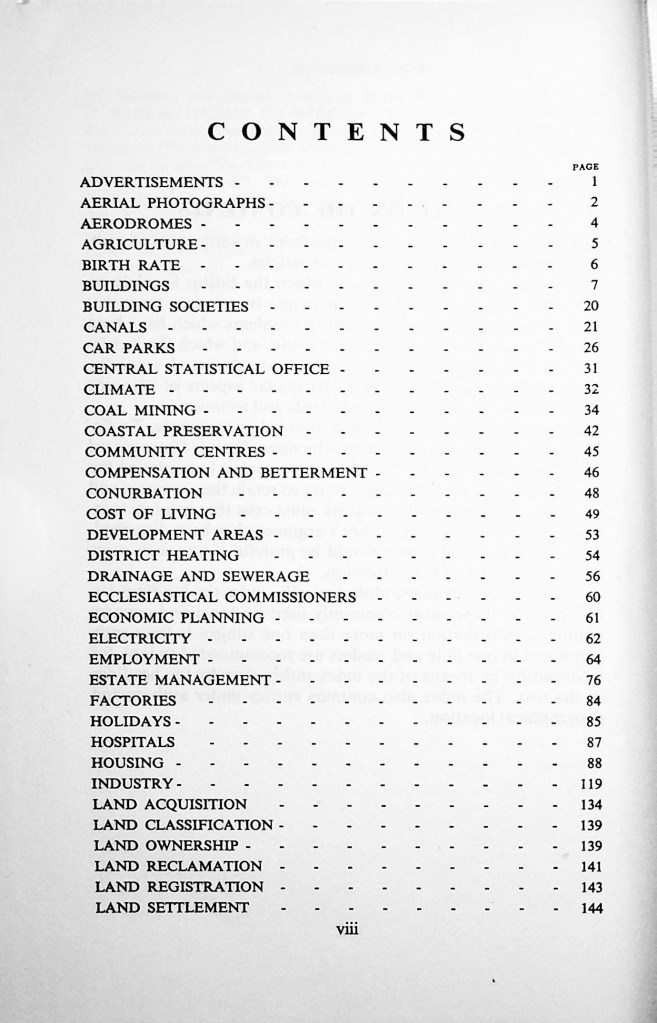

Above – the contents of Myles Wright’s Planner’s Notebook (1948)
I’ve digitised Part 1 (A-M) here, and Part 2 (N-Z) here as it reads as both a fascinating snapshot of people’s hopes for the future, *and* provides a useful history of interwar UK that in the grand scheme of things has been forgotten. One thing that rally stood out for me was… The Severn Barrage. Which reminded me of how big the tidal ranges in parts of Scotland are. (See this paper from 2017 here). Their conclusions on schemes that generate less electricity but which are more constant and predictable is interesting too.
One of the things that we saw in the 20th Century was the closure of many municipal utilities either through regionalisation and/or privatisation. One of the things that small scale renewables allow for is council-backed schemes that not only provide cleaner power sources, but also sustainable revenue streams for town halls, reducing their dependency on Central Government.
“A “hollowing out of local government over the past decade” had created workforce, leadership and long-term capability challenges that were “driving much of the resilience out of the sector”.
“If you’ve got local authorities that in real terms are spending significantly less than they were 15 years ago, then their role in their local community, by definition, is going to be different,”
That brings me to my final point about how much power should councils have when it comes to dealing with things like the climate emergency? For example central government is only beginning to realise how big a retrofitting job is required for Cambridge in order for it to have enough water to grow further, alongside new supplies piped in. For all of the recommendations about what needs to happen, under the current planning system reliant on developers having to make a profit means very little progress can be made.
“The latest scientific literature and recent research conducted at the Design & Health Lab, Department ABC of Politecnico di Milano, show that three factors, in particular, significantly improve the urban environment and, in turn, people’s health: green spaces, digitalisation and inclusive design.”
“Greenery and nature must be integrated into the urban landscape, so as to achieve a balance between the natural and the built environment. Green spaces are critical for many reasons. They promote biodiversity, improve outdoor air quality and urban microclimatic comfort, minimise the impact of environmental pollutants and favour physical activities, which help combat a sedentary lifestyle and enhance mental wellbeing.“
Stefano Capolongo in New Civil Engineer 08 April 2024
The problem is that open green spaces don’t make profits for developers. The financial incentives and the gaming of the planning system mean that all too often people cannot have the nice things because they are value-engineered out of developments to reduce the costs/increase the profit margins of developers and the firms/institutions that finance them. And when that has a negative impact on health of the people who have to live with the consequences, that’s a classic case of privatising/extracting the profits, and socialising the losses.
We cannot have an informed discussion about overhauling local government until more of us have the knowledge of the essentials of local government.
One of the big lessons from the Greater Cambridge Partnership is that ministers and councillors took for granted the support of the people. There was no informed consent. Any nominal consent was taken as a given through the giant mandates that incoming governments take from a general election. Because that’s ‘the choice of the people’. If every voter had read all of the manifestos, and had listened to, and had been able to question every candidate campaigning for their votes, and had watched the party leaders on TV, maybe. But that doesn’t happen. In anycase, how many decent books are there on how local government functions? (Ones that are not out of date?) Exactly. Here’s one from 1990 by the NCVO. Make of it what you will. (Given the constant policy churn, printed books soon go out of date.)
Immy Blackburn-Horgan at the Queen Edith’s Hustings on 18 April 2024
One of the questions I asked was why none of the local elections manifestos for Cambridge didn’t contain clear policies about how to educate the residents of our city and county about how the state functions.
Whichever party brings forward proposals to overhaul how Cambridge is governed, this has to include a major component that covers educating the citizens – especially those of us that never covered it at school.
Food for thought?
If you are interested in the longer term future of Cambridge, and on what happens at the local democracy meetings where decisions are made, feel free to:
- Follow me on Twitter
- Like my Facebook page
- Consider a small donation to help fund my continued research and reporting on local democracy in and around Cambridge.
Interested in campaigning for a unitary council? See https://www.cambsunitaries.org.uk/ (of which I am a member)

 The Cambridge Town Owl