
Me and Ellie Breeze (or is that ‘Ellie and I’?) of Together Culture tried out an alternative way of getting people through the door to discuss their issues with council candidates. We managed to persuade…one person!
With thanks to:
- Tim Bick (Lib Dems candidate for Market)
- Rosy Greenlees (Labour candidate for Market)
- Naomi Bennett (Green candidate for Abbey)
….for giving up their time to participate.
Part of the deal was that Ellie and I would try and persuade the public to come in, as well as encouraging the 250+ membership to participate. That only a handful of the latter turned up – in stark contrast to the well-attended workshops is something we’ll all need to investigate.
It wasn’t a wasted effort – there was a huge amount of learning in that 45 minute session for the pair of us given the ambitions of Together Culture
Several of those lessons go to the heart of how important democracy is, and who actually has access to democracy and the rights it supposedly bestowes.
Young adults being failed by institutions – political and educational
If local democracy was important, wouldn’t the further education colleges and higher education institutions make much more of an effort to prepare their students for the local elections which, in Cambridge take place every year?
This was my main point of my last post. Back in the late 1990s no one at sixth form college told me there were local elections happening. I made it my business to go out and vote because I didn’t get the opportunity to vote out the Tories in 1997 – being a few months too young. The only name I vaguely recognised on the ballot paper was Ruth Bagnall – the Labour candidate. Because the Lib Dems had not made the effort to reach out, I defaulted to Labour. In those days, few made the effort to educate us about civics and democracy. We were a generation taught to the test and (in my view) educated to be ignorant about the wider world and the knowledge we’d need to survive in it. I am still of that view – only I’ve learnt that it applies to the chronically under-funded lifelong learning sector too.
https://whocanivotefor.co.uk
No – really – who can I vote for? Several of the teenagers around town told me and Ellie that they were too young to vote. Fortunately on the 80 or so flyers I printed out that afternoon I had a snapshot of the above online tool that enables people to ask questions of the candidates where they live, irrespective of their citizenship status. For a number of the I suggested they could email the candidates to ask about youth services, only that in my day Thatcher’s policies all but obliterated youth services in Cambridge by the 1990s.
What does it mean to be a citizen of Cambridge if your nationality bars you from voting? (Even though your employer may have made a persuasive case for you to move to Cambridge from another country?)
In 1764, [James] Otis wrote in “Rights of the British Colonies Asserted and Proved” that “the very act of taxing, exercised over those who are not represented, appears to me to be depriving them of one of their most essential rights, as freemen; and if continued, seems to be in effect an entire disfranchisement of every civil right.”
Constitution Centre – No taxation without representation
As Naomi Bennett said in the discussion afterwards on this point, she takes the view that people who live and work in Cambridge should also have voting rights in Cambridge. This reflects a stream of thought within the Labour Party and The Green Party too.
“We propose a system where all residents with lawful status in the UK who are currently disenfranchised gain the right to vote in [local elections in England]”
Lara Parizotto to LPC 14 March 2023
As voting status in Scotland for all but the general elections is a devolved competency, the Scottish Parliament legislated to grant residence-based voting rights to all those legally resident in Scotland. (See https://www.gov.scot/news/right-to-vote-extended/). That stands in stark contrast to the steps taken by the current Conservative government to make registering to vote and casting a vote much more difficult – such as the Voter ID requirement.
In the grand scheme of things, the Government’s ambitions for Cambridge is incompatible with its policies on who has the right to vote. Looking at the 2021 census figures we can see that over 40% of Cambridge residents were born outside of England. Note that does not mean they are all not UK citizens. Many acquired citizenship a long time ago, while others were, due to the quirks of Empire, born with citizenship even though their place of birth may have been a British colony at the time.
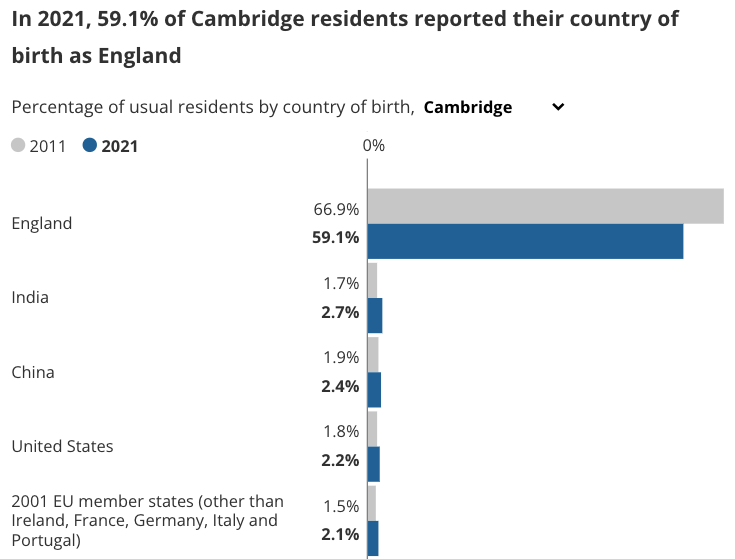
Above – from Cambridgeshire Insights
My point is that we have a critical mass of residents across the income and social spectrums who are barred from taking part in one of the most basic of civic functions: voting.
Don’t think that it doesn’t have an impact on how people choose to interact with the state. If you’re not allowed to vote, why would they think the state (local and national) is interested in their opinions on things like transport consultations or even the future of Cambridge? When I was in hospital in 2021 during a lockdown, the only people I had to talk to were the staff. So I asked them lots of questions and this is what I found out.
Any solutions won’t be along the lines of the things that I’ve tried out such as the informal drop-ins at Rock Road Library and Together Culture. This requires institutions to sort themselves out, take some responsibility for the civic and democratic health of our city, and show that thing that corporations like to talk about but show precious little of: Leadership.
- Which of the large further education institutions are going to schedule annual local election events so they become routine?
- Which of the same institutions are going to prepare their students (and staff) for such events so that they have time to prepare informed questions/
- Which of the large employers are going to inform their staff when elections are taking place?
- Which of the large employers are going to use their resources to organise and host events that will enable ordinary staff members to meet candidates and discuss issues? (i.e. not senior executives in private board meetings with ‘decision-makers’).
- Which of the large institutions are going to make it their civic duty and a core value of their organisation to support and improve the health of our democracy, and improve how our city and county function?
Because I have neither the legitimacy nor the capacity to do this, and councillors in political parties cannot do it on their own.
Either that, or everyone tells visiting ministers and dignitaries that democracy isn’t all that politicians make it out to be in their public speeches.
Food for thought?
If you are interested in the longer term future of Cambridge, and on what happens at the local democracy meetings where decisions are made, feel free to:
- Follow me on Twitter
- Like my Facebook page
- Consider a small donation to help fund [things like venue hire and leaflet printing as well as…] my continued research and reporting on local democracy in and around Cambridge.

 The Cambridge Town Owl