
And it’s all over the papers! But even in the very unlikely case of the Tories being re-elected, the detail shows not only has it not been thought through, but also that the whole thing would get stuck in the long grass of a Royal Commission
Image – From the Government’s National Citizens Service programme website
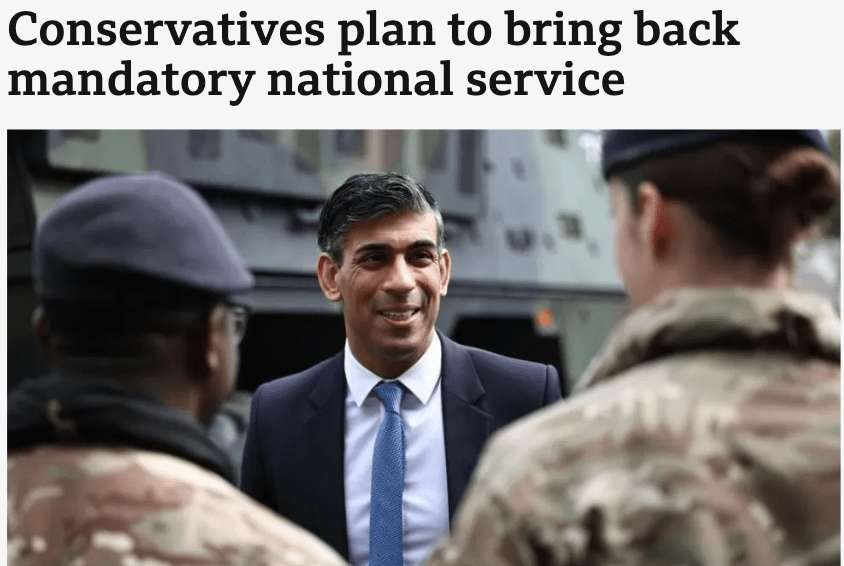
Above – from BBC News 25 March 2024
In the olden days, annual party political conferences used to function as the top policy-making function for political parties. They were traditionally at seaside resorts as they were the only places with hotel and guesthouse capacity to cope with large numbers of people from all over the country rocking up for such events. Furthermore, they were scheduled for just after the summer peak season in late September/early October – when the weather was still reasonable enough to enjoy.
The function of those conferences amongst other things was to have national debates to filter out some of the more radical and/or crazy ideas that (in the latter case) would have the public unpicking the policies or simply laughing at them. But in more recent years, the Conservative conferences have ceased to be formal policy-making events – rather they have become like presidential-style rallies and schmoozing sessions. While Labour’s looks similar on the outside, the essential functions of party conferences approving/voting down policies at least still happens.
“Doesn’t this policy have … history?”
It does.
The UK does not have a long tradition of conscription because historically the country’s security has been dependent on control of the seas. Hence the UK has never had the political or military need for the large, permanent standing armies of continental Europe. It was only during the huge losses in the First World War that conscription – compulsory military service for adult men, was brought in. After the collapse of Neville Chamberlain’s Munich Agreement in April 1939, his Government brought back conscription for men aged 20-21.

Above – Cambridge Daily News 26 April 1939 courtesy of the Cambridgeshire Collection
Imagine you’re a 20 year old getting on with your day and that lands on your desk. Mindful that their parents generation lost so many in the First World War. My point? Don’t think conscription in the run up to the Second World War was not contested – it was.
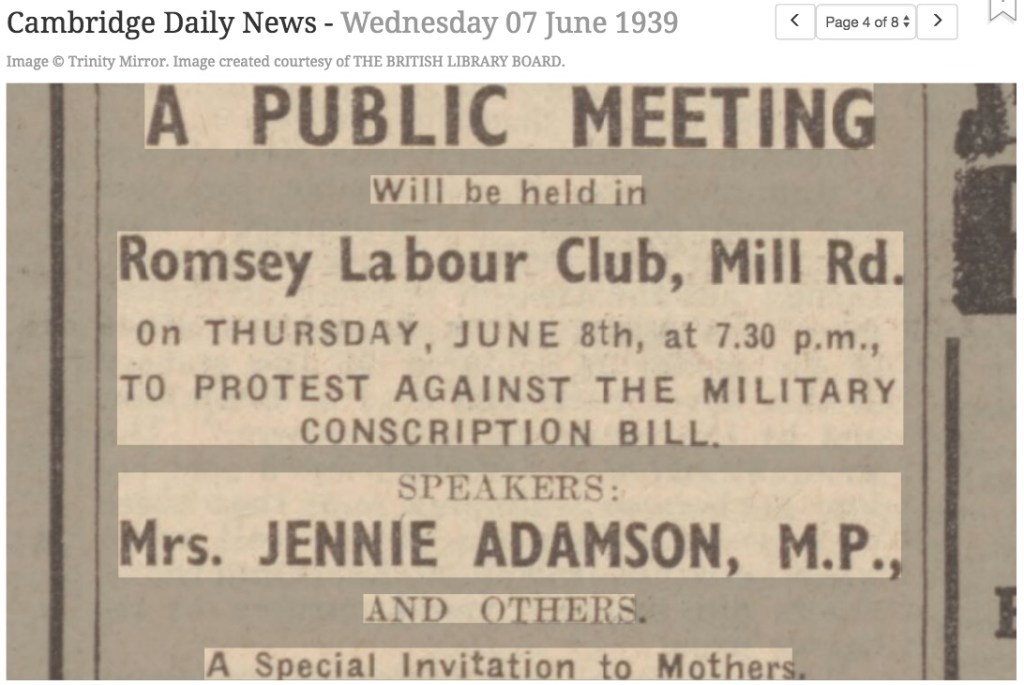
Above – A protest meeting at the old Romsey Labour Club advertised. 07 June 1939. From the British Newspaper Archive
Many people still had faith in the collective action of the League of Nations even though the Conservative-led National Government had long-abandoned the institution and the concept, in favour of Empire.
I recall my former history lecturer at Anglia Ruskin University, the late David Weigall (who was also a longtime Conservative Party activist in Cambridge during the 1970s & 1980s) telling us at the start of our Historical Studies postgraduate course in 2002 that the British Empire had over 800,000 soldiers in the field on continental Europe in 1945. “A not inconsiderable number” when considering the growing tensions between Stalin and The West.
The Suez Crisis
The National Army Museum has pages introducing the policy of National Service here
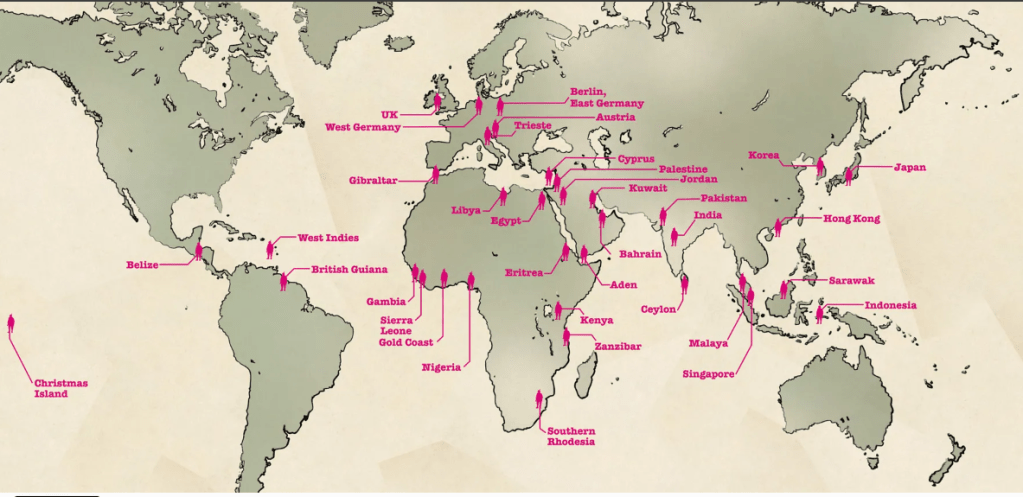
Above – Global areas of operation for National Servicemen, 1947-63. National Army Museum
The above webpage goes onto state that it was the debacle of the Suez Crisis of 1956 that forced the Conservative Government of Harold MacMillan (who had replaced Anthony Eden as Prime Minister after the latter had resigned due to ill health caused by the stress of the crisis) to reassess the need for national service.
“The large number of men absorbed into National Service had become a burden to the Army, tying up regular soldiers in training new recruits. National Service also drained workers from the economy, which resulted in opposition from the public, the government, industry and many high-ranking officers.”
So it’s reasonable to ask whether the criticisms of the old policy will apply to any new policy.
Whitehall was already talking about bringing in a form of national and civic service in the late 2000s in Gordon Brown’s Government
See the article here from 2009
This was followed through by Michael Gove in one of his few reasonably successful policies when he launched the National Citizens Service (NCS)
Above – National Citizens Service 2013
The National Citizens Service programme is still going. The problem is that without Gove’s backing at the Department for Education to drive it through, it ended up being an under-funded shadow of what it could have become.
In Cambridgeshire, National Citizens Service has been taken over by Cambridgeshire County Council – which I think is the right thing because it brings a much-needed local democratic oversight and can also (in principle) make it easier to link up with other local institutions. The problem inevitably is lack of funding because ministers won’t let the council tax the wealth being made in Cambridge’s wider economy to spend on our teenagers’ futures.
Where Rishi’s announcement came from
See Robert Peston below.
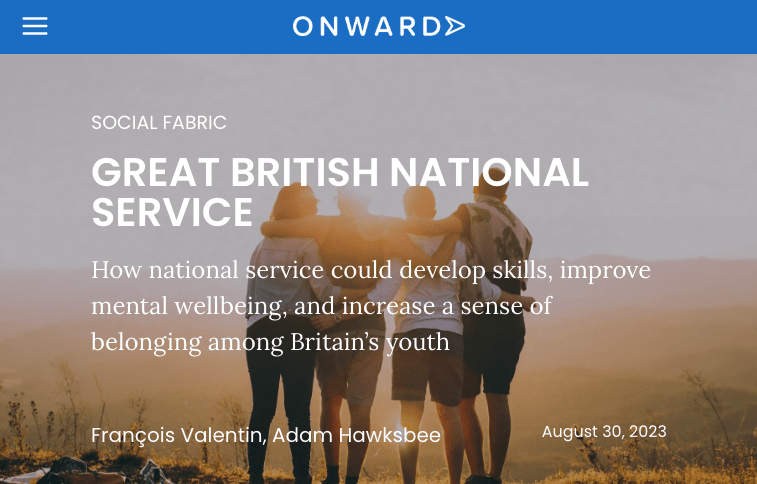
Above – by UK Onward the think tank. You can read the report here
“Today, many other developed countries use civic national service initiatives to help grow and develop young people. France introduced its voluntary scheme, the Service Nationale Universel (SNU), in 2018 and the vast majority of participants say the experience gave them a greater sense of civic engagement and taught them new personal skills. Switzerland, the USA, and Germany also have national civic service schemes.”
“Does the public support it?”
Depends on the order you ask the questions – as described by Sir Humphrey here and road tested by Ipsos Mori.
…and some of you may recall the Status Quo number that was re-recorded in 2010 for the British Army’s charities.
What could have been a positive policy announcement also clashed with Sir Keir Starmer’s comments that he supports Votes at 16. It remains to be seen if this becomes a manifesto commitment. At which Conservative MP Andrea Jenkyns responded with her own take.
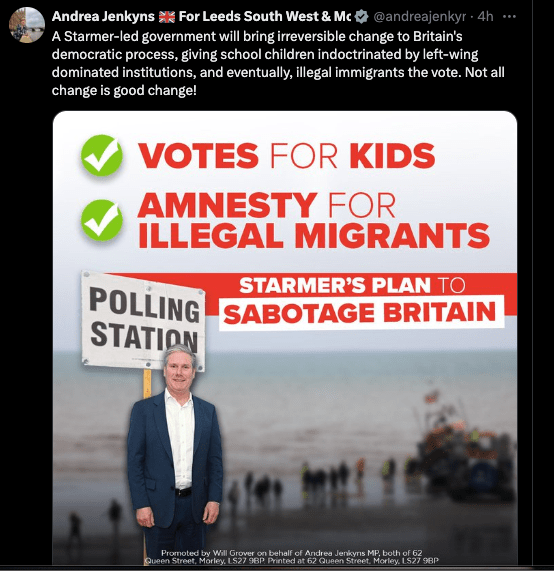
The placing of the above – and similar responses opposing Votes at 16 does not sit comfortably by saying 16-17 year olds are not mature enough to vote while at the same time bringing in a policy that says that they are mature en mass to handle firearms.
My take for some time re Votes at 16 is that if they can be taxed on their earned income from employment, then they should have the right to vote in order to have a say on how that revenue should be spent. ‘No taxation without representation’. This was a principle that Scotland extended to residents irrespective of nationality when they brought in residence-based voting. I.e. if you are over 16 and you are lawfully living in Scotland, you have the right to vote. (A policy some in Labour want extended to the rest of the UK)
This is an issue I raised at Together Culture recently when we tried to do some local elections outreach and found many passers-by telling us they did not have the right to vote. What does it mean for an international city like Cambridge to want to have talent from all over the world living and working here, but not having equal rights to participate in local democracy?
A Royal Commission – to kick it into the long grass?
It will be interesting to see if Labour choose to come up with their own version of national civic service – not least because they will be inheriting the NCS programme from the Conservatives anyway. As we have seen however, the imploding communications operation from Rishi Sunak’s team – along with the inertia of the London-based press, has immediately reached for the historical military conscription lines without asking some of the basic public policy questions such as:
- Where is the money coming from?
- What happens in the case of non-compliance?
- Create a new criminal offence of ignoring a call-up for national service
- Punishment – fines / jail / community service?
- Increased costs for police/enforcement, courts, prisons, and probation?
- What does the military think?
- Will participants be paid? (And if not, who covers their living costs?)
- How could the policy possibly go wrong and lead to (as I recall some fellow students at uni from countries that still had it) large groups of young men not doing anything productive, ‘and smoking dope all day in barracks’? (When doing things at such huge scale, public policy makers *must* model for mediocrity – there simply won’t be enough highly competent and high calibre people to go round)
On the money side, turns out it risks crashing Michael Gove’s Levelling Up policies. But then Gove is standing down from Parliament anyway – taking his policy with it. Including his plans for Cambridge – which are now in ‘suspended animation’ by the looks of things.
Perhaps the one advantage for some of the ‘One Nation’ Tories looking to regain control of their party in the distant future is that any of the more extreme policies that Rishi Sunak’s team includes in the manifesto can be included on a ‘policy cull’ list. “We tried that in the 2024 manifesto and the voters comprehensively rejected it”. Similar to what Sir Keir Starmer has done with Labour’s 2019 policies – for better or worse.
In the meantime, keep an eye out on the future of the existing NCS programme. I really hope something good comes from it for our country’s teenagers in the future.
If you are interested in the longer term future of Cambridge, and on what happens at the local democracy meetings where decisions are made, feel free to:
- Follow me on Twitter
- Like my Facebook page
- Consider a small donation to help fund my continued research and reporting on local democracy in and around Cambridge.

 The Cambridge Town Owl