
Phil Rodgers confirmed the news earlier.
“Strewth! They didn’t pick a local guy either!”
Which sort of surprised me – I thought they’d have backed Zachary Marsh given his reasonably competent showing in the local media in the recent local elections. This now means that all parties that have councillors on Cambridge City Council are represented in the four constituencies in and around Cambridge. See Phil’s table below.
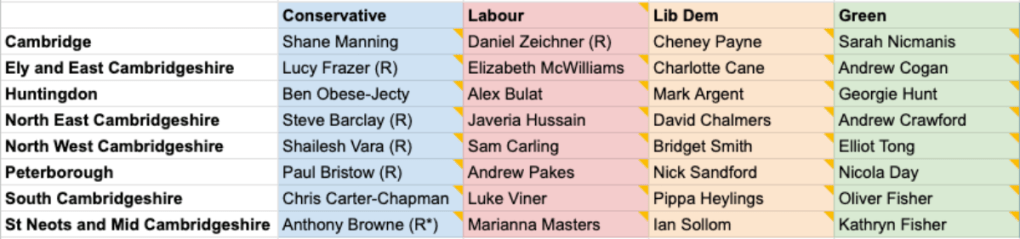
…which is about all one can ask for really – especially given that most of them will be expected to undertake at least one hustings/public appearance in the next six weeks.
“So, who’s Shane?”
Dunno. He blocked me before I even knew he had been selected.
That said, I don’t claim any special right to see anyone’s social media feed. As I mentioned during training courses throughout the 2010s: Your Account, Your Rules. Don’t waste time with people you don’t want to engage with. Life is too short. (I should know!)
“Where will the public debates on the record of the Conservatives in Government start?”
That’ll be part of the challenge: Where to start? Only this thread has a ***huge list*** of woe from which to pick from.
And that’s where for any candidate standing for election taking part in a public debate I recommend having a ‘Tony Blair-style folder’ with a single page typed up document for each topic – and have each one ‘flagged’. I had to prepare some of these for ministerial visits during my civil service days. Think file dividers for each section then a little tab attached to each page with topic listed. One section might be on transport, and you may have separate tabs/flags for:
- cars
- freight
- potholes
- trains
- trams
- buses
- walking and cycling
- e-scooters
For each page you have:
- Your top three ‘killer stats’ (in this case where the Government has failed)
- Your top 1-3 policy alternatives
- Responses to difficult questions that you might get
- An ‘if pushed, concede here
- A ‘Red line’ – do not concede under any circumstances’
And that’s it. In the case of Cambridge and Cambridgeshire over the past decade, you’d need to frame all of the above on transport into the context of the Greater Cambridge City Deal / GCP, and the Combined Authority. This may also include having an annex to the section that is a timeline of who made what decisions when, and what was the party political control of the GCP at the time. As this covers all three of the main Westminster political parties, all three will have to be on the defensive *at some stage*.
Voting records in the House of Commons
As all three MPs are re-standing for election in and around Cambridge, the public can view their voting records. Furthermore, opposition candidates and activists can also view those voting records too – for example the MP for South Cambridgeshire. The most important votes to look for are:
- Second Reading of a piece of legislation (a Government Bill)
- Report Stage of a piece of legislation
- Third Reading of a piece of legislation
- Approval/disagreeing of Lords’ Amendments
- Approving of key sets of regulations.
Backbench debates and opposition day debates tend not to be substantive debates (even though they really should be), but the main ones to look out for are the ones I’ve listed as these are votes on substantive issues which involve changing the law. For example:
- Air quality targets (2021)
- Raw sewage discharges (2021)
…to name but a few.
And in the case of all of our three now former MPs who are re-standing, they all hold frontbench portfolios, which means they are and have all been bound by the convention of collective responsibility. i.e. they lose their ministerial/shadow ministerial posts in the event of not following the directions of whips/party enforcers. (Helen Jones describes what Whips do in Parliament in her book here)
“Someone’s got to organise the hustings and debates!”
I’m trying to co-ordinate some of them and give support/advice to others. In the meantime, Phil Rodgers is keeping the list of confirmed ones here. As I’ve mentioned in my previous blogpost, I’m working with several community and campaign groups that cover Cambridge & District to see if we can cover theme-wide issues that go beyond one constituency. e.g. The growth of Cambridge. That way we can invite the parties to nominate the candidate out of the four standing in/around Cambridge that they think is best suited to take questions on that issue. Furthermore, we announce beforehand to the audience that the candidates or party representatives will not be speaking ‘to make the case for themselves as individuals’ (even though this is what the ballot paper asks voters to indicate a preference on), but rather as representatives of their political party who have the authority to speak on behalf of their party.
So for example on a public transport-related debate, I would want the party representatives to come equipped with up-to-date policies and positions on things like:
- East West Rail
- Congestion charging
- New light rail proposals such as Connect Cambridge
- The ongoing busway proposals from the Greater Cambridge Partnership
- Proposals on new segregated cycleways, footpaths, bridleways, and active travel routes
…and so on.
“What if they have not agreed a formal policy?”
Then I’d expect them to say: “Our party is still agreeing what our policy should be” – or words to that effect. ***And it’s OK to say “I don’t know” if you really do not know.***
Above – one example of a senior shadow minister saying “I don’t know – that’s a good question”
Not least because that enables the debate to move on quickly, and also allows voters & reporters to follow-up the point at a later date.
I don’t like public debates or hustings being used to catch candidates out – which is what Question Time both in the Commons for ministers, and on the telly can feel like
As I’ve said to candidates of all parties and none (and having sat through them myself as an independent candidate last year at the city council elections in Queen Edith’s), I want the candidates to respond and engage with the voters to the best of their ability. I don’t want any of the candidates to leave a hustings/debate thinking that they did not do well or they feel they want to blame ‘the video’ for the outcome of an election contest. Because there will be some policies where as a politician you have to come down for one side or another. There is no fence to sit on. For example the Cambourne-Cambridge Busway.
Note in this case the opponents of the Busway plans gave Labour’s Luke Viner credit for actually visiting the site before stating what his party’s policy was. It remains to be seen whether they follow through on it in their manifesto. In the case of the Conservatives in South Cambridgeshire and in the new St Neots and Mid Cambs seats, both candidates have come out *against* the proposals for East West Rail, even though those proposals were signed off by The Chancellor Jeremy Hunt, and the latter is actually a minister in the Department for Transport – albeit for a different policy area. Things are slightly trickier now though given that the man who drove through “The Case for Cambridge” – Michael Gove – has stepped down. Which leaves that policy in suspended animation. (Either it is still Government policy – in which case party candidates are duty-bound to defend it, or it is no longer party policy in which case they have to explain what their alternative is). Which reflects the chaos within Team Rishi of late.
That’s not to say the Labour Leadership is making things any easier for its candidates with some of their announcements – the latest being the news on longtime Labour MP Diane Abbott, the first Black Woman to be elected to the House of Commons in 1987.
…noting even more from Victoria Derbyshire and Newsnight here (28 May 2024 at 1940)
A final decision won’t be taken until nominations close on Fri 07 June 2024. But I would not want to be the candidates who have to defend that decision by party bosses.
In the meantime two of the seats the Conservatives will want to hold onto – the St Neots and Mid Cambs seat, and the Culture Secretary’s seat of Ely & East Cambs, don’t currently have Reform/Brexit candidates. It remains to be seen if the right flank remains vacant or if other candidates step up.
Above – potential candidates have until Friday 07 June 2024 to decide whether to stand – and to submit their £500 deposits too.
Thirty-seven days and counting…
If you are interested in the longer term future of Cambridge, and on what happens at the local democracy meetings where decisions are made, feel free to:
- Follow me on Twitter
- Like my Facebook page
- Consider a small donation to help fund my continued research and reporting on local democracy in and around Cambridge.
Below – https://whocanivotefor.co.uk/ <- Click here, type in your postcode, and find out who is standing for election where you live

 The Cambridge Town Owl