Cambridge City Council publishes its report on local democratic engagement – including recommendations on what will replace the old area committees
This will be discussed on Wed 10 July 2024 – see Item 7 App B for the report here.
For me, the consultant’s report (which I was one of the interviewees for) highlighted how broken our city’s and county’s governance structures are – and how fragmented our local public services are. Furthermore, I made the point about the lack of collective knowledge about how our city and county function – a point reinforced by a series of public questions to the general election candidates that they had no chance of providing a satisfactory answer to. That wasn’t the fault of the audience either – this is part of a wider problem that successive Parliamentary select committees have reported on. Questions such as:
- ‘You have been our MP for nine years and the streets have gotten worse – such as the potholes…’ [To Daniel Zeichner]
- ‘Why does the GCP spend money on pet projects and not repairing the roads?’
- ‘What are you going to do about saving the shops threatened by the Beehive redevelopment?’
It’s not the fault of residents that no one taught them at school or offered them as adults the learning opportunities to inform them about how their vote works [i.e. what the ballot paper invites the voter to do], how to hold holders of public office accountable, or how our city functions/malfunctions.
“What were the shortcomings of the old area committees?”
Ultimately the councillors on them could not hold accountable the decision-makers whose day-to-day decisions affected the lives of local residents.
- Police officers unable to deal effectively with anti-social behaviour
- Highways authorities unwilling/unable to deal with rat-running
- Councillors having planning refusals overturned by national planning inspectors despite huge and sustained opposition (see The Flying Pig Pub)
- No one able to hold the providers of places for doctors’ surgeries or NHS dentists to account while residents watch as more and more homes are built

Above – Unless other public service providers are brought into the orbit of local councillors, any local democratic forum that will replace the area committees will fail.
What the incoming government chooses to do with local government policy will be crucial to the success or failure of what Cambridge City Council proposes.
In my mind I’m already lining up a list of letters to draft to Daniel Zeichner to top-and-tail and forward onto his soon-to-be ministerial colleagues. That includes inviting the new Minister for Local Government to provide a substantive policy response to the PACAC’s report on the mess that is local government in England. Only Labour’s manifesto is far too vague to have any idea of what they might have planned for our neck of the woods.
This is one of the reasons why the city council is not going to restart the area committees or bring in a formal replacement until the new civic year in Spring 2025. Instead they will be piloting a range of approaches across different parts of our city – understandable when you consider the huge inequalities there are. What might work in Abbey Ward (one of the most economically-deprived in Cambridgeshire) won’t work in a ward full of affluent university-linked residents combined with halls of residences that have a huge annual population turnover.
If Cambridge City Council is to experiment, I think they should try to get the participation of service providers that have separate reporting silos to Whitehall – in particular the Department of Health and Department for Education.
That said, much depends on what the incoming government does to the machinery of government. I’d be surprised if say a Labour Government stuck with a ‘Department for Levelling Up…etc’ given it was Michael Gove’s pet project.
Getting snapshots of the city from different viewpoints
What is the current situation for each of the service providers? And then for service users. For example what public administration might call education and health, the public will know as schools, hospitals, GPs and dentists. Yet such are the interdependencies that services and institutions have on each other that when one breaks down, they all take a hit.
“At the end of each focus group we ask the people to describe the country in a word, and the most common word is ‘Broken'”
Luke Tryl of More in Common – BBC Newsnight 02 July 2024 – scroll to 14m35s
The people who are the most dependent on state provision of services are also the ones who are most likely to see where the failures are at a front-line level across the piece – and also the ones who have some of the best ideas on how to overcome them. And the cost of paying them for their time to help co-design those solutions is likely to be far, far less than the day rate for a senior London-based corporate management consultant who may only be a few years out of university. (I’ve worked with some of them in times gone by!)
Citizenship and civic education for adults has to be part of the solution
One of my requests for Cambridge City Council to put to both the Combined Authority (as funder for adult education) and Cambridge Regional College (as delivery organisation) is to develop a GCSE Citizenship course for adults. For participants that don’t have any level 3 qualifications, I think the coursework could align with what the information gathering needs are for the organisations. Then pay the adult students first of all on commencement, then on completion of the coursework, and then finally on completion of the exams. Demonstrate to the participants that their work is valued. For what it’s worth, I also think the GCSE in Citizenship should also be made available for CRC’s further education students 16-19 too. Because in 2022 only 145 teenagers in the whole of Cambridgeshire actually took it. Yet the politicians and academics who I have shown some of the past textbooks of the GCSE have told me, the content is ever so relevant to a host of other topics in both academia and the workplace.
“What does success look like?”
The corporate statement/objective is that:
“…councillors play an active, visible and effective role in supporting Cambridge’s diverse communities to engage with the issues, changes and choices which affect their lives and the city’s future.“
Which feels too vague for my liking. I want some specifics – and these need to involve defining what improvements we want to see.
For example: Cambridge has changed significantly in the past few decades and continues to change and grow. These changes have been caused by…[and list them, including Central Government policies, University of Cambridge policies, the flow of international capital – especially in property and specific industrial sectors etc].
As well as opportunities and benefits which the corporate brochures repeatedly promote, the changes have also brought about significant challenges and have created huge problems. These can be summarised in a single sentence:
“The rapid growth of Cambridge has been poorly managed, and has resulted in the city and economic sub-region having reached some of the limits to growth – whether through house prices, supply of electricity, or the ability of our local environment to sustain the demand for water and sewerage facilities. “
You could easily add the following:
“The problems linked to the rapid growth of Cambridge have been compounded by the inadequate governance structures and lines of democratic accountability to the people who make up our city – whether residents, commuters, or regular visitors. All too often it feels like the future of our city is being decided not by the people who make up our city, but by people and institutions outside of it who have vested financial interests in the decisions they take – all too often at the expense of the people and environment. This is unsustainable”
Now look at the recommendations below in the New Local report
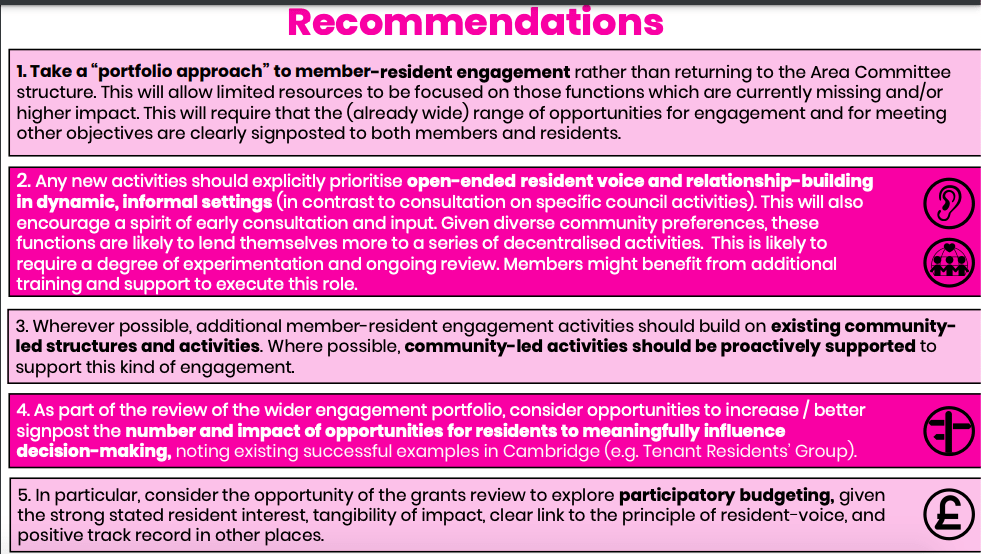
…which makes me feel like there is a massive gap between what the consultants are proposing vs the scale of the challenges Cambridge faces.
And that is linked to the limited terms of reference provided by Cambridge City Council – who only have the authority and the budget to cover what is legally within their institution’s remit. The city council has neither the resources, the influence, nor the expertise to start getting stuck into what schools in the academies system do, what local NHS bodies do, and so on. Which in part reflects this explainer from New Local below:
Above – on Community Power.
This brings us back to the discussion that New Local hosted with the former Secretary of State for Communities & Local Government, John Denham, on his short-lived policy of Total Place.
This for me is what councillors will need to find out very early on from the new government on whether future policy development is going to involve bringing in a new form of Total Place. Because if it does, then whatever Cambridge City Council comes up with would do well to align with that policy development from the centre. And a reminder – the new MPs return from 09 July 2024, and the state opening of the new Parliament is scheduled for 17 July. That’s in two weeks time.
Food for thought?
If you are interested in the longer term future of Cambridge, and on what happens at the local democracy meetings where decisions are made, feel free to:
- Follow me on Twitter
- Like my Facebook page
- Consider a small donation to help fund my continued research and reporting on local democracy in and around Cambridge.
Below – from Cambridge City Council’s housing strategy – what can councils influence?

 The Cambridge Town Owl