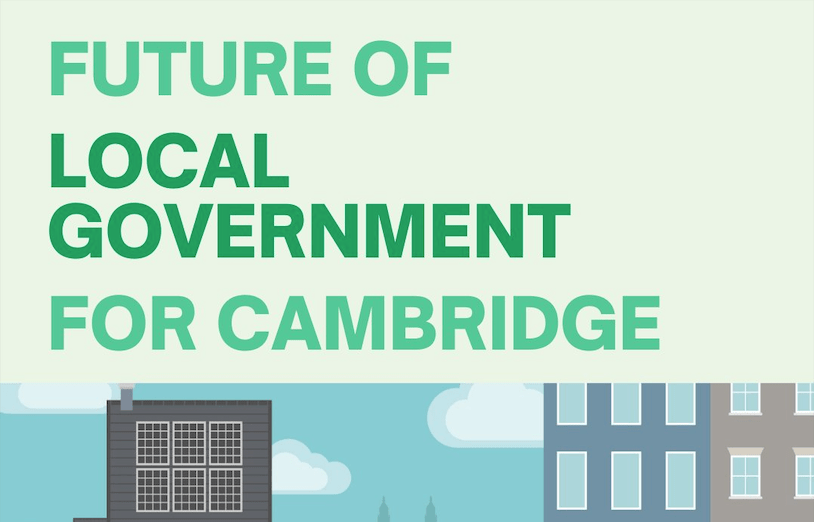
Cambridge City Council launches early survey to find out what you think
You can take the survey here – over 100 people have already made their views known.
The work stems from a council motion debated and passed on 19th October 2023 at a meeting of the full council of Cambridge City Council.
“Accordingly, Council asks the Leader and Chief Executive to initiate discussions with other Authorities in the region and then central Government to identify options for a less fragmented and more cohesive model of Government for Cambridge, that best serves the needs of its residents.
“These discussions should involve and engage with the people of the city in a meaningful way, thereby recognising the need for our governance structures to reflect the wishes of the people we serve.“
Cambridge City Council Full Council minutes of agenda item 6a, 19 Oct 2023
Note this does not automatically mean a unitary council. Furthermore, there are two public events booked for the consultation. Furthermore, there has been no agreement on joint consultations or discussions with neighbouring district councils or Cambridgeshire County Council. Hence what may feel like a very superficial request for views.
- Tuesday 23 July 2024, 5.30pm to 7pm at The Guildhall, Cambridge
- Saturday 31 August 2024, 10.30am to 12pm at The Guildhall, Cambridge
The Cambs Unitaries Campaign has been exploring some of the issues
You can find out more about the campaign at https://www.cambsunitaries.org.uk/ – it’s worth noting that they don’t have a ‘set in stone’ view of what the solution should be.
“Our objective is to secure better local government arrangements for Cambridgeshire and Peterborough through a grassroots campaign to replace all the current main tiers of local government (the district Councils, the County Council, the Cambridgeshire and Peterborough Combined Authority and the Greater Cambridge Partnership) with at least two new Unitary Authorities to provide local services for the communities in the north and south of the County more effectively and democratically.”
Above – Cambs Unitaries Campaign’s objective
Inevitably there has been a very long history of past, failed attempts to overhaul how Cambridge is governed
The last major attempt at a unitary council was the proposal as part of the Redcliffe-Maud report of 1966-69. You can read the summary of the report here which explains the proposals for larger unitary councils and the creations of new provinces – what later became regions of England created by Michael Heseltine as the Government Office Network (where I began my civil service career).

Above – detail of Redcliffe-Maud’s proposals (1969).
In the early 1990s, Michael Heseltine who was Deputy Prime Minister and Secretary of State for the Environment (incorporating local government and housing) launched a new policy to overhaul the structures of local government. The options proposed at the time were radical, but internal opposition resulted in the proposals being watered down significantly.
In Cambridgeshire in particular, the councils got together to debate and come up with a joint response to central government – which I wrote about for Lost Cambridge here

You can get hold of the above document in the Cambridgeshire Collection.
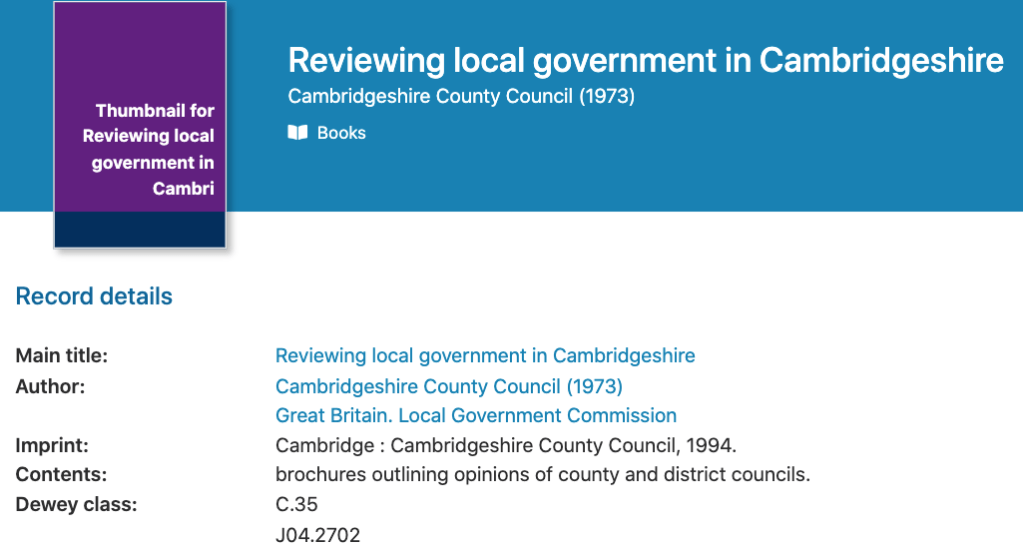
Above – the link in the Cambridgeshire Collection
I hope that Cambridge City Council officers will ensure that this document and the couple of others published at the time by local government are photocopied/scanned and are made available to the public in accessible formats to inform them of what previous generations debated.
Other considerations
I have written about these – some of the most recent being
- Educating the public on the essentials of central and local government – from their perspective.
- Questioning how local and central government can work with each other rather than having a top-down solution imposed
- Ensuring young people in town and gown can influence the debates – and hold powerful institutions (such as the colleges) accountable for their own decisions that affect the future of our city.
Getting the basics right
The problem is that after 14 years of local government austerity, people will have lost faith in councils’ abilities to do anything. These examples reflect some of the challenges of underfunded, fragmented, and under-empowered local government.
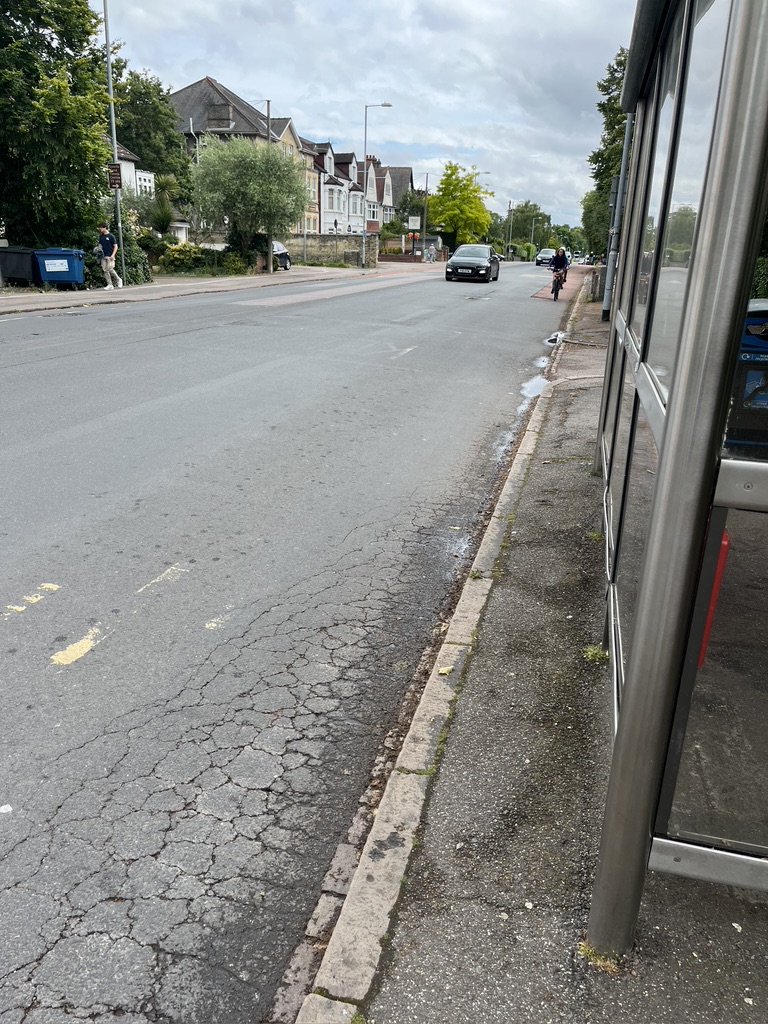
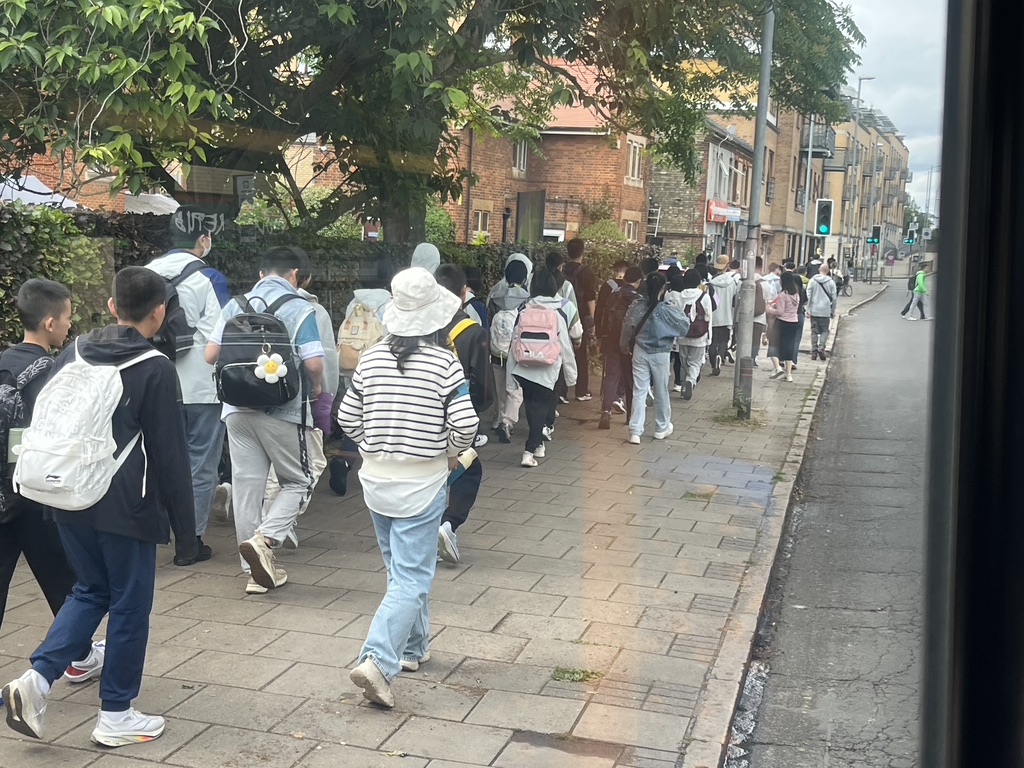
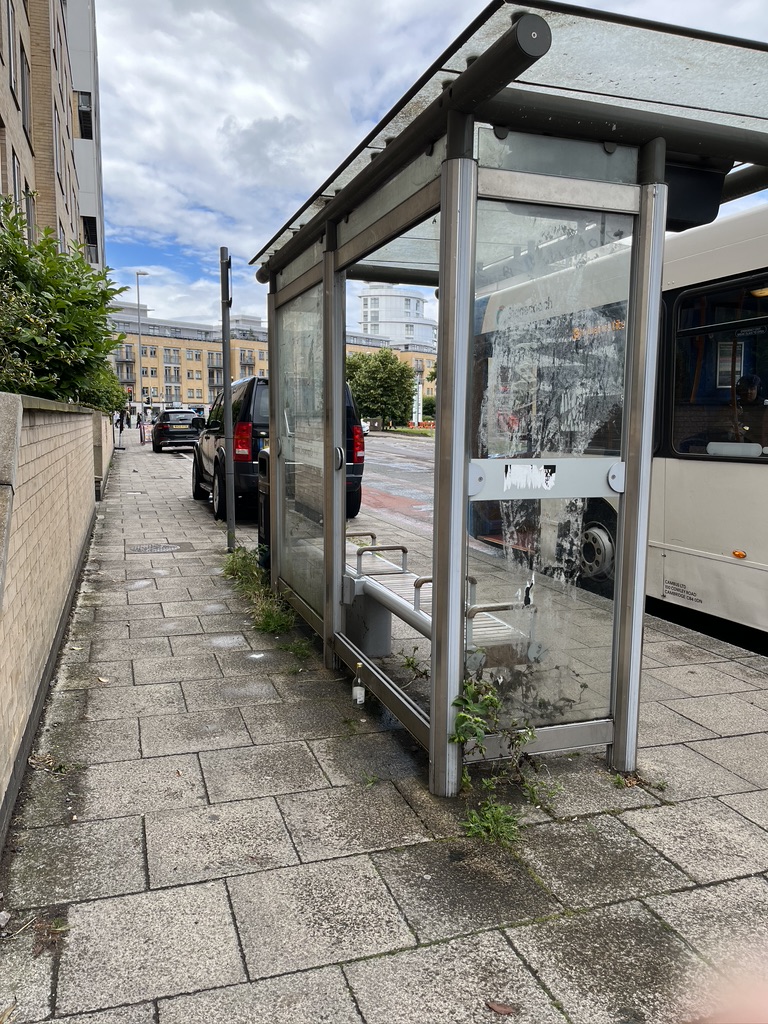
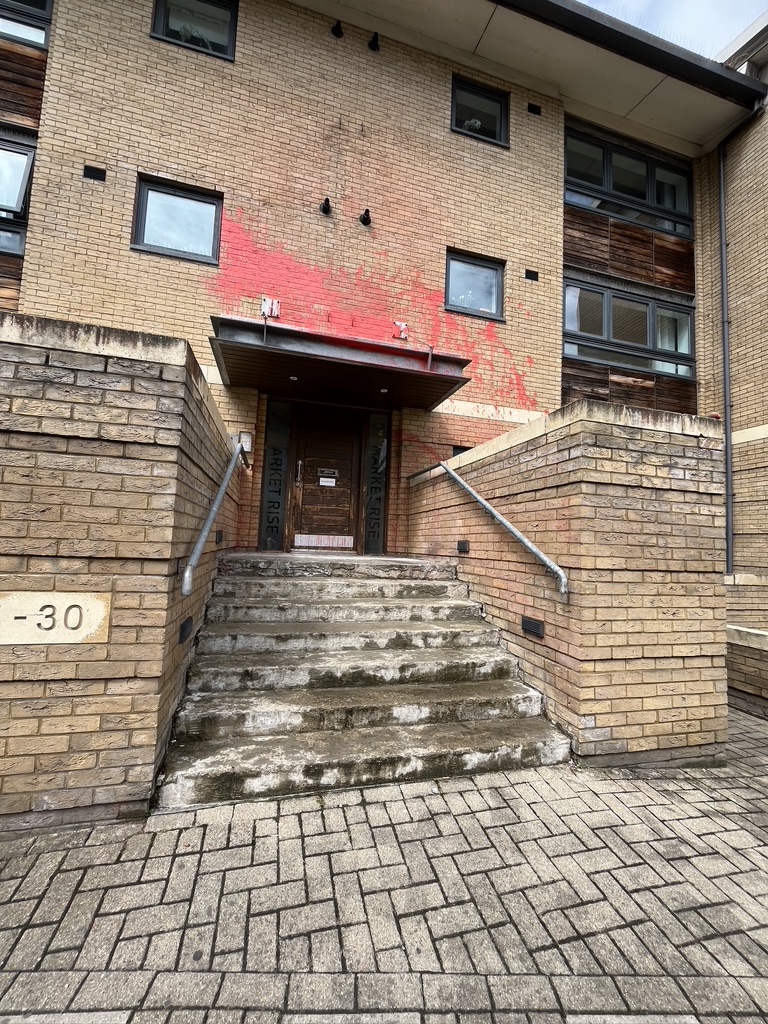
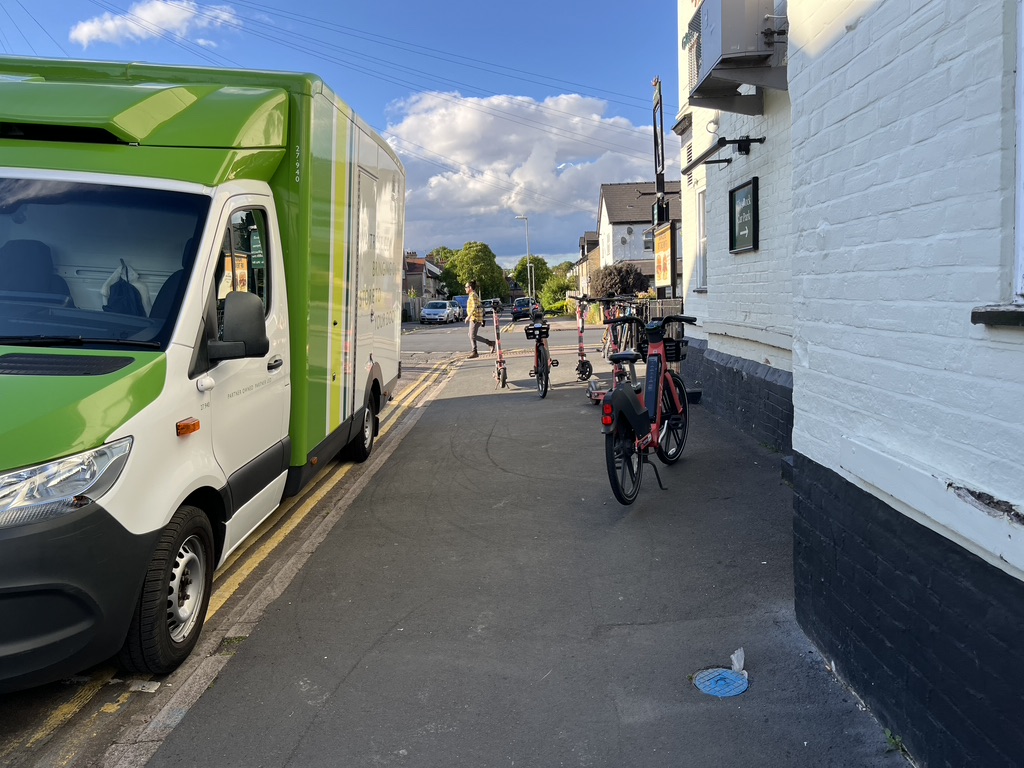
Above – clockwise from top-left:
- Bus stop paint demarcation worn away – indicating under-funded road maintenance on Hills Road outside one of the busiest further education colleges in the county
- Excessively large tour groups organised by profit-making institutions from which local councils have few powers and little capacity to restrict numbers or tax the economic activities to alleviate the negative impacts of mass tourism (see also Barcelona in the news)
- Smashed bus stop panels by poorly-maintained bus stops that have vegetation growing out of them – and with illegally-parked very large motor cars on the pavement over the cycle lane next to one of the ugliest and most expensive residences in Cambridge
- Freeholder of the corporate cash cow that is Cambridge Leisure Park not cleaning up the building it owns that someone threw paint over
- Supermarket delivery van parked on double yellow lines while the VOI Tech e-scooters and bikes block the pavement.
If in the eyes of local residents local government is seen to be failing on the basics, why would they think what looks like an administrative overhaul would make any difference?
Recall that in the eyes of the longer-term residents – the ones needed to anchor and stabilise communities, they have seen the massive expansion of the city over the past few decades alongside the decline in provision of GPs, NHS dentists and other public services that are essential for the sound functioning of city life.
Hence part of the challenge isn’t just about the administrative boundaries, but also about making the visible changes – and central government providing both the funding and the revenue-raising powers to enable these.
Barcelona protests against mass tourism
Some of you may have seen the news here. I don’t particularly like the response – because like many of us I have been a tourist in the past and would not like that to happen to me. At the same time I can understand why it happened because it reflects a chronic political failure to deal with the impact of the economic phenomenon of mass tourism on this scale – along with the impact of ‘extreme footloose working’ where people can rent out an otherwise residential property because they can work remotely, but at the same time not contribute towards local taxation because public administration structures globally have not adapted to it.
It’s not all bad news with tourists though. There are cities trying to come up with alternative, positive solutions – not that you will find many of them in the UK because local government has so few powers and even fewer resources.
“Tourists will be rewarded with free food and activities if they participate in environmentally friendly tasks while visiting Copenhagen, the city’s tourist board has announced.”
One of the bigger issues we have in Cambridge is with short-term stays that are longer than tourist stays but shorter than an academic term.
How do we ensure that the city is getting enough revenue from those that use apart-hotels? How do we ensure that there is a level playing field for smaller hoteliers? How do we ensure that properties that were built as family/residential homes but converted either into slum student accommodation or long term Air BnB units unlawfully are converted back to what they were originally designed for – whilst ensuring that education establishments pay for their own new specially-designed student accommodation units, while driving out the full-time use of homes for very short-term lets that they were never designed for?
The point being that Cambridge has a chronic housing crisis, and getting more of the homes currently being used as cash cows for property owners at the current level it is at, inevitably destabilises communities and leads to the sorts of backlashes we see in other towns and cities. Building new council houses and social housing is part of the solution, But so to is ensuring those business sectors that gain from ‘brand Cambridge’ not only pay their ‘fair share’ but also pay up for the negative impacts of their business activities. That was we are more likely to get to a stable equilibrium of the different, competing business interests and residential needs of our city.
Food for thought?
If you are interested in the longer term future of Cambridge, and on what happens at the local democracy meetings where decisions are made, feel free to:
- Follow me on Twitter
- Like my Facebook page
- Consider a small donation to help fund my continued research and reporting on local democracy in and around Cambridge.
Below: Talking of local democratic engagement, have a look at this recently-published report
 The Cambridge Town Owl