Without co-ordination and sequencing of consultations, individual projects will be constrained by circumstances and issues that are both critical to their success yet are outside of their scope
Cambridge Civic Quarter
In Case You Missed It (ICYMI) see the consultation boards and pages via here.
I went to the last of the public events earlier today (13 July 2024) and the problems raised by the dozen or so participants fell outside the scope of the project.

Above – the first of the display boards that need printing out and displaying in public spaces.
“How do you pedestrianise the Civic Quarter if so many freight vehicles need to use the area?”
Below – see the Peas Hill ‘social space’ in front of the Arts Theatre exit. Where will the theatre stage lorries get access to/from the theatre? Ditto the Corn Exchange and the large hall of the guildhall?
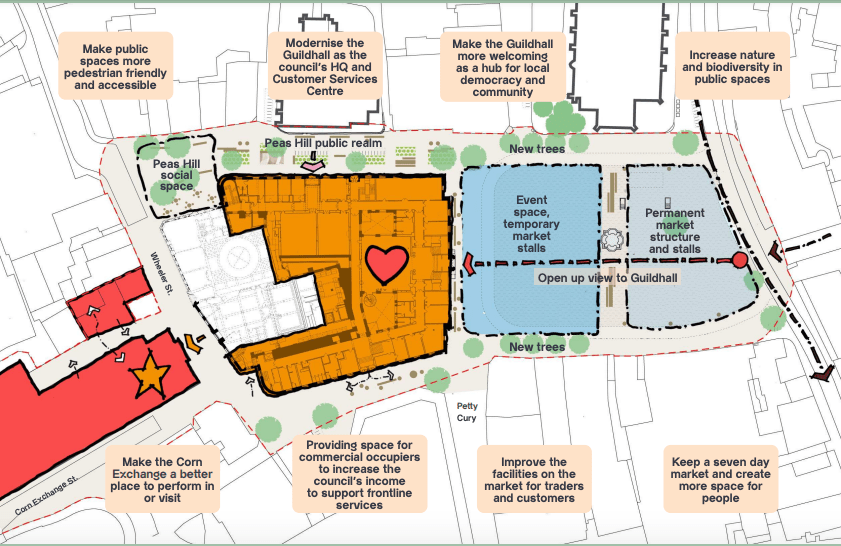
Above – from the consultation slides – p3
“Is it possible to pedestrianise Wheeler Street by putting bollards up at the end of it?”
That was one of the questions put to the group – which raised the issue of enforcement. One of the participants who was partially sighted complained bitterly (and understandably) about too much anti-social cycling – and e-scootering. We wanted accessibility and safety for pedestrians but at the same time seem unable to enforce existing laws whether on anti-social motoring or anti-social cycling. But both are outside of the scope of the civic quarter.
It has been the policy of successive governments to attract tourists and language school students from affluent families to the UK for the revenues and foreign exchange they bring in. Yet the companies that facilitate this and profit from it don’t do nearly enough when it comes to reducing tensions between young people that inevitably want to have a good time – and we were all young once, and the local residents for whom Cambridge is home.
The problems boil down to how limited resources are shared in societies with unlimited and competing wants.
The Conservatives’ ‘small state’ ideology crudely exposed for its inability to enforce its own laws.
The noise of motorcars with unlawfully-loud engines is one that is depressingly familiar to too many of us these days. So much so that back in 2019 even the RAC was writing about how some residents were calling for ‘noise cameras’ to deal with the problem. Having the noise cameras is one thing, but having penalties in place that both deal with the problem and reduce the incentives for them to recur is quite another. In the case of the civic quarter, anecdotally you can see during the summer months cars that don’t have permission to be in the city centre being parked there. Further challenges are caused with college students moving in and out at the end of each term. But unlike previous eras of town history, you won’t see a local police constable standing on the corner telling unlawfully-parked motorists to move on. (Mindful that this function has now transferred to the county council. Based in Alconbury again due to party political considerations from the county Conservatives).
The only chance a civic quarter has of succeeding (in my view) is with a light rail underground
And that depends on where any underground station in Cambridge is located. Which brings us back to Cambridge Connect Light Rail.

Above – concept diagram from Cambridge Connect.
Furthermore, this also links to the issue of tourist coaches and freight vehicles. One of the suggestions was to have out-of-town freight exchanges to transfer as much light and parcel freight onto e-couriers in Cambridge – especially for internet shopping orders. The additional costs of that would help level the playing field commercially making it more economical for independent shops with a high street presence to establish themselves and fill the voids in our commercial areas.
One of the additional benefits of being compelled to use local e-couriers is that the latter in principle will have both a greater knowledge of, and a greater incentive not to block roads unlawfully – while providing for alternative local employment at the same time in a city that would then have cleaner air. But there is one very big problem with this.
No council has the legal powers (as far as I know) to bring in such a scheme. Furthermore, as I’ve written repeatedly, local government has neither the powers nor the funding to do the things it needs to do (let alone the things I’d like it to do) in order to improve our city. the recent farce of the ‘referendum of hoteliers’ regarding a tourist tax on overnight stays in Cambridge reflects this. And why should they if they already have to compete with Air BnB while at the same time see no levy on day-trippers?
My proposal for day-trippers/coaches is to ban their vehicles from the city and force them to use out-of-town car parks with light rail stops at them where they can buy all-day travel tickets. That in itself would function as a tourist tax to help maintain a rail-based public transport system. This links to another point from one of the participants about getting tourists out ‘beyond Cambridge’ – which is where a system of looped light rail lines (which I describe in the second half of this blogpost) would help facilitate transport to nearby market towns. Because not everything needs to be in the historical centre of Cambridge.

Above – the Cambridge-Haverhill section of Cambridge Connect could extend in a loop from Haverhill to Saffron Walden, the Wellcome Campus, and the Imperial War Museum at Duxford
Hotel-mania in Cambridge
You’ll have seen the latest proposal from Cambridgeshire County Council to turn the Old Shire Hall into a hotel. Similar is proposed for part of the old Guildhall.
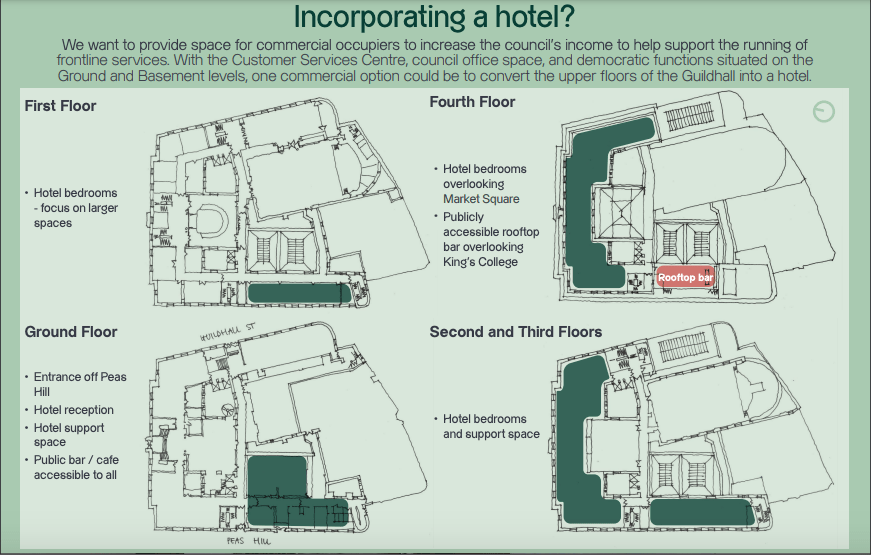
This is on top of the proposals for Lion Yard’s hotel (the corporate signs are cheap, crass, and prominent from a well-known brand) and the nearly completed old police station next to Mandela House – the last of which is being ‘disposed of’. That makes me wonder what it will mean for the day-to-day functions of local government in Cambridge. Is it wise to sell off or long-lease-off so many of the historic buildings *before* finding out what the vision for local government is from the new ministers?
The problem is that local government does not have the capacity to consider all of these things collectively. The additional hotel space will inevitably generate more taxi-based traffic because the target market is not the one that’s going to get out and walk with their suitcases from a bus stop. Yet there is little incentive from the commercial groups to consider the cumulative impact of such business growth because they are not responsible for the negative externalities. Where attempts are made to get them to pay for such externalities in the current system, they vote them down – whether the rejected tourism levy through to the rejected workplace parking levy reportedly vetoed by Cambridge University-linked interests – resulting in the congestion charging debacle.
In the meantime a host of other consultations are happening that are bypassing so many of us in the city that it’s proving impossible to hold decision-makers to account not only for the individual decisions but also for the cumulative impact of those decisions.
This is unsustainable.
With the Combined Authority and County Council elections coming up, I hope that the political parties will come up with some alternative, improved structures and ways of doing things. Furthermore, I hope there is a critical mass of independent candidates ready to challenge them all on them – ideally with their own positive alternatives for the electorate to discuss with their local candidates.
Food for thought?
If you are interested in the longer term future of Cambridge, and on what happens at the local democracy meetings where decisions are made, feel free to:
- Follow me on Twitter
- Like my Facebook page
- Consider a small donation to help fund my continued research and reporting on local democracy in and around Cambridge.
Below: Want to see local government in Cambridgeshire overhauled just as we did in the early 1990s? See the Cambs Unitaries Campaign which I am supporting.

 The Cambridge Town Owl