
Big questions remain for the organisations supporting the Cambridge Biomedical Campus – and ministers need to clarify what their policies are on the growth of Cambridge
I wrote about the housing report the CBC published back in April 2024 here. I won’t repeat what I wrote in there. The meeting I was at earlier was the first chance to put some of my observations to CBC officers alongside the concerns of other local residents and participants – about a dozen of us, who also heard about the latest from the Cambridge Cancer Hospital development.
Issues:
There are multiple reasons for the limited number of participants which include
- No co-ordinated, sequenced system of public consultation
- No single place or publication where the public can find the essentials for each consultation
- No collective/shared means of getting educated and knowledgeable about how our city functions and malfunctions – let alone learning the essentials of the town planning processes
- No collective/shared means of finding out about how central government functions/malfunctions, and what it has planned for our city & county
- No recognised forum for having grass-roots-based discussions on what is happening, and on who is deciding what
Participants remain highly concerned about the imbalance between the ambition of the CBC and the provision of housing and public transport in and around Cambridge
- The water and ecological crisis still has not been addressed – it remains outstanding for the new government
- The estimated requirement for new homes according to the CBC’s consultants (Lichfield) is the equivalent of a town the size of Haverhill (30,000 people) as I noted here
- There is no plan to enable local residents to switch careers and retrain in the fields where the CBC has chronic staff and skills shortages – there isn’t a plan for a new lifelong learning college that might facilitate this
- Not everyone is familiar with the due process required for the transport projects, let along the histories of each of them – the assumption seems to be that the GCP has got things in hand. (It hasn’t – it is still squabbling over hotly-contested busways)
- There is significant uncertainty about what the state of Michael Gove’s ‘Case for Cambridge’ is and what the policies of the new Government will be.
CBC staff acknowledged that the issues relating to how Cambridge & Cambridgeshire are governed inevitably affect their work because it is not clear to anyone who has legal and policy responsibility for what.
- CBC and its partners along with central and local government don’t appear to have access to the same information, reports, or data sets at the same time – therefore different institutions are publishing reports on inconsistent data.
- CBC is due to publish its new transport strategy for the campus – but it’s not clear whether this has been influenced by or has accounted for the refreshed transport documents only just published by the Combined Authority that they will be discussing in their Transport Committee on 22 July 2024.
- We’re still waiting for the next Greater Cambridge Partnership Meeting – an institution that I think should be abolished.
- It’s not clear what conversations the CBC has had with which institutions regarding possible housing and transport solutions to its housing needs – including but not limited to Cambridge Connect Light Rail, and Rail Future East.
Possible new housing developments along upgraded existing railway lines
I wrote about these in the second half of my April 2024 blogpost here. To cut a long story short, the CBC should sit down with Rail Future East, and representatives of the district councils along the relevant rail lines/transport corridors and work out which would be suitable sites for homes that could in-part house rail-based commuters. Having identified suitable areas, they then need to work with their MPs to lobby ministers to ensure that the infrastructure improvements are paid for by a levy on the massive rise in land values that would accompany making that land around potential new rail/light rail stations available for development. For example land within 500m that is currently undeveloped.
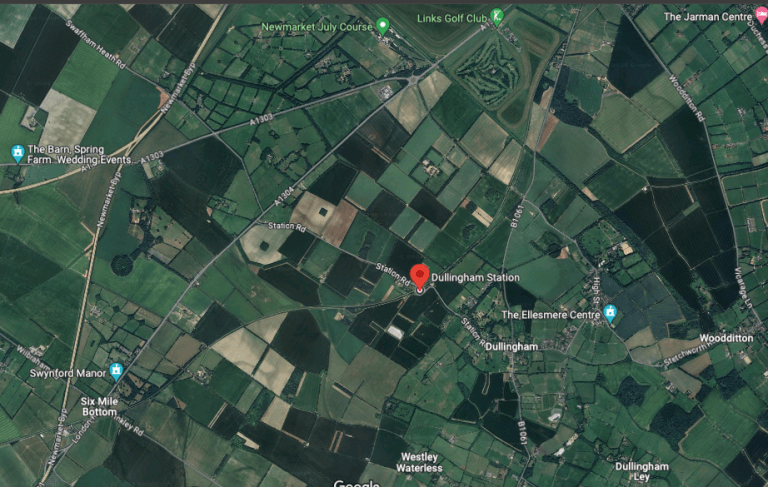
Above – Dullingham station is an ideal location *in principle.*
The rail upgrades required were covered by Rail Future East – which also proposes an additional railway station between the closed Cherry Hinton and Fulbourn railway stations.

Above – from Rail Future East and the proposed Cambridge East railway station somewhere between Cherry Hinton and Fulbourn.
The line between Cambridge and the East Coast need dualling and electrifying. How much of that could be covered by a land value levy? How much could be covered by a levy on the land owners of the science parks & CBC, and/or on the tenants?
While southern Cambridgeshire is saddled with the malfunctioning GCP, the Mayor of West Yorkshire in the meantime is getting on with things – you can see their emerging proposals here -> https://www.yourvoice.westyorks-ca.gov.uk/hub-page/mass-transit
Can we have something like this too?
If you are interested in the longer term future of Cambridge, and on what happens at the local democracy meetings where decisions are made, feel free to:
- Follow me on Twitter
- Like my Facebook page
- Consider a small donation to help fund my continued research and reporting on local democracy in and around Cambridge.
Below – one option to improve governance and accountability is to move to a unitary structure of local government. The Cambs Unitaries Campaign was formed to secure such better local government arrangements. See https://www.cambsunitaries.org.uk/our-objective/

 The Cambridge Town Owl