What will our county or combined authority area be like in a quarter of a century’s time?
TL/DR? Fill out the survey here. Actually, you’ll need to read the second PDF document of the Stakeholder Engagement Workshop 3 materials here in order to make sense of what the survey asks of you.
Civics and citizenship – responding to consultations is a civic and democratic action
In order to make it useful and meaningful, the public needs to be literate, numerate, and informed about whatever the issues are in order to provide responses that can influence what happens next. One of the reasons I go on about civics & citizenship learning is so that more people can give informed answers when more consultations are published – as they will be and at this rate until someone gets a grip of our broken system of public consultation.
The latest one that has caught my attention is sort of a continuation of an existing exercise by the Combined Authority. Have a look at Stakeholder Engagement Workshop 3 materials here
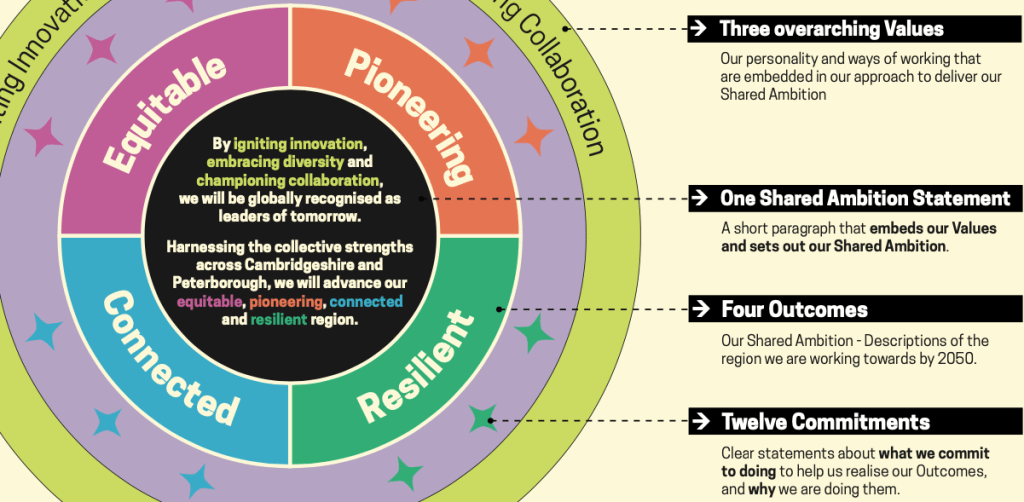
Above – detail from the workshop activities second PDF
To the right of the poster (which is designed to be printed in a large format for group-based workshops) are the outcomes and commitments. I’ve screen-grabbed the top one below.
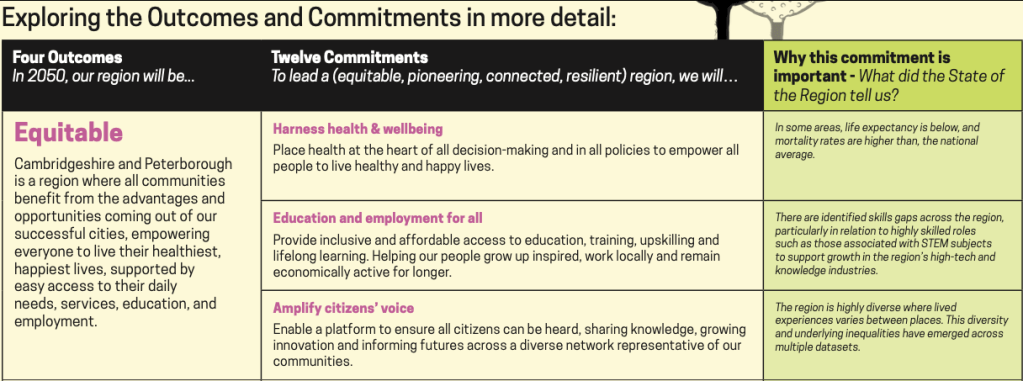
Above – Equitable Cambridgeshire & Peterborough 2050
Which sounds ambitious given where we are – and where we were in 1999. Hence why I went off on one in my consultation response. There seems to have been precious little improvement in *how* the state does consultations in order to inform policy-making: i.e. what institutions of the state decide to do on behalf of, and in the interests of the people. (In principle when you don’t have a broken and corrupt government)
Cambs & PBoro – State of the Region Review 2024
I wrote about this here noting that until 1998 Cambridgeshire was a standalone administrative county council, and was part of the East of England region. So how/why we’ve ended up getting historically inconsistent labelling is beyond me. One of the issues I picked up from the data was the direction of inequality changes – it’s getting even worse on housing affordability.

Above – CPCA O&S 11 July 2024 Item 11. App A. p192
On each of the equitable commitments, the CPCA is failing. Badly.
- Harness health and wellbeing
- Education and employment for all
- Amplify citizens’ voices
In fact you could probably say the whole country is failing – these are not unique to our patch.
On putting health at the heart of policy/decision-making, this assumes that the decision-making organisations have the legal powers, policy competencies, and the resources to make a difference. You only have to look at the fragmentation of, and the enfeebling of local public services to see where the tensions are:
- The inequalities between local council town planning teams vs big developers
- The broken link between house building rates and public service, leisure service, and green space provision
- The failure of transport authorities to design, build in, and retrofit public and active travel networks to reduce substantially the dependency on cars
On education and employment for all, back in the mid-1990s my generation was told at school that our generation would not have jobs for life like previous ones, and that we would have to change careers. What they didn’t tell us was that ministers and successive governments would make such changes progressively more difficult and more expensive through fees, huge loans, and massive increases in rents, house prices, and costs of living.
Is the county ‘providing inclusive and affordable access to education, training, upskilling and lifelong learning’? Only to a very small, targeted minority who have the most acute need. That is not nearly enough given the ambition we’re told that politicians and the sci-tech bubble tells us we have. Part of the problem is structural, reflected by the local council’s quango the Cambridge BID having to ask nicely some of its members if they would be so kind as to pay a levy on hotel rooms. In the olden days this would have happened.
Yep, the Sheriff would tax you, and if you didn’t cough up, he’d have put you in chains and thrown you in the slammer. (These days, the High Sheriff is a ceremonial role with striking fancy dress – as Essex explains.)
Above – that was my mood back in the late summer/early autumn 1999 just before I left Cambridge for university – with no intention of returning either. Ditto in 2006 when I left (again) to go to London with the civil service. Poor health ultimately meant I had to boomerang back, and the fact I’m now stuck in my childhood home town gives me all the more incentive to go after the structural problems that I’ve long since found out didn’t just affect me, but entire cohorts and generations of us that grew up here.
As things stand, the Combined Authority’s remit on lifelong learning is basic vocational skills for adults. It does not encompass education and the acquisition of knowledge in its much more broader sense. This is despite the fact that the acquisition of knowledge could involve things like learning the rules of a new sport, learning a new style of dancing, learning a new form of exercise – none of which would meet the educational targets but which would contribute significantly to health and wellbeing outcomes. Mindful of our society’s chronic loneliness epidemic too.
What’s the point on amplifying a voice if a person does not know how to use it?
This could be in the form of putting a microphone in front of a baby’s mouth through to inviting a random person at a basic adult skills class to write responses on a consultation response form asking for their views on the structures and finances of local government in England. You are providing them with the tools to amplify their voice/have their say, but the usefulness of what the organisations will get back from it is…questionable.
Hence the importance of providing adults with the means and the motives to learn the essentials of civics, citizenship and democracy. Otherwise the rhetoric from ministers about ‘defending democracy’ rings hollow. This was something Field Marshal Montgomery spoke about after WWII in a video interview here about meeting the men face-to-face that he sent into battle (He also makes a very interesting comparison between the soldiers of WWI vs WWII – the latter generally having been educated much more than the former – think how that applies to local decision-making, democratic legitimacy, and participation/turnout). Ditto the mutiny scene in Dr Zhivago set around the outbreak of the Russian Revolution.
Gonna get ourselves connected?
The Stereo MCs had something to say about that in the early 1990s.
County-wise it’s still work in progress. Yet it has never been clear that the decision-makers have understood the importance of designing a transport network that can meet multiple needs at once. The transport engineers of the GCP since 2014 all too often gave the impression that busways were their chosen solution and ‘engineered’ the various consultation exercises to come up with the answer of ‘busways’. And a decade later they are still squabbling over a concept that was originally designed in the late 1990s/early 2000s.
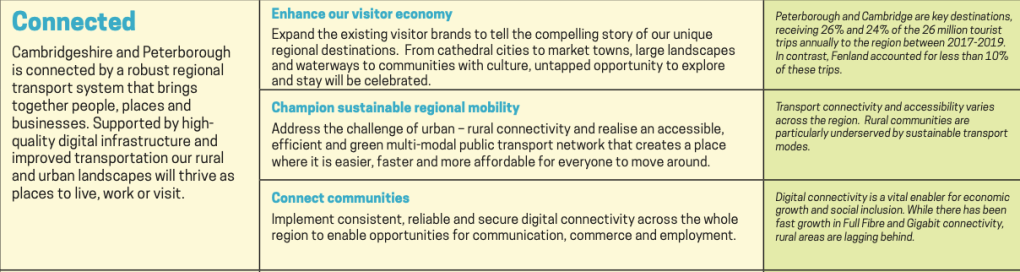
Above – Cambridgeshire and Peterborough have three large cohorts to manage and improve connections for:
- Commuters
- Tourists
- Communities
Your stereotypical male commuter (as I used to be) often only wanted the most efficient and least stressful A-to-B-to-A commute – especially if using buses/rail/metro. Yet as a cyclist on a cycle commute before then, I would cycle to evening classes after work. Therefore a day would involve a circular route. Similar could be said for other cohorts – for example working women who disproportionately bear caring responsibilities for example picking up children from school (although there are a sizeable number of kinship carers who are prominent in doing this too – eg grandparents picking up grandchildren). Finally there are tourists – not just the international tourists or the day-trippers, but people who live in Cambridge who might want to visit other parts of the county or East Anglia.
One of the persistent points I raise is that the easiest seaside resort for me to get to by public transport is Brighton. By train. Bus to the railway station, on the train, and there. 20 years too late for my university days, but better late than never. Pre-Beeching you could get direct train services to Great Yarmouth and Hunstanton. Given Cambridge’s continued rapid population growth, I believe there is a growing case for reopening and upgrading the necessary railway lines, chords, and junctions to enable such day-trips to occur again. Not least because the economies of both resorts really could do with the custom without having to deal with the motor traffic.
Food for thought?
If you are interested in the longer term future of Cambridge, and on what happens at the local democracy meetings where decisions are made, feel free to:
- Follow me on Twitter
- Like my Facebook page
- Consider a small donation to help fund my continued research and reporting on local democracy in and around Cambridge.
Below – one option to improve governance and accountability is to move to a unitary structure of local government. The Cambs Unitaries Campaign was formed to secure such better local government arrangements. See https://www.cambsunitaries.org.uk/our-objective/
 The Cambridge Town Owl