
Even though I asked them specifically to cover how improved public transport infrastructure could support better provision for our county’s teenagers
Disappointed but not surprised is my take on the long-awaited Grant Thornton study on the further education ‘cold spots’. You can see the formal reports item 6 of the CPCA’s Skills Committee meeting papers 29 July 2024 here.
That they didn’t cover the transport issues in nearly enough depth, and given that we’ve not got a vision that covers significant improvements to rail and the creation of light rail, it’s hard to know what to recommend based on the findings of the consultants.
Expect the rail/light rail debate to come back for the county council / mayoral elections in May 2025 – especially as ministers will have set out their new policies for the Cambridge sub-region.
Above – Item 6 Appendix A in these papers is the executive summary
The easy-to-miss wider recommendations need to be given more publicity
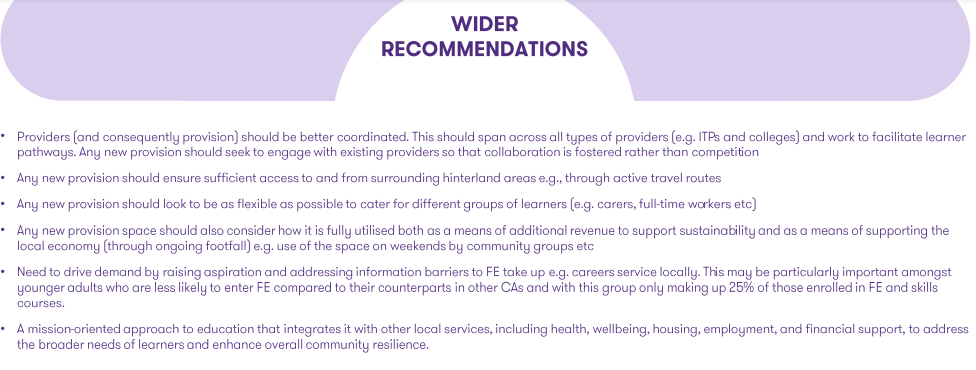
“Any new provision should ensure sufficient access to and from surrounding hinterland areas, eg through active travel routes”
Above – from Item 6 Appendix C, p26 – Wider Recommendations
Grant Thornton have not shown evidence of local policy history analysis regarding ‘how we got to here’
Which is a basic level error when doing public policy analysis of this magnitude. They restricted themselves to recent policy history from the founding of the CPCA (See Appendix C p5 of item 6) which did not explain for example how Cambridgeshire ended up with such a large concentration of further education places located in such a small geographical part of Cambridgeshire. I covered this in a 2021 blogpost here.
“Browsing through one of the local history books written about [one] institution, I turned to the pages of the 1990s and the run-up to the years that I was there in the latter part of that decade. They revealed the reason for why numbers expanded so rapidly in the 1990s – from just over 800 in the early 1990s to over 1,400 by the Millennium.”
“It was central government policy. The problem was that there was no extra funding for this policy. Instead there were only cuts – a recurring theme of my childhood growing up here. As a result, the only ‘new’ money available came from expanding student numbers. Which is what many institutions ended up doing, irrespective of whether there was enough space.“
In 2020, the Queen Edith’s Community Forum magazine noted:
When you look at some of the institutions named, the over-development of their sites and the lack of communal space for students are more than apparent even to the passer-by.
The Grant Thornton study does not appear to have given much consideration of how or why we ended up in this situation, let alone whether it was a good thing or not. Furthermore, little consideration seems to have been given about the impact this has on county transport.
Consultees mentioned transport, but the proposed solutions did not
For teenagers living in the cities, transport is far less likely to be an issue. I was astonished to find the number of fellow A-level students who crossed county boundaries to get to college and back when I was fortunate to walk up the top of the road.

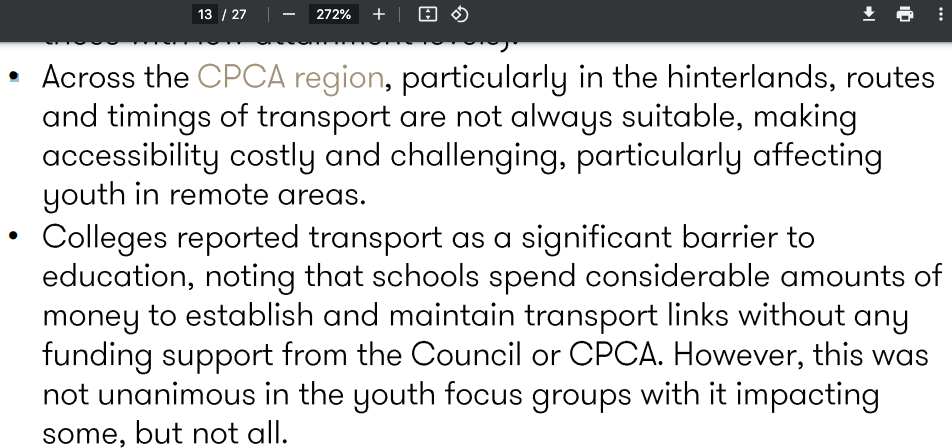
Above – Item 6 Appendix C p13
Hence the above finding that not all youth groups mentioned transport as an issue does not surprise me. But given that the report was meant to deal with further education cold spots…exactly.
“What do the consultants recommend as actions?”
“What needs to be done:
- Scale up activity to cover key skills/sectors
- Expand middle/high level skills
- Expand T-level provision
- Do nothing
“How do to 1-3
- Build a new further education college or two in said cold spots (Note – ministerial approval needed)
- Invest in subject-specific areas scattered across the county
- Invest in existing providers in cold-spots ie St Neots & East Cambs
- Invest in existing providers elsewhere in the county (including Cambridge & Peterborough)
From Item 6 Appendix A pages 6-7
A large chunk of the cold spots problem is in transport.
The reason why this matters is because one of the key findings by Grant Thornton’s consultants is the weak financial case and weak viability of establishing new institutions

The failure of the iMet project was mentioned – see the BBC report here.
“It was meant to enrol 4,000 students and 500 apprentices a year, but it closed in 2020. The reasons stated for its failure were poor transport links from neighbouring Huntingdon, lack of demand in the catchment area, as well as Covid-19.”
BBC Cambridgeshire 29 Sept 2021
The article also mentions that the iMet was approved by the dysfunctional LEP that got torn to bits by the Public Accounts Committee before being wound up – it never should have gotten approval in the first place and its lack of transport accessibility mirrors that of Cambridgeshire County Council where the Conservatives moved the institution also to Alconbury (where the iMet was) without having built the rail-based public transport in the first place.
Hence why I have spent longer than is sensible looking at rail-based improvements to public transport in and around Cambridge. Rail Future East has been doing it for even longer – browse through their publications here to see what their ideas are.
“Will East West Rail come to the rescue?”
Who knows? – Note that East West Rail is now moving ahead on work east of Cambridge, and further news awaited on any policy changes on EWR regarding both electrification and a northern/southern route into Cambridge itself.
Coming back to reconnecting Cambridgeshire (we used to have a more extensive rail network – see here) what I’ve looked at over the years are a series of rail loops – light or suburban. In the case below I proposed what is effectively a Mid-Cambs loop
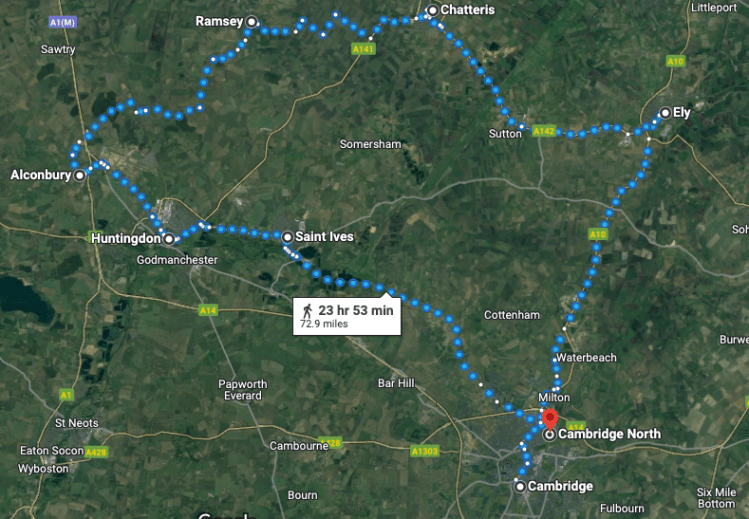
That rail/light rail loop could provide the reliable rail-based services that would be harder for a future government to cut because the hard infrastructure is in place. We saw the impact of bus service cuts in the austerity of 2010-24 under the previous Conservative government. In the case of the line from Cambridge-Cambourne-St Neots, one of the options is to extend the proposed Cambridge Connect Light Rail line from Haverhill-Cambridge-Cambourne to St Neots on a line that could be shared by suburban and light rail services – possibly adjacent to an EWR line. Amongst other things it would reduce some of the resistance from locals if they got new accessible transport infrastructure.
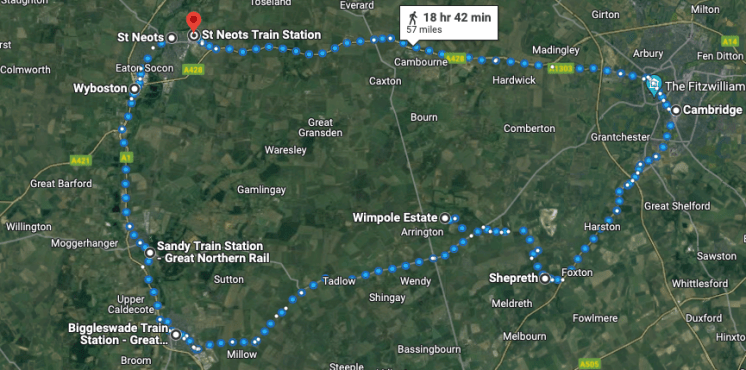
Above – a possible SW-Cambs loop that links up St Neots and some of the southern Cambridgeshire villages to Bedfordshire – while opening up heritage and leisure attractions at the same time.
As I mentioned in the blogpost featured above, the over-centralised governance structures and very limited revenue-raising powers that local government has are the biggest barriers that stop local politicians from exploring these ideas. Hence it’s up to ministers to make the first move. They won’t move unless they are lobbied by campaigners. residents and students through their Members of Parliament.
There are the mayoral and county council elections in May 2025 – under nine months time
There are, and it’s up to individuals to start lobbying their existing county councillors (or proactively contacting the county political parties (feel free to look them up online) to find out what their current policies are – and to tell them what you think should be in their county election manifestos.
If you are interested in the longer term future of Cambridge, and on what happens at the local democracy meetings where decisions are made, feel free to:
- Follow me on Twitter
- Like my Facebook page
- Consider a small subscription to help fund my continued research and reporting on local democracy in and around Cambridge.

 The Cambridge Town Owl