
A controversial (with some people at least) pension fund is trying to push through a development far faster than the system will allow for – not least because government policy is likely to change between now and the time they get to submit their planning application
I didn’t make the connection between the pension fund stumping up the cash (that’s now been removed from the website) for the development and the ongoing war and violence in the Middle East. Other people in Cambridge however, did.
Hence the protesters outside the event. However, as with so many consultations for developments of this site, no one from the investors was there – it was entirely the consultants and property professionals. Or the ‘corporate shock absorbers’ for want of another term. And this is a process that we have seen time and again in/around Cambridge. The gap between those looking for financial returns vs those that live and work in the places affected remains as wide as ever.
None of the consultants I spoke to lived or worked locally
Three of the representatives I spoke to were from London, Bristol, and Reading respectively. Inevitably when I quizzed them on what the local community was like, what our local concerns were, what local traffic was like and what the future housing and transport plans and options were, none of them could respond in any detail.
That’s not to place the blame at the feet of the people I spoke to – the problem is with the system. At the same time, there’s no guarantee that having locally-based firms will automatically provide a better standard of service to all concerned (not just the developer) than someone else based far away. What it does mean however is that the consultants are more dependent on the local community to provide them with the feedback in order to make sound decisions. And that is not a cost-free action for local residents or communities because it involves giving up our own free time. Furthermore, doing this on a regular basis as I do, along with my ongoing health issues, is something that is ****incredibly draining****
I.e. taking part in the consultation event earlier means I won’t get to do other things later this week because I’ll be trying to recharge my spoons. (It’s a chronic fatigue thing).
I forgot to take a photo of the timetable at the consultation – and it’s omitted from their website but they want to submit a full planning application by the autumn 2024 and have spades in the ground by summer 2025. Which I said to them was laughable given the mess that is the local government structure of Cambridgeshire (too many of them confused the Greater Cambridge Planning Service with the Greater Cambridge Partnership, and did not know the different responsibilities between Cambridgeshire County Council and the Cambridgeshire & Peterborough Combined Authority – and the latter’s responsibility for strategic transport planning).
It was all very vague – because it is a speculative application aimed at a sector of the economy experiencing a bubble.
This was reflected in conversations about building heights, floor space, and the maximum number of employees expected to work on the site – one that is allocated for housing in the Cambridge Local Plan 2018 as mentioned earlier. No one had a substantive answer to the question on how they will get round the default setting of the rejection of planning applications that are a departure from/contrary to the approved local plan. I said they would need some incredibly convincing reasons why they should be allowed to proceed with their development on land allocated for housing in a city that is in the midst of a housing crisis. None were forthcoming. (That’s not to say none can be made – it’s just that none of the representatives could think of any at the time).
I’m actually fairly neutral as to what happens to the site in general.
Cambridge is in the middle of a speculative bubble, and the site’s financial value (and potential return on a long term investment) is far greater than the use it currently has. Furthermore a number of the buildings are not in the best of repair. If anything, I’m surprised it has taken so long for it to be snapped up.
That said, there is a huge mismatch between the speed that the financiers want to progress at vs the capacity of communities, local government, and even the planning professionals/consultants can process such an application.
The fact that they are only holding one early consultation event in person – one scheduled only four days after launching the publicity for their application, speaks volumes. I said to them that they needed to extend the consultation date to mid-September at least, if only to ensure that local parents, children, and teenagers can have their say on the proposals.
The lack of community facilities in my part of Cambridge – the Coleridge-Queen Edith’s border
I mentioned the Holford Wright report of 1950 (see Lost Cambridge on Cambridge’s town here) and how the original proposal for the Queen Edith’s estate included a bespoke community centre.

Above – Holford-Wright (1950)

Above – Detail of Queen Edith’s Way/Mowbray Road/Wulfstan Way junctions – Holford-Wright (1950)
People familiar with the neighbourhood will note that we didn’t get the promised community centre. The roundabout at the bottom-left has since become the famous Dutch roundabout. I think I’m one of the few people that likes it and is prepared to say so publicly!
Given how large the Paddocks is, I tried to make a case for a community centre to be located on the site – ideally close to the entrance, one that during the day may also serve a corporate/commercial purpose to ensure it does not need a public subsidy. What I also said was essential was that it was not run by a church or religious organisation. With so few council-run facilities in the area, we found out during the lockdowns how the only places that seemed to be available for community support functions were church-based groups. And there are a whole host of reasons why some residents won’t want to engage with faith-based organisations. Given the census findings, local government – and ministers as well, really need to accommodate for this.

Above – Cambridge – from the 2021 Census.
Given the site and the potential resources that the developer can bring to bear, and also both existing and emerging planning policies on developer contributions towards community services, councillors and council planners should be able to make a strong enough case for a new community centre on the site. It doesn’t have to be a standalone building, but it should have a large hall suitable for activities suitable for multiple uses – whether conferences through to active games for teenagers and young people. (i.e. larger than your standard single badminton court!)
Finally, I mentioned (aside from the local history of Cornford House) that the developers should work with The Junction in Cambridge and youth charities to get some high quality proposals in place – such as Make Space for Girls given how little provision there has been historically and currently for teenage girls in Cambridge. The consultants mentioned engagement with the GCSP (the joint Cambridge & South Cambs Planning Function) and their youth service but my concern about the rushed time scales the financiers of the development have means that there is a huge risk that any benefits of such engagement will be lost. I also suggested The Junction as a long term partner – joining all things science with the arts. Because culturally in Cambridge, the two sectors have been artificially separated. Us 1990s teenagers who were pushed towards an academic route were told we had to choose between a science stream or an arts stream. No, I still haven’t forgiven that generation! Hence I ended the conversations with:
“Please, please don’t make the mistakes with our community that previous generations did”
Hopefully the more of you that respond early enough to stand up for the community’s needs and interests, the greater that risk will be avoided.
Food for thought?
Right…what’s happening next? Another consultation event you say? Tomorrow morning?
***I’m a night owl! Clue’s in the blog name!***
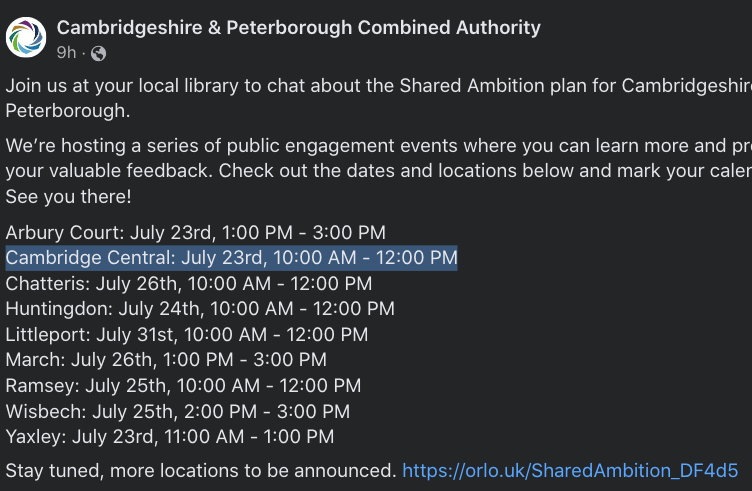
Above – the Combined Authority’s shared ambition
10am Cambridge Central Library if you’re free – and also at Arbury Court Library 1pm-3pm
If you are interested in the longer term future of Cambridge, and on what happens at the local democracy meetings where decisions are made, feel free to:
- Follow me on Twitter
- Like my Facebook page
- Consider a small donation to help fund my continued research and reporting on local democracy in and around Cambridge.
 The Cambridge Town Owl