Over 50 people took part in the first consultation event at The Guildhall – you can sign up for the second one on 31 August, also at The Guildhall
Alternatively, you can browse the consultation and fill in the initial survey
This post follows on from a number of previous ones including:
- Visiting academics from across the world branding Cambridge’s local government structures as ‘ridiculous’;
- Ex-Astra-Zeneca executive stating Cambridge’s governance structures are not able to handle the sub-region’s sci-tech boom
- The announcement of the consultation on the future governance of the city
- The need to get the basics right – maintenance, prevention, and enforcement
What local history tells us
- That in 1913 Cambridge made a bid for county borough status – similar to the unitary status of today, but was rejected
- That protests against the enlargement of the old county council in the 1960s failed – thus beginning the expansion of Cambridgeshire County Council from covering present day South Cambridgeshire District and the southern half of East Cambridgeshire District, to incorporate the rest of the latter and also Fenland District – i.e. the old Isle of Ely County Council
- The debates in the 1990s that started off with radical dreams in 1991, only for them to be snuffed out by the mid-1990s
Question: What is the purpose of local government?
There were some interesting contributions on what participants thought the purpose of local government is or should be. But then from a policy perspective I reminded myself that Parliament is Sovereign and ultimately the purpose of local government is whatever Central Government says it is – and what it will become if any changes are to be made are whatever Parliament allows.
That’s different to what we as individuals might have as opinions on the purpose of local government. The contributions from the participants coalesced around what I thought sounded very similar to the definition that Lord Redcliffe Maud wrote in his summary of his Royal Commission on Local Government in 1969.
“The pattern and character of local government must be such as to enable it to do four things:
- to perform efficiently a wide range of profoundly important tasks concerned with the safety, health and well-being of people in different localities;
- to attract and hold the interest of its citizens;
- to develop enough inherent strength to deal with national government in a valid partnership; and
- to adapt itself continuously to the unprecedented changes that are going on in the way people live, work, move, shop and enjoy themselves.”
Above – Redcliffe Maud (1969) p2, HMSO
Which I think still stands the test of time today. From the perspective of the institutions you could say:
- Keep them safe, keep them healthy, keep them happy (or content!)
- Keep them involved and interested
- Stand up for your fair share from Westminster
- When the challenges that life throws up change, so should local government to respond to those challenges.
Collectively and over the past half century, I think the sector has both failed to meet the above four, and (more importantly) has been failed by successive council administrations of all parties and none, and by Chancellors of the Exchequer and Local Government Ministers of all parties that have held those offices who have not provided the resources or the leadership to deliver the above.
Cllr Mike Davey’s doubts on a unitary structure
The Leader of Cambridge City Council, Cllr Davey (Labour – Petersfield) said he remained to be convinced of the merits of those of us supporting the principle of a unitary council for Cambridge and however much of the surrounding area one chooses to designate. Which is fine – I don’t have a problem with that. Switching to a unitary structure within Cambridge’s 1935-era boundaries wouldn’t work for a start – not with the suburbs having long overspilled the city limits. Furthermore, local government restructures are fiendishly complex in their own right. See the scanned docs of my copy of Redcliffe-Maud’s Royal Commission Report on Local Government in England 1966-69. It was a massive undertaking with a huge research function – complemented by other reports such as this one on community attitudes from 1969.
The changing of governance structures will require a substantial research and evidence base.
Some of you may be interested in one of the earlier local government commissions and what they had to say about the components of what we now call the Cambridgeshire & Peterborough Combined Authority Area.
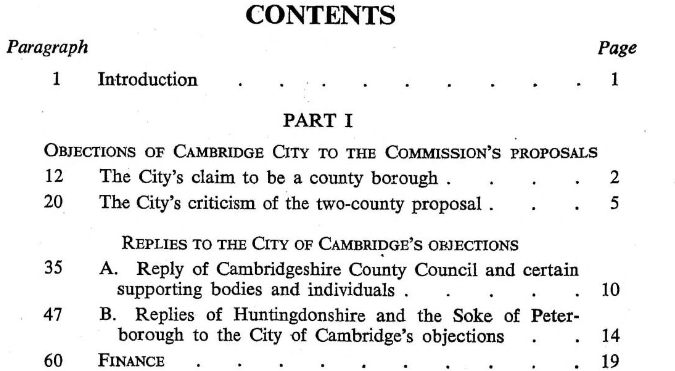
How do the arguments and issues raised in the above document from 1962 compare with the Cambridgeshire and Peterborough of today? You can get a feel for what the City of Cambridge was like in that era in one of the city council’s final public health reports from 1968 before the function was transferred by central government.
Getting everyone to do a standalone citizenship course won’t solve the problems either
For a start, who has the time and motivation? For many people I’d guess that they’d be content with just someone – anyone from ‘the council’ or ‘the government’ to ‘sort it out’ – whatever ‘it’ may be. At the same time, I’d like to think there is potentially a critical mass of people out there who, if provided with the right opportunities, incentives, and were appealed to in a well-planned and actioned marketing campaign, would get involved. Especially if the tangible improvements to their local area were clear and up front at the start.
You don’t need to have everyone involved in everything – and you also need to accept that there will be a large number of people who won’t be engaged at all
We’re an international city with residents from all over the world – more than a few of them are disenfranchised because of nationality. One of the final barriers on the right to vote in this era of globalisation is the campaign for residence-based voting: ie you vote where you live. The decision on whether to switch to a unitary council or not does not cover this. But if we are looking at building the best governance structure, system, and model that we can for the good of the people who make up our city and county, then it clearly does.
The very heavy lifting of what an alternative local governance structure might be like
This is where the summary of Redcliffe-Maud’s principles here are really useful as they set some sound parameters/borders to work within. I particularly like his third principle:
“In each part of the country, all services concerned with the physical environment (planning, transportation and major development) must be in the hands of one authority.”
Redcliffe-Maud, Royal Commission Summary (1969) p4 HMSO
One of the reasons why we are a complete mess is because strategic town & country planning has been separated from strategic county-level transport planning. Which is separate from regional/sub-national transport planning. And don’t get me started with privatisation of the public utilities which in times gone by used to be part of a local council’s responsibility. As demonstrated by Leicester in 1939 in their civic guide digitised here
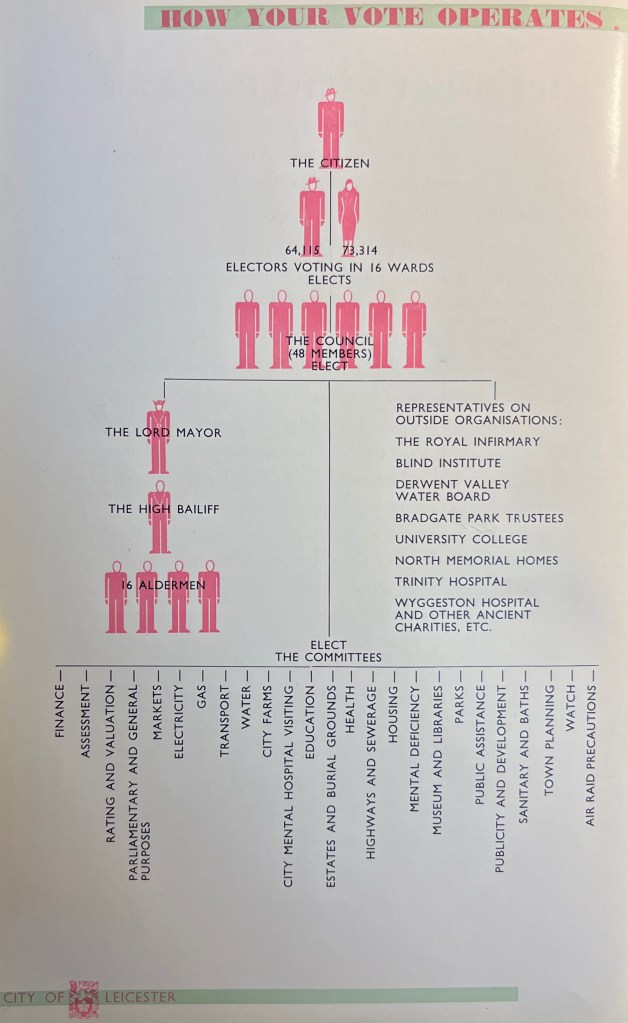
Above – Civic Affairs – City of Leicester 1939-40
Yes – that is ‘Air Raid Precautions’ you see in the list of committees.
Functions, finances, boundaries – what should local government be responsible for?
At the end of the event, a couple of participants questioned me on what I thought a solution might look like. Essentially it’s the second half of this blogpost which would be my starting point for negotiations.
On finances, that’s The Treasury’s prerogative. But ultimately it makes more sense to enable a powerful unitary council to tax more of the wealth being made in the Cambridge area to spend on much-needed infrastructure improvements, higher salaries for essential public services in the face of the housing crisis, and investment in arts, sports, leisure and general wellbeing – rather than having funding seen to come direct from central government while economically-deprived areas get much less.
The scale that I have been looking at this issue is one that meets Redcliffe-Maud’s third principle: “to develop enough inherent strength to deal with national government in a valid partnership“.
As things stand, there is no local government institution (whether here or anywhere else in England) that has ability to stand up to national government and not be intimidated by it. Not least because everyone is dependent on The Treasury. And that’s where the crux of the challenge resides – and one that the entire local public service sector needs to unite on across England.
Food for thought?
If you are interested in the longer term future of Cambridge, and on what happens at the local democracy meetings where decisions are made, feel free to:
- Follow me on Twitter
- Like my Facebook page
- Consider a small donation to help fund my continued research and reporting on local democracy in and around Cambridge.
ALSO: A new policy document from Demos. For anyone interested in civic action
 The Cambridge Town Owl